Paula Edgar: Welcome to Branding Room Only, the podcast where your personal brand gets a front-row seat. I'm Paula Edgar, and if you're here, it's because you know your brand isn't just about what you do. It's about how people experience you. In each episode, you'll hear stories, strategies, and lessons from leaders and influencers who built their brands and made their mark. And I'll share the tools you need to do the same. Let's go.
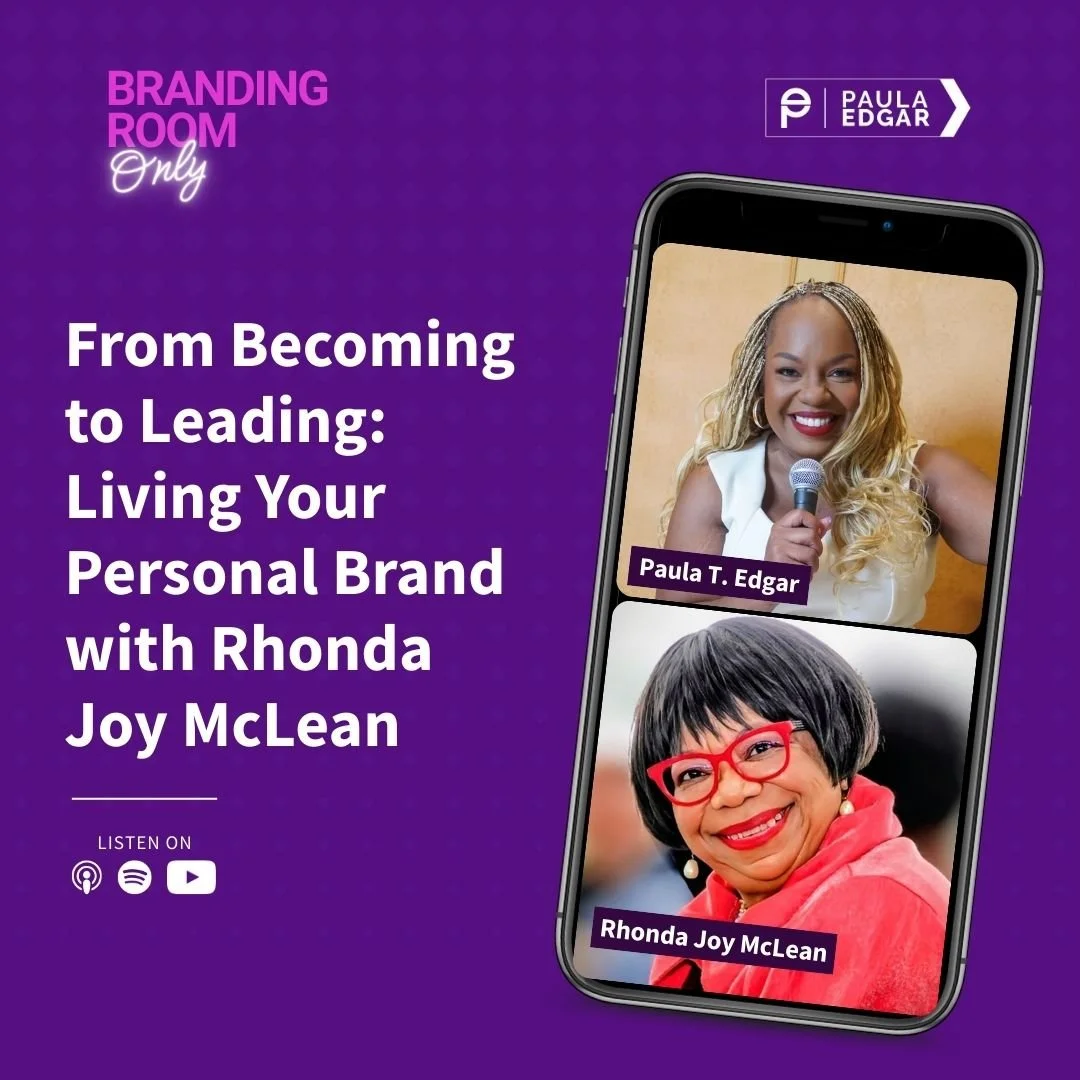
And we are back. Welcome back to Branding Room Only. I’m Paula T. Edgar, and this is part two of my conversation with the fabulous Rhonda Joy McLean.
If you have not listened to part one yet, pause, stop right now, and go back. The first episode is fantastic, all about becoming, identity, history, values, and the foundations of a durable personal brand.
In this episode, Rhonda and I move from becoming to leading. We talk about what it looks like to live your personal brand in real time and how leadership evolves. So take a breath, get comfortable, and let’s get back into the conversation.
How have personal relationships impacted your ability to manage and build your brand?
Rhonda Joy McLean: Thank you. Well, first and foremost, I’m so glad you asked this question. Because one of the things my friends, business partners, and co-authors, Elaine Meryl Brown and Marsha Haygood, and we’ve been friends 25 years. But let’s just start with they knew each other. I didn’t know them.
When I came to Time Inc. as the first Black woman attorney in the in-house law department, which seems wrong—1999, come on—I kept saying, “That’s late,” and people kept saying, “Oh, oh, oh.” I thought that maybe people had come like they did in law firms, came and left. But they said no, so whatever.
So you know what I did, which is what I know that you did as you were starting out as a brilliant young attorney. You work like a dog. Head down. Don’t look left or right. Don’t look up. So what happens? People are happy for you to work like that. They don’t necessarily notice you or give you credit. They just let you work like a dog and work yourself into the hospital. I was hospitalized for depression twice because I said yes too much. I didn’t have enough boundaries. I was very worried about representing. And, of course, no one person represents a race of people.
Paula Edgar: You were the only, though, right? So that heaviness of the only, the lonely only.
Rhonda Joy McLean: Yes. Yeah, it’s such pressure, and it still exists. We have to just help each other. So the bottom line is Marsha Haygood called me out. It was seven o’clock. She was in a cab on Seventh Avenue, and she said, “I know you’re in there, and I know you’re in there working, and ain’t nobody else there.” It was all true. She said, “Close up your computer, come down, and get in this taxi.” I did.
She took me up to what I think was O. Henry’s at 100-and-something. There, Elaine had invited a number of beautiful sisters, all of whom were highly placed women in different kinds of Time Warner companies. Some of them were at HBO. Some of them were at corporate, working closely with Dick Parsons. Some of them were here. Some of them were there. Marsha was at a movie company. Elaine launched Showtime. So I was like, “Whoa.” But they all knew each other. I didn’t know them.
So I’m happy to say, and I met them in March of 2000, that literally for nearly ten years, we started GNO. We went out four times a year just to do what
Paula Edgar: Girls' Night Out.
Rhonda Joy McLean: That’s it. GNO was on my calendar just to do what we’re doing now, just to encourage each other, just sister to sister. Whatever you said was in confidence. If you wanted to plot to murder your husband, you could go right ahead and do that. If you wanted to send your children away because they were right on that last nerve, we wouldn’t tell nobody. You could just talk. But you need it. It was a safe space.
Paula Edgar: Yes.
Rhonda Joy McLean: Occasionally, we would go to Broadway. We did things. Some of them had children. I didn’t. I wasn’t married then. But the short of it is, before any idea about the book or any kind of products, we just formed a network of supportive sisters. Most of them are still very closely my friends today.
Then Elaine came up with this idea about the book. But it wasn’t about a book. It wasn’t about anything. So what you talked about in terms of non-competitiveness, it was the first time really in a long time that I felt safe.
So at some point, I negotiated a promotion and I negotiated a title change, and I created a position that didn’t exist in my law department because a girl needs to do what a girl needs to do.
Paula Edgar: Certainly.
Rhonda Joy McLean: But I rehearsed every bit of it with the sisters at the table at dinner. I grew up in the South. You don’t talk about money. You don’t promote yourself. I would promote you, and you could promote me. But for us to each promote ourselves, it was just considered rude and unladylike, not to mention unchristian. We could go down a whole line there.
So I’m grateful for the sisterhood, and I’m all about building sisterhoods like you are. To me, your brand—I know you have all kinds of other brands—but you build sisterhoods. Brothers are welcome too, but it’s about a community of people helping each other go in the same direction. You are on your track. You do something different.
Paula Edgar: I think it’s a very important piece. And I’m glad that you brought up the ladies, the triad that you all are, and that you not just conspired to do the thing that you put out, but that you support each other through all of the things. And I do think that friendship is one that I emulate and I try to emulate with a lot of the people who are in my close circle.
How would you say that your brand has evolved or changed over the course of your career, who you are and how you’ve shown up?
Rhonda Joy McLean: Thank you. I’ve learned to listen. In my family—I love y’all, don’t hurt me—but people wait to speak. It’s not the same thing. I didn’t know that.
I was a manager for the first time of about, I don’t even know, maybe 30 people when I was 22 or 20. I was far too young. Smart and fast, but I didn’t have any.
So the same Barbara Kamara, my mentor, sent me to the Center for Creative Leadership, which still exists as one of the global leadership polishing entities. Mostly corporate, but they do all kinds of things.
We were not-for-profit. I don’t know how she got us in there. We were very not-for-profit. We didn’t have money. I went for several years. Once a month, I learned about group dynamics, “I’m okay, you’re okay,” strategic planning, management by objectives. But on effective listening, they made me take it twice because I can talk.
The key thing that I learned is before you form any sort of a response—you don’t have to do it out loud, they made us do it out loud—in your head, repeat what that person said to you so that you are sure that you are responding to what he or she actually said and not what you heard.
Paula Edgar: Like marriage counseling.
Rhonda Joy McLean: Because often we hear what we are prepared to speak to. In this time of division and polarization, all the more reason to listen deeply and compassionately, and I’m working hard on doing that.
Paula Edgar: Yeah, my therapist always says we listen with our trauma.
Rhonda Joy McLean: Amen.
Paula Edgar: Then we repeat it back.
Rhonda Joy McLean: Sometimes it can get loud, and it ain’t got nothing to do with what they said.
Paula Edgar: That part. So, Rhonda Joy, you’re on every single board. How has leadership and volunteerism been a part of how you have built your brand? And tell us some of the organizations that you were involved in.
Rhonda Joy McLean: Thank you. Well, I will say that my grandmother, Eva Belle Coleman-Coles, all four-foot-eleven of her—my mother’s mother—was a poll watcher at voting precincts until she was almost ninety years old. She had grown up in Richmond. She knew what it was like before voting was made a little bit easier by the Voting Rights Act, which they’re trying to attack now. But we will come through. Come on, people. We will come through. They did, and we did.
So from a young child, I saw my grandmother working at home, working at church, in the community. The door was always open. If there were children whose parents weren’t really available to them, they could come to the house, or she would arrange for them to go somewhere to learn something. So it was about being productive and giving back. My parents, the same. Nobody talked about it.
So I have been blessed to serve on the board. I’m a past chair of the board of the New York Women’s Foundation, which gives away many millions of dollars to small women-led, women-run nonprofits that lift the lives of women and their families in the five boroughs of New York. I am very active with my law school. I just came last weekend from Yale Law School fund board meetings and executive committees where we look to the future. I just did a workshop on networking for the members of the Launchpad Scholars Program. These are extraordinary students who are the first in their family to go beyond high school. It’s just been such a privilege. This is my third year.
Just a quick side trip. They often think of networking as being bourgeois. I’m not sure why that is exactly. They associate it with golf courses and drinking and stuff. I think I did that too. But no matter what you call it, it’s building relationships. You do it every day of your life. You just need to make a choice about, “Are you being wise about the relationships you’re building?” And then, “What will you do to sustain them?”
And I just have to call out Marsha’s name because she is the queen of networking. I’m pretty good. I’m a good little connector, and so are you. However, Marsha's got a little beat. Elaine is really, really good, but she's a little bit more shy. So we all work on this.
But I really am grateful to have had the opportunity to work at the foundation, to work at the law school. I've done a lot of other stuff. However, the thing I'm doing right now that is feeding my soul, I'm on the board of the Union Theological Seminary, where Martin Luther King Jr. studied, where James Cone—he had already developed the Black Liberation Theology—brought him with him to Union. It's just an extraordinary place.
We have Muslim students. We have Anglican students, Protestant students. Buddhist, which it's very rare to have that at seminary. So Serene Jones, who was my wedding officiant, was also the first woman president at Union. After 18 years, she's stepping down to go on and do some great things. I'm leading the search for her successor. Let me tell you, I had no idea.
This is a high calling of great magnitude. I'm privileged to work with six extraordinary people, including a student representative, a faculty representative, a staff representative, and then other members of the board. We already have over 100 candidates. So thank God we've got some time. She's not stepping down until next June because I would run away if she were. But those are just a few examples of what I do.
Paula Edgar: And again, it was like, “Which one are you going to find out? Who knows which one?” But when I think of you and leading, I definitely think of the Links. Thinking about the Links Luncheon and you and your grandeur and glory and just seeing you in your element and how people react and connect with you. Rhonda Joy McLean knows how to hold a crowd on a microphone. So I wanted to make sure that the Links got that shout out as well, too.
Rhonda Joy McLean: Thank you. Thank you. I was going to come to them, but thank you. I would say the Links, the Greater New York Links, is one of nine chapters in New York. There are over 600 of us just in the New York area. There are about 17,000 or 18,000 of us around the world. We have chapters now, almost 300 chapters, in London, in the Bahamas, and around the United States.
Our mission is friendship and service, as you well know. Mostly we raise money to support services to youth. We mentor students, help them go to college and stay in college. Our older health and human services, international services—we've brought water and wells to other countries. International, we do work with the United Nations. Then national trends—we just hosted a month ago a mayoral debate for the three primary mayoral candidates in New York. It was standing room only at the Apollo. So shout out to the Apollo for hosting it.
Paula Edgar: Speaking of boards I've been on.
Rhonda Joy McLean: Yes, it's a wonderful place and getting better. Michelle Ebanks is doing great things. So I just want to say there is a way for you both to learn how to lead in your life before you ever get paid to lead.
Paula Edgar: Yes, and you drew out exactly what I wanted to call, which is that oftentimes people think that leadership is only in the title that you have at work. But most of the people who I know who built their leadership have done it through their volunteerism, through being tasked, asked, or told that they're going to elevate the connection to an organization. When you have a certain set of skills that are highlighted in the role that you have, one way to build additional skills and to have visibility around it is through other organizations. You have skills beyond skills, but I've seen you in so many different lights in all these different places. So I'm glad that you called that piece out.
What we learn is that when we do it well, when you serve and lead well, then people keep asking you to serve.
Rhonda Joy McLean: Well, yes, they do. That's important, particularly now. Because—I'm just going to say that it may be controversial—folks are tired.
Paula Edgar: Oh, exhausted folks. The folks are tired.
Rhonda Joy McLean: So you need to take a minute to talk about self-care because I didn't learn that.
Paula Edgar: You talked about not having boundaries and not saying no.
Rhonda Joy McLean: I never saw my mother stop. Even if sick, lame, limping, she would go to work. My father, the same, although he had asthma and emphysema, so often he would end up in the hospital. So that would force him to stop. But Mom, never. So for me, the girl doesn't stop. The woman goes.
She keeps the house going. She keeps the fires burning. She brings the groceries in. I can hear her tapping now, doing my little scales, and she would be cooking. Then I would hear her go, “What? That's not the right key. What? That's wrong. What's wrong with you?” So she just seemed to keep our world turning. So that as I had the great good fortune to meet and fall in love with Bill Craig, my late husband, and then become a bonus mother—we don't use step—to his daughter, who's a brilliant scientist, whom unfortunately we lost to cancer a couple of years ago, and my son, Asa Jeremiah, who, again, from Bill's marriage.
But I feel that even though I did not give birth to them, they are my children. Asa went to my law school. He's a fabulous attorney doing great things, and he's engaged to Victoria. So I'm excited. We're waiting for news. But all of that to say, throughout my family, my aunts, my uncles—my uncle Leroy ran the Buffalo Urban League for 35 years—they were always working, thinking. Even if you were at the table, there would be other people there.
So I really had to go into therapy. I couldn't disconnect work from life. I just didn't see a line. I was engaged for more than months, but I really didn't know how to be in a relationship. I would often leave people waiting, get up from the table. “Oh, I've got to go to this meeting.” Not really. You know, the world will not stop turning. But that's some of what—and now when you have such crises in the world, it's hard to give yourself permission to rest. But you must.
Paula Edgar: So what's your self-care strategy? What's your go-to self-care?
Rhonda Joy McLean: Well, thank you. I am walking every day. I walked just before I came here. Music is vital to my life. I wish I could meditate. My brain is just—my brain talks too loud.
Paula Edgar: I can't do it either.
Rhonda Joy McLean: You know, because I start writing a grocery list like, “Mmm, mmm, you want to go have a dinner tonight? Mmm, oh, I like that dress. I like that yoga outfit. She has a—mmm.” So I think you need to find what works for you. So for me, it's being quiet. I do have a circle of friends. I would call them walk-through-fire friends. So we check on each other, some more often than others.
Then through COVID, we all learned a lot. I did form a Yale Law School Soul Sisters Zoom chat group. So we meet quarterly online. They're all over the country. They're doing amazing things. Again, same thing, just support each other. So I would say I try to do some physical workout. I love to eat. I love to travel. I love murder mysteries. Public libraries are my friend. The arts—anything in the arts.
Paula Edgar: Love that. Love that. Okay. I want you to talk about The Little Black Book of Success.
Rhonda Joy McLean: Yes, ma'am.
Paula Edgar: How it came about, what it's about, and what is the new iteration of it?
Rhonda Joy McLean: Thank you for that opportunity.
Paula Edgar: You're welcome.
Rhonda Joy McLean: So as I said, the Girls' Night Out women that started meeting in 2000, and we met and did all kinds of fun things, supported each other. Also, we would host book signings. We would host resource kinds of events. So we would host—if you were doing something, we would celebrate you. That's what I should say. So I'm very grateful for that support, and encouragement to step outside of our comfort zones and try something new.
So Elaine raised her hand. She was then the divorced mother of a teenage young man. She said, “I don't see anything about leadership for Black teens, particularly Black boys.” So she tried to write it herself. Just had a lot of trouble. Then the more she thought of it, she said, “Well, I think I should just write it for Black young people in general. Maybe Black people who are about to enter the workforce.”
So then she came to us at one of these dinners and said, “I'm just not getting anywhere.” You know, she wrote a manuscript. Her agent said, “I don't think I can sell this.” So she said, “We talk about this stuff all the time, and mistakes we've made and stepping landmines, people who helped us, people who hurt us, things we wish we had known when we started working.” We thought, "Well, maybe we could write some laws about leadership." We were like, “Ooh, I like that idea.”
So then she looked around the table at eight of us or nine of us and said, “Well, who will help me?” So Marsha and I were like, “We don't exactly know what we're talking about,” but that's what happened. So we started working in 2007, 2008. The first draft was completely rejected by everyone that we submitted it to because, we got to get that in there, sometimes the no comes before the yes, but you don't quit.
Paula Edgar: You heard that. Okay.
Rhonda Joy McLean: Just saying. A lot of no's. Fortunately, we were all working and we were doing other stuff, but still on the side. So we hired an editor who took us to B. Smith. Some of you will know what that means, the first one. We sat there for five hours, and she took our manuscript apart, and she said, “Oh, no, no, no. You wrote it in three—you wrote it, it sounds like this person. You wrote it, it sounded like this person.” Because we had divided it up.
So she said, “No, no, no, no. You need to find a way to write in a unified way so that you're speaking with one voice to the reader.” So then we changed our writing style, and rather than me being over here in a corner writing and then throwing something, we each wrote a few chapters. We agreed on what the laws were because leadership, we feel, is fundamental. It's really not race-bound, gender-bound, age-bound. But the way it manifests in your life depends on who you are and what your values are and what your culture is.
So we try to write about that and say, you wrote some chapters, I wrote some chapters. Then we swap chapters. You commented on my stuff, I commented on yours. That's how we've written all the way through until today.
Paula Edgar: Love that.
Rhonda Joy McLean: Yeah, and now, thank God for technology, we read out loud to each other, and we edit that way. So it takes longer.
Paula Edgar: Yeah. So you all are the authors of The Little Black Book of Success, The Little Black Book of Success Workbook. Now the newest iteration is going to be what?
Rhonda Joy McLean: The Next Little Black Book of Success.
Paula Edgar: The Next Little Black Book of Success.
Rhonda Joy McLean: Yes. This is the galley. It’s the uncorrected proof. Then after the colon comes Laws of Leadership for Black Women. Every single time. But what we found is we’ve been blessed to speak in 18 states and to thousands of readers. We have almost 20,000 followers on Facebook. But many of them have said to us, “Is the book just for Black people?” And the answer is nope.
But we didn’t see a book in 2007 written by Black women for Black women. You know, Random House tried to change the title. They wanted us to take the Black out. We were like, “Oh, no. We’ve got to keep the Black in.” That’s why we wrote it.
Then we found that there were people we were working with. We began—now everybody, you probably are working with someone in another country whose language is not English. So apparently our book will help you with global management. Also, if you’re a little bit introverted, it will help you with how to be seen if you consider yourself to be invisible.
So the first book we consider to be a mentor in your pocket, A Little Black Book of Success. Second book, the workbook, is a personal call to action. You actually have to do some exercises in there. You’ve got to do some work. Then there’s, if you’re already pretty senior, we have an executive suite little piece in there. So there are some things for you to think about.
Then this book, The Next Little Black Book of Success, which is available for pre-order now.
Paula Edgar: Yes. We will have that link inside the show notes.
Rhonda Joy McLean: Yay. Anywhere books are sold. So you can go to your favorite bookstore, online or offline, and order it. It will be published in January of 2026. But I want to say it’s published by Storehouse Voices, which is a Black women-led imprint at Random House. They be some bad sisters.
Paula Edgar: Yes. Shout out to Porscha.
Rhonda Joy McLean: Yes. Always. Our editor, Porscha. And our agent, Cherise Fisher, who’s fabulous. But I do want to say, why another book? “Why now?” Because we’ve been working on this book. Random House said to us, “After COVID and the changes you’ve seen in the workplace, do you have anything more to say?” What? Yes. Yes. Yes. So much has changed.
So how we work, technology, AI, authenticity. Can you be authentic in this world? We say yes, but don’t be crazy. Come on. Use some common sense like your grandma told you. But at the same time, we try to give some practical strategies. Leading after loss. We lost millions of people in COVID, and now nobody wants to talk about it. It’s like it never happened. So you have to acknowledge it and be aware of it. I think it can enrich your leadership. You don’t have to stop the wheels from turning, but you can smooth things out for people.
So we are hoping about, I guess, two-thirds of this book is new writing, where we try to look at global management. We really think inclusivity, no matter what people are saying and no matter what is happening to us, is the only way for the world to survive.
Paula Edgar: I mean, if it’s people, then you’ve got to think about inclusion.
Rhonda Joy McLean: Yes. Research has shown—not just McKinsey’s, but we actually refer to several McKinsey studies in our book—that proves that almost the more diverse your team is, the richer the experience, the talent you have at the table, and the better you do and the more money you make. So I don’t understand what the problem is.
Paula Edgar: “Sigh, sigh, sigh.” Right? So I’m glad you walked through that and very excited about the new book.
Rhonda Joy McLean: Oh, I forgot. I was supposed to say my little tagline. The Next Little Black Book of Success: New Laws of Leadership for Black Women is your roadmap to the future.
Paula Edgar: Ooh. So we went from mentor in the pocket to self-advocacy roadmap. Roadmap. I love that.
Rhonda Joy McLean: Me too.
Paula Edgar: I also love how that aligns with our conversation that we're having because we’ve talked about all the winding roads that you’ve taken and the detours and the stops and all the things. For those of you who have known me for any good length, all of my mentees have gotten this book. Black, white, green. They’ve all gotten the book. I give it to all of them.
I was part of the fan club. I was going to every single book signing. I had the opportunity to meet around the church. Wonderful parents. Sat next to your dad once. He sat there talking about how much he loved you. I was like, “I love you too. I love her too.” I’m trying to listen to her, but you’re talking to me about loving her. I love all of you.
There were some times that I really think, because at that point I was a new, youngish mother going through a lot, thinking about the workplace. I was not having my own business yet. Navigating some of the things that were going on, it was really helpful to have a resource in that. So that is why I’m like, “I’m buying for everybody,” and everybody needs to go. So I will do the same thing with the new book because it has been a wonderful treasure in terms of really having some mentors in my pocket, giving me a roadmap to all the things that I need.
So I’m glad that other people will have access to a new version that is up to the times of reflecting on the things that we are navigating now. Although the other ones are still good. All of them are good. Just get them all.
Rhonda Joy McLean: Thank you. They build on each other. I will say one of the things Marsha ensured that we do is we do have one—I can’t remember which chapter it is—but it’s 12 steps before you launch your own business. Because Marsha had a 12-year plan.
Paula Edgar: Oh, that’s good.
Rhonda Joy McLean: I’m doing good to have a 24-hour plan. So she really is a really good visionary. She was the one that helped us stay steady along all these years of working together. But I tried to channel her, and she and I together fleshed out, with Elaine’s help. All three of us have our own business, our own website, our own everything, but then we also work together.
Paula Edgar: So I knew this conversation was going to go fast.
Rhonda Joy McLean: I’m sorry.
Paula Edgar: But I’m going to ask you three of my last questions that I ask everybody, and we’re going to make them fast tight.
One, you already went through this one, but I’ll ask you directly just in case. What do you do for fun?
Rhonda Joy McLean: Dance. Read. Flirt.
Paula Edgar: Yes, yes. I love all of those things. That might be the name of my book. Dance, Read, Flirt. Sorry, husband. Anyway. So, okay. Stand by your brand. This is the question I ask everybody. What is the authentic aspect about your personal brand that you will never, ever deviate from or give up on?
Rhonda Joy McLean: I believe my leadership is people-centered. So no matter what else happens, if it’s not people-centered, I’m not going to do it.
Paula Edgar: I love that. Now this question for you is going to be interesting because there are so many things. But Branding Room Only is a play on the term standing room only. So I would ask everybody, what is the special magic about you that would have people in a room, standing room only, no seats available, to experience about you?
Rhonda Joy McLean: Leadership adventuring with tough love and fun.
Paula Edgar: Nice little snippet there. But you know what was wonderful is that literally you could have said anything. You could have been like singing. You could have been like listening to me speak. There are so many things, which really speaks to the aspect and the breadth of who you are.
Rhonda Joy McLean, it has been my pleasure to have you in the Branding Room. Tell people how they can find out more about you and connect with your work.
Rhonda Joy McLean: Thank you, my dear. As always, I’m always grateful to be in your presence. Thank you for all that you do to help all of us. Because the other thing, the reverse mentoring thing, you’re teaching me how to brand me. So thank you. I’m learning.
So RJMLEADS has a website, www.rjmleads.com.
From that, you can learn everything you want to know about me. I do executive coaching still. I do all kinds of stuff, strategic planning. But you can contact me through the website. That’s the best way. Then also, as of this morning, there is a popover on my website that has a button and you can pre-order the book. I’m learning
Paula Edgar: Yes, yes. Love, love that. Listen, y’all, tell everybody they need to listen to this podcast and hear about wonderful Rhonda Joy McLean, her life, the breadth of what she has done and what she will continue to do, and the book that is coming out. You’ll be hearing a lot more about that. I love all of y’all. I love her more, just so you know. Listen to what she said. Listen to the lessons. Remember to stand by your brand. Thanks, everybody. Bye.
Rhonda Joy McLean: Bye.
Paula Edgar: That brings us to the end of my conversation with the fabulous Rhonda Joy McLean. Didn’t I tell you she’s wonderful? Listen, between part one, which was about becoming, and part two, which is about leading, together both episodes remind us that living your personal brand is not about perfection or performance. It is about alignment and consistency over time, which is the building block of a great personal brand.
So if this episode resonated with you—and I know it did—please take a moment to help others find the podcast by leaving a rating at ratethispodcast.com/branding. Also, be sure to check the show notes for information about The Next Little Black Book of Success, which is Rhonda and her co-authors’ new book.
Thank you for being in the Branding Room with me and Rhonda Joy. Remember your roots, remember your values, and as always, stand by your brand. Bye, y’all.
That's it for this episode. I appreciate you hanging out with me on Branding Room Only. Now, please do me a quick favor: head over to ratethispodcast.com/branding so more people can join this conversation. And make sure to stop by at paulaedgar.com/events to see what's next. Whether I'm live, online, or in person, I'd love to see you there. See you next time in the Branding Room. And until then, stand tall, shine bright, and always stand by your brand.