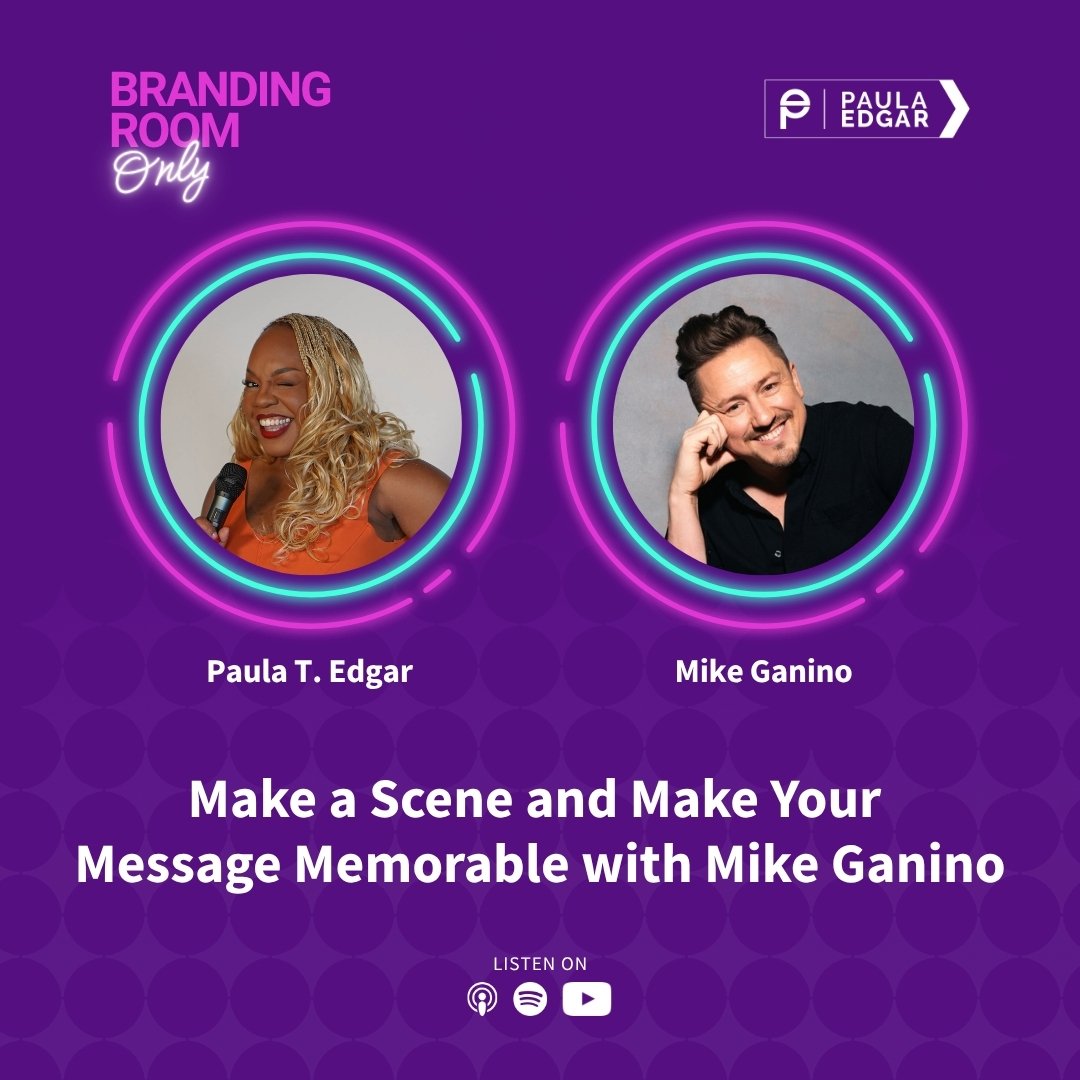
Paula Edgar: Welcome to Branding Room Only, the podcast where your personal brand gets a front row seat. I'm Paula Edgar and if you're here, it's because you know your brand isn't just about what you do. It's about how people experience you. In each episode, you'll hear stories, strategies and lessons from leaders and influencers who built their brands and made their mark. And I'll share the tools you need to do the same.
Let's go. Hi, everybody. Welcome back to the Branding Room. It's your girl, Paula Edgar and I am here with my fabulous guest today. His name is Mike Ganino. He is a best-selling author of “Make a Scene”. Let me tell you a little more about him. Mike Ganino is a keynote director, author and expert in transformational self-expression who helps leaders, founders, authors and visible experts build a public presence people can feel. He is the author of “Make a Scene”, where he shares his signature frameworks for storytelling, stage presence and magnetic communication. Through his coaching, speaking and programs, he helps clients align their voice, story, identity and presence, so they become not just respected, but unforgettable. Mike, welcome to the Branding Room.
Mike Ganino: Thank you. It's always so lovely to hear someone say the nice things that someone on my team wrote about me. And they sound great coming out of your mouth, Paula. Everything sounds good, coming out of Paula's mouth. She is the one to listen to. Let me tell you.
Paula Edgar: Thank’s, I appreciate it. Now, I ask everybody this. What does personal branding mean to you and how would you define it?
Mike Ganino: For me, I think it's like the real fundamental thing is just when people think of you, what do they think about? What are the stories? What are the associations? What's the lore? You know, L-O-R-E, what's the lore about you? And you could see that through, you know, you think of an artist like Taylor Swift and certainly there's the professional branding in a way of like, she has this many albums and she owns this and she just wrote the song for Toy Story 5 or whatever the case is. But then there's the personal brand that is what we know Taylor Swift to be like, the kinds of things that we would say, oh, that's a Taylor Swift thing. Taylor Swift would have wrote that. Taylor Swift would have done that. That, to me, is what personal branding is.
Paula Edgar: Yes, the you of it all.
Mike Ganino: The you of it all.
Paula Edgar: Speaking of the you of it all, how would you describe yourself in three words or short phrases?
Mike Ganino: Oh, this is fun, huh? I think enthusiastic. I think contagious.
Paula Edgar: In a good way.
Mike Ganino: In a good way. I work really hard to get myself to a place where I can bring the energy to the room and I could… I could delight in things that are going to, you know, I always think when I'm having fun, we're having fun. When I'm having fun, I'm selling. I know all those, like if I'm having fun, stuff sells. I know it. So I know that that's contagious. People want that, you know? So I would say enthusiastic, contagious. And I also think intimate. Intimate. I love seeing what's underneath. I love seeing what's not being said. I love seeing what's not being expressed, because I think sometimes the big breakthrough is there. It's underneath of it. So I love intimacy.
Paula Edgar: I love that. I would add just from having worked with you before and us having interactions, I would add intentional.
Mike Ganino: I love that.
Paula Edgar: When I think of you, I think it's not just happening, it's happening on purpose, which is a good thing.
Mike Ganino: Yeah. I love that. I'm going to bring that with me. Next time someone asks me for, I'm going to use intentional. So thank you.
Paula Edgar: You're welcome. Do you have a favorite quote or motto that resonates for you right now?
Mike Ganino: You know what? My favorite quote is one of the opening quotes I used in my book, “Make a Scene”. It's from one of my favorite people in the world. And I did a very Taylor Swift thing. So Taylor Swift is known for like these Easter eggs that she hides, like what's going to happen? When's the album going to come? She does all this kind of thing. So on page 17 of my book, “Make a Scene”, there's a quote from a lady named Linda Smith, who I call Granny. She's my grandma. And her birthday, by the way, is on the 17th. So it's on page 17. It's a quote from her. It's one of the opening quotes of the book. And it says, “say the truest thing you can”. And I think in almost every situation you're going in, I'm going through a thing right now with a friend and, you know, a really serious thing. And a lot of times we want to, we want to hide our grief and we want to hide our shame and we want to hide our stories. And all that does is perpetuate stuff. And if we can just say the truest thing we can to each other, I think that in sales, say the truest thing you can to the person. Get rid of all the fluff, get rid of all the woozy, woozy, woozy, woozy and say the thing. Say the thing. When people get on stage, when my clients go on television, they're going to go on Good Morning America, or they're going to go on CNBC, say the truest thing you can. It's always going to work. And that's something my granny told me in high school. I got to go on the National Youth Leadership Forum for Law and Constitution.
Paula Edgar: Okay, fancy.
Mike Ganino: It sounded really fancy, but I realized later it's just a racket, where they just charge you money. It's like when I was 11 years old, I wanted to be a model, because my uncle was an Italian model. So I wanted to be a model. And so we went to Barbizon. You know that Barbizon modeling school?
Paula Edgar: I remember the Barbizon commercial. Come on. Yeah.
Mike Ganino: And I was like, for $4,000, I can be a model? Like, how do we… And we were so poor. We were living in a carport at one point. We didn't have the money for that. And I thought, like, $4,000 is my dream. What I realized, of course, is they just take your money.
Paula Edgar: Yes.
Mike Ganino: I think the National Leadership Forum was the same. But it got me, this little trailer park kid from California, to D.C. I got to go to the Supreme Court. We got a tour of the Supreme Court. I got to go to this whole great experience. We did a mock trial and everything. But I didn't have the money to go. So I had to go raise the money from the Kiwanis Club and the Rotary Club and all these things. And I said to my grandma, I'm really nervous. I don't know what to say when I go in, you know, me, the messaging person now, I didn't know what to say. And she said, just say the truest thing you can think of. And I've never forgotten that.
Paula Edgar: Sage words, sage words, very, very much so. And in all cases and especially now, but more folks need to do that. So tell me this, when they're going to get full mic on a stage, what song is playing in your head? What's your hype song?
Mike Ganino: Ooh, you know what song I love? It changes a lot, but I really love the song “Into You” by Ariana Grande. It just makes me feel like I was listening to it today, walking around Barcelona and nobody was going to tell me nothing, OK? I was it, honey. I was it. Walking around with my little hat on and I was it. I was it. And it's just a song that's like, you know, like, I'm so into you. And it's got this great, this great, like, baby, just rev me up. Ba-ba-bum. Da-da-da-da-da-da-da. It's so good. And it's about like, I'm so into you and also like, look at me, look at me. And it's this exchange in the song because like, I'm so into you, I can't even like think straight.
Paula Edgar: Yes.
Mike Ganino: But also like, look at me popping too.
Paula Edgar: Yes.
Mike Ganino: And I think that's the exchange we're looking for, when we're with an audience, whether that's on screen or on a podcast or on a stage as a speaker, we’re looking for that exchange where we're both a little more alive, because we're here together.
Paula Edgar: You know, it's funny that you mentioned that because I just recorded another podcast with a good friend of mine, who does speech coaching for folks, for professionals. And we went off on a little tangent where I was talking about how, as a speaker, I feel like I'm in agreement with the audience. And if they don't have their part of the agreement done, I'm very mad. So part of it is, they need to be nodding their heads and giving me cues, so I know that we're good. And when I have an audience that doesn't do that, I'm like, What's going on? You're supposed to be responding to me." And she was saying that for a lot of her clients that she works with, that they take it as something personal to them, but a lot of times it's the people and whatever they're experiencing and the fact that we're all multitasking, et cetera. But I was like, I don't care. I take it personally because how dare you? But anyway…
Mike Ganino: Okay, can I give you a little heuristic, a little, a little trick?
Paula Edgar: Yes.
Mike Ganino: I got two things for you that will help that so much.
Paula Edgar: Okay.
Mike Ganino: One is, hold eye contact even longer. Hold eye contact until that person moves, blinks, chisels, because what happens is it increases. You know, I said one of my words was intimacy. Holding eye contact is intimate. You think about all the songs, all the books, all the romance comedies of like eye contact. I knew at first glance, eye contact is intimacy. And as speakers, we make eye contact. We look, we see people, they see us, but we don't hold it long enough. So my one heuristic for you would be hold it, just hold it and keep talking to that person. Keep just talking to them until they nod, they wink, they shift in their seats, they scratch themselves, whatever, something happens. Then you can look at someone else and do it again and do it again. Bill Clinton, that's part of his magic as a speaker. He has that magic. That's one of the things. He just looks at someone and he just talks to them for so dang long until something shifts. That's rule number one. And number two, is really thinking about how to enroll your physicality. So in those moments, it's like, okay, do I take four steps and walk closer to that person while I talk? Because now they think, ooh, we got a live one. It's like Randy Jackson from the early days of American Idol, when he used to say, we got a live one. They think, ooh, Paula's a tiger up there. She's going to come over here and pounce on me. I better wake up. And it's really amazing how the longer eye contact and that more intentional, like, let me come over there and talk to you for a minute, wakes up the whole damn room, because they're like, okay, we can't sleep on this one because she's going to come over here.
Paula Edgar: [inaudible 00:09:30] come over here?
Mike Ganino: Yes. And they love it. They love it.
Paula Edgar: That's good. That's good. I like that. So tell me, where did you grow up and how do you think it shaped you?
Mike Ganino: Oh, wow. I grew up on a lot of places. I had teen parents. My mom was 15 when I was born, 14 when she was pregnant with me, but 15 when I was born. And we grew up all over the place in Southern California. I was born in Southern California to teenage parents. And we lived all over. We moved a lot. My parents got divorced when I was nine. And after that, we moved a lot, a lot. My single mom was, you know, she was Reba McEntire in that song. A single mom who works two jobs, who loves her kids. Like she was it. She was working. She was trying. And back then, this was before the days of the courts helping her at all.
Paula Edgar: Yeah, yeah.
Mike Ganino: And so we moved a lot, sometimes because we couldn't afford it, sometimes because we got evicted. We were all over the place a lot of times. And I think that for me, growing up that way, and I'm also type 1 diabetic. So in that time, we were on state welfare. We had a Medi-Cal, which is the California state welfare and food stamps and the whole thing. And so I got to witness a couple of things that I think have shaped me.
Paula Edgar: Yeah.
Mike Ganino: One is that we often don't value people for what they are, we value them for the presentation, okay? And the amount of times that I've seen my mom be embarrassed, I learned to be embarrassed about food stamps and needing to eat, you know? Having to feel myself, even in my teen years, like a, you know, a person who didn't belong, because I was going… and I had to go to a certain doctor, because they took the insurance that was the state kind of thing. And I just learned that so much about us is dictated before anyone gets to see our true colors. And so for me, that is shaped, can we lead with it a little more? Can I help people? Can I help myself get to the forefront of that, so people don't have a chance to misunderstand us. And it really drives the work I do and who I love working with and how I like helping them is, the person with the best idea is not the one that wins. It's the person with the best story. And if that's true, then let's make you the best dang storyteller there is. And I think that growing up that way really shaped the value that I saw that people could bring who were often looked over.
Paula Edgar: Wow. I love asking this question, because I learned so much about, you know, I would say it's like, you know, like Marvel is a villain origin story, but it's really not. It's like the professional origin story, because there's always something that is there. I've shared before in the podcast that I understood personal branding before I even knew that's what it was called. For two ways that my grandmother, she, you know, she was a domestic and worked for rich people in Long Island. And she saw how they dress their kids. And she was like, we were not rich at all, but she was like, you're going to dress like those kids. You're going to show up a certain way, because at a minimum, they're not going to be able to judge you on what you look like. Right. It's going to be that that's going to be a thing. And so when I tell people, I'm like, branding is what you look like, but it's also who you are and what your values are and how you present as well. And so that resonates for me that, you know, my parents would say to me when I was walking out the door, don't embarrass us. Like when you leave, and I tell my kids now, I don't say don't embarrass, I go, remember you and Edgar, when you walk out this house.
Mike Ganino: Okay.
Paula Edgar: Right. And whatever that means for them that day, hopefully it means I'm not embarrassing me. But my point is, is that we bring a lot of our origin story. And for you to say one of your words was intimacy. I kind of hear that in having had those experiences of people judging and thinking about where you have to override all these different hurdles before you're even seen. And so I love that that brings you here.
Mike Ganino: Yeah.
Paula Edgar: Now, tell me about your professional journey. Tell me about from all that hopping around, how did you get to right here, in front of us, in this podcast?
Mike Ganino: Oh, I kept hopping around is the answer, Paula, more than I wish I had. You know, being type 1 diabetic really did shape it. I went to college for journalism. I left early. I didn't finish college at the time. I left early to become an actor, moved to New York, realized, oh, New York, she's expensive.
Paula Edgar: Yes, she is.
Mike Ganino: And I was, you know, living at 67th and Lexington in a walk-in closet. I slept in a walk-in closet in a studio. That was my bedroom on a cot with a with a playwright. He was a playwright. And we had also another creative in there too. They slept in the living room. And I slept in the walk in closet on a cot. And even that I couldn't afford working at the coffee shop at 67th and Lexington.
Paula Edgar: Oh my goodness.
Mike Ganino: And so that didn't last long, because I'm also type one diabetic and insulin is a very expensive habit that I can't shake. So I ended up at this crossroads of I got to do something that has like as much as I would love to act, I got to have a serious job with health benefits.
Paula Edgar: Yeah.
Mike Ganino: And so I ended up becoming a flight attendant, which landed me in Chicago. And I had good benefits, lived in Chicago. This was 2000. And I was on an airplane on 9-11, we were getting ready to take off, we hadn't taken off yet, we were taking off from Chicago to go to Denver and as we had pulled away from the the gate, we were getting ready to taxi at midway and the captain came on and said hey we have to go back to the gate. And I remember people were complaining…
Paula Edgar: Yeah.
Mike Ganino: … like the passengers and we were like yeah we don't know like didn't tell us what's going on either. We don't know. At the time I made like $17,000 a year and I was like, I make $17,000 a year. I got a pink palm tree on my thing and I serve Diet Coke. You think I'm in charge of this airplane, sweetie? Calm down, okay. So we go back to the gate, we get everyone off and the pilot calls us up to the cockpit and tells us what had just happened in New York City. And then we exited the plane and TVs were scrambled. We had to go right to the crew room to get debriefed. And I was in the crew room when the second plane happened. We were watching it live on TV, which is just wild, because at that point we didn't know if those were our friends, if those were our airplanes, if they were our colleagues. They were certainly our colleagues just because we were all in the same profession.
Paula Edgar: Yeah.
Mike Ganino: But it was a really wild time and the airline offered... And at the same time, I was doing commercials and trying to act and get in shows. Because being a flight attendant, I had a really flexible schedule. So I was like, oh, I'll do that. And they offered us furlough, because there's such a reduction in work. And they said, if you're not laid off, if you choose furlough, if you do voluntary furlough, then you can have your flight benefits for two years and you can have your health benefits for two years. And I said, you know what, that's enough. Say no more. I'm out.
Paula Edgar: Yeah.
Mike Ganino: And so I then took that opportunity to have the healthcare, because this is before Affordable Care Act.
Paula Edgar: Right, right, yeah.
Mike Ganino: And at the time, I got a Disney Cruise Line contract around the same time. And I couldn't take it, because the health insurance would have been $3,500 a month for me to get private health care insurance. And I was like, I can't afford it because of type one diabetes.
Paula Edgar: Yeah.
Mike Ganino: They couldn't charge me more. So I ended up doing acting. I studied improv. I was at Second City in Chicago and a couple of other places and ended up in the, I still needed to pay rent. So I ended up in the restaurant industry and was really successful there and stayed there for 14 years. Ended up becoming a sommelier, ended up becoming a director of operations, the head of training and then finally was a partner and chief operating officer of a place called Protein Bar Kitchen, in Chicago, that we started, grew to 14 locations, sold to private equity.
Paula Edgar: Nice.
Mike Ganino: And that gave me an opportunity to say, you know what? I got the money. And I'm going to go do something for me now. And at that point, I knew I wanted to speak and teach and do something like that. And so I left. We moved from Chicago to L.A. and the rest is history. That was 2014, started speaking. Speaking led to my first book deal, which was “Company culture for dummies” and those dummy series of books. I wrote that. And one of my clients, I was speaking on company culture, leadership, how do you build a great brand, like I had done with, with protein bar. And one of my clients was a hotel, a hotelier.
Paula Edgar: Yeah.
Mike Ganino: And they had me come in and speak to all their general managers at their annual conference. They called me back and they said, hey, you know, we want to hire you again. I was like, great, perfect. Yeah, there's a lot of turnover with restaurant or hotel people. So yeah, you want the same speech? What do you want? She said, no, we don't want you to speak. And Paula, I thought, well, you're not the first people to tell me you'd pay me to shut up. I've heard that before. Once an actor, always an actor. But what they wanted and you're going to love this, because in an entrepreneurial way, she goes, do you do you offer this? And I was like, before you even say anything, yes, the answer is yes. I'm an entrepreneur. I offer it. What do you need? And what they wanted was for me to coach their executives, because they would host these conferences and they would hire people like me to come in and give a speech. And it was great because that was our job. And then their executives would go up and be so dry…
Paula Edgar: Yes.
Mike Ganino: … or so boring or run over. And they were realizing the power of not only at their own conferences, but when their chief marketing officer went to an industry conference and spoke, that's an opportunity if you know what to do with it. Otherwise, it's a liability, I would say.
Paula Edgar: Yes, yes.
Mike Ganino: And so they said, can you coach him? And I, oh yeah, you know me, I said, oh yeah, of course, absolutely, I know how to do that. And then I was like, I don't know how to do that. So I started looking up all the books of like public speaking, how do you do… And I thought, I'm not doing any of the stuff that's in these public speaking books. I'm not following any of those rules.
Paula Edgar: Yes.
Mike Ganino: So these are not helping me. And I went back to what I had learned, doing 14 years of doing improv, doing acting, directing other people's shows, writing shows and I thought, that's what I need to do. I need to help non-actors tap into that truth that actors find in a role. And so that's how I started this that I'm doing now. And I've been doing this now for 10 years, working with people on their voice, on their messaging, how they move, how they sound, how they connect with a camera. And I love it. I love it.
Paula Edgar: I love that. And I love the story. I think that you know that my mother was killed in September 11.
Mike Ganino: Yeah.
Paula Edgar: My mother was in the towers. For me, whenever, because it was such a personal experience, even though it was such a global experience, when I hear people talking about how they experienced it, it brings me, I feel closer to them, because I'm like, yeah, I experienced it, but never the way that anybody else did. And kind of hearing it, it's like the empathy, like I can't imagine having been on a plane and having to say to the people and do all the things.
Mike Ganino: Even though you had a far bigger cost than I did.
Paula Edgar: It just, for me, it just makes, it reminds me of our humanity and our shared story, no matter what our sort of runway of the story is, that we can have had one shared thing and then experience it different ways, but it brings us closer together, because of our humanity. And empathy is something that is so lost these days that whenever I experience it, I like to be able to call it out and say, like, this is how human we are.
Mike Ganino: Yeah. Remember those days afterwards. I mean, you were living in New York City at the time, correct?
Paula Edgar: I wasn't. I was in Southern California. I was in Tustin, California.
Mike Ganino: You were in California, Tustin.
Paula Edgar: Tustin with a guy who I didn't love.
Mike Ganino: I once did a show at the Tustin Dinner Theater, by the way.
Paula Edgar: Listen, Tustin has a lot of memories for me, because I was the only Black person there. Anyway.
Mike Ganino: In those days, remember… Oh gosh, I can imagine. Orange County is where Tustin is, for anyone listening.
Paula Edgar: Right.
Mike Ganino: Orange County, the land of a lot of blonde hair. A lot of blonde hair.
Paula Edgar: Yes.
Mike Ganino: You look good now, though.
Paula Edgar: That’s right, thank you.
Mike Ganino: But remember those days afterwards, how just walking on the street, we looked at each other. We saw each other.
Paula Edgar: Yes.
Mike Ganino: We saw each other for the first time. And we said, it’s… there's something in such a tragic thing. And so many people, I think everyone lost something. And a lot of us, like you, lost a lot.
Paula Edgar: Yeah.
Mike Ganino: And I think we all saw each other a lot more in those days afterwards.
Paula Edgar: Yeah, definitely. I was working in Irvine and the company I worked for, literally that was a Tuesday, didn't know what to do, went to work and continued to go to work. And they were so loving, because obviously they were like, we don't know what to do with her. But they were taking care of me by giving me some place to be. I probably did nothing other than stand by my phone waiting to hear about something.
Mike Ganino: Yes. But it was a place to be.
Paula Edgar: It was someplace to be. And as my audience who's heard me talk about this many times, I did not love that man who I was living with. The last words my mother said to me was enough already with you in this relationship…
Mike Ganino: Wow.
Paula Edgar: … you know what I mean? And so he had to go. Literally, I answered that. I was like, all right, well, it's over between us. Make it a great day. Bye-bye.
Mike Ganino: Have it your way. See you later.
Paula Edgar: Right. Exactly. Exactly. And so, yes. Let's get back to talking about what you do. A lot of people have expertise. All of us have experiences and I think some of us have great ideas. What do you think separates the people whose messages get remembered from those whose messages get overlooked or not prioritized? What do you think?
Mike Ganino: There's a lot of things, but I think at the core of it is how clearly does someone say, oh, I know what that's like? Even today, I was reviewing a client's website copy with her and I said, this piece doesn't say anything. It's nice. It's a lot of words. It feels pretty. Like a person would look at it and say, ooh, this is smart. But I don't really know what it looks like and I don't know if I ever experienced it. Versus saying something that cuts really through. And someone says, Oh, yes, that. Okay. Yes, I understand that. So for me, the fundamental piece of messaging in general, before we get clever, before we get cute, before we get charismatic is, is it clear?
Paula Edgar: Is it clear.
Mike Ganino: Is it clear? Because I think that's what audiences want. I listened… One of the things that I do is video review. So someone gets to me a video of a keynote or an appearance and I watch it, I send them notes back of here's what I would do with it. Here's what I would think about, from… how to really take it up. And one of the things so often is a lot of times I'll watch it, I think, I'm not exactly clear what you're saying the problem is, how I am experiencing the problem and what you're telling me I need to think about and do differently. And I think what we've been trained by so many systems is that we need to show up, we need to be so damn helpful, we need all the practical takeaways and sometimes we lose clarity in all of those teaching points.
Paula Edgar: Yeah, yeah. I will say that one of the things that I really gained from working with you is that, is exactly what you just said, because I, you know, I was jumping into it. Like, I'm a speaker, I've been speaking and I'm a lawyer, so here's all this information, right? But not making it clear, like, this is the, here's the story. That's happening now. Here's the story is going to be when we're done with this. If you do this properly, you take these things.
Mike Ganino: So good.
Paula Edgar: And so shout out to my girl, Jacquette, for making sure that I knew about Mike and being able to work with you. So, yeah.
Mike Ganino: She is a… shout out to Jacquette M. Timmons.
Paula Edgar: Yeah.
Mike Ganino: She is a gift in… If you don't have her in your life, I'm sorry for you. You can't have her. She's ours, but get yourself one. She just is alive in a way that so many people aren't alive. She really is.
Paula Edgar: So very true. Okay. Tell me about the work of a signature message. Why does it matter for career growth, visibility, business, et cetera? Why does having a signature story, a message matter?
Mike Ganino: I think it ties back into where we started this conversation around a personal brand. What is the journey? What are you about? What am I supposed to pull away from this? And so I think that so often we walk away and people think, oh, cool cat. I don't know what the heck they do. It's kind of the same thing with songwriting. We talked about Taylor Swift a minute ago. I think one of the reasons that someone like Taylor Swift has resonated and had such lasting power, the reason somebody like Stevie Nicks has resonated is, it was specific. Those old Fleetwood Mac songs, you heard that pain between them. She eviscerated that man in those lyrics. And he had to stand next to her and play his instrument. And it was specific. And I think when you look at songwriting sometimes…
Paula Edgar: Yeah.
Mike Ganino: … there are songs that are fun. And it's like, yeah, this is a good little bop. But you don't hear it and say, ooh, that is it.
Paula Edgar: Yeah.
Mike Ganino: That's exactly what it feels like when my little heart broke. I think we see that with people like the late, great Anthony Bourdain, the food travel host and chef and writer. He's one of my favorite writers, because it's so specific.
Paula Edgar: Yeah, yeah.
Mike Ganino: And specificity is clear. And what's wild is specificity is the most universal thing we have. It feels opposite, right? Like, oh, if it's so specific about me, they won't see themselves in it. But if it's not specific enough, I can't connect to it. I can't figure out how it is. And so I think that a signature message and signature points, knowing how, when I work with authors who are going to go on book tour, doing podcasts or doing television, doing book readings, what we're looking for in the book is how do we pull some threads that people leave that saying, ah, I know what this person's about. I know how they see the world. I like how they see the world. I see the world the same, or I don't see the world the same, but that was interesting. Now I understand them better. That's why a really strong signature message, a signature narrative is so critical, because it allows you to be remembered. It allows someone to connect and say, I remember that. I remember that. People are going to listen to this and they're going to remember the stories that we shared here, Paula. They're not going to remember some random thing I gave them about eye contact, although they might, but they're going to remember these little elements. Oh, that's the guy that did this. Oh, Paula, she went through that.
Paula Edgar: Yeah, yeah.
Mike Ganino: That's the power of those things.
Paula Edgar: I love that. So you've talked about the fact that you were an actor and hopped around and did that for a while. What lessons from the stage can people, professionals, apply to strengthen their personal brand and their presence?
Mike Ganino: You know, there's a big difference. Sometimes when we think of performance, we think of fakery, you know, we think of that kind of thing. But the reality is we're performing all the time. Like, if I'm talking to my five-year-old daughter, I talk differently to her than I do the teacher.
Paula Edgar: Yeah, yes.
Mike Ganino: And I talk differently to my doctor than I do the IRS agent who's going to call me, right? We're always choosing, because of the words you said earlier. That's actually really interesting. Intentionality. What is my intention here? Right? And if my daughter is playing around and I just want her to be a little careful, my intention is different than if I think she's literally about to get hurt and I need to stop her. So my performance is different, because I have a different intention. And that's all performances. What is my goal here? One of the things I think is really… separates great acting from bad acting. When you see the acting where you're like, okay, that's, you know, if I were to say like, you stole everything from me, how dare you? This is bad acting. This is soap opera acting, right?
Paula Edgar: Yeah.
Mike Ganino: Because there's no connection there. There's no intention there besides perform shock, perform anger, perform happiness. Versus what am I trying… There's a thing in acting called, the word acting is not about pretending to be something. It's not act like, it's acting meaning taking actions. Let me act upon you. And so taking actions in the world of an actor is what do I need from you, my scene partner? And then what do I do to get them? So if my job is like, oh, I need to seduce her, then what do I play? What actions do I take to seduce, versus let me perform seductor, right? And so I think one of the big things there is it brings some intentionality to the non-performer to say, ah, let me think about, like imagine going into to a one-on-one and you know this is going to be with an employee, this is going to be a tough one…
Paula Edgar: Yeah.
Mike Ganino: … you've got some things to say. So often we go into those geared up, armed up, hair on the back of our neck charge, they're probably feeling it too…
Paula Edgar: Yeah.
Mike Ganino: … and now we're in a place where we're already adversarial…
Paula Edgar: Yeah.
Mike Ganino: … versus what is my intention here, what am I trying to do? When I was a corporate trainer, way back in the day at Popilly Sandwich Shop, by the way, the Popilly place. I worked there from the time they had seven locations to 200 and something. I started as an assistant manager, left as one of the directors of training, director of our corporate university. And I used to say to people all the time, this is like kind of the beginning, it's kind of like a cute little like, oh, that came up later. I would always say to managers, when I was teaching them about one-on-ones and feedback and difficult conversations, I would say, what's the story? What's the story you're telling yourself already walking in? What's the story they're telling themselves? And then tonight when they go home and they talk to their mom, or they talk to their bestie, or they talk to their boo, what's the story they tell about this interaction? Because if your goal is to help them understand how they could perform better, if the story they go and tell is that you're an a-hole who doesn't care about them, then you failed.
Paula Edgar: Then you failed.
Mike Ganino: You failed. So that intentionality of it and I think sometimes just stopping before you walk in. I've worked with a lot of trial lawyers on performance, you know, on closing remarks, opening remarks. I've worked with expert witnesses. Because a jury, by the way, a jury, once they hear the same story told the same way three times, it's hard for the other side to negate you. So if you're opening your clothes and an expert witness has the same narrative, it's really hard, once an audience starts to believe a story, it’s hard to get them to unbelieve a story. But one of the things with trial lawyers too is what's the intention here?
Paula Edgar: Yeah.
Mike Ganino: What are you carrying in? Did you take a moment to pause and think about what's the intention? What are the actions I need to play to get what I need from this person up here? And that isn't manipulative, because we're doing it anyway.
Paula Edgar: Right.
Mike Ganino: So why not be thoughtful about it first? That's, I think, the big lesson from the stage into all of the kinds of things that people listening probably do, is just take a second first and say, what's the story here? What's my story? What's their story? And what's the story tonight, when they're with their friends having a drink and they're talking about what happened today? What's that story? And then how can I best put that into play, so that's what happens?
Paula Edgar: I think that that's such a great point, because your point about people being fraught and feeling it, you know, thinking about different conversations, thinking about feedback, it's something that, you know, they say that to be direct is to be kind, but we were not taught to be direct. And so folks don't know and that there's that discomfort and being intentional about what the end result is, I really think is a great strategy for folks to take it down a notch and also act right.
Mike Ganino: Yes, act right.
Paula Edgar: If I want to be, you know, it's not, you have to be so overly kind that the niceness overrides what you're trying to say, but it's being intentional to give the person this with kindness, so they don't say that you're an ass later on and you get better performance later on, because they've heard you. I think that that is key. I know that y'all are listening and particularly trial lawyers, you're thinking about how you're acting now too as well.
Mike Ganino: Yes. And it's also like what you're saying there too, it gives you a chance to say, either way, something's going to happen. Let me take a good shot at guiding it where I want it to go at least.
Paula Edgar: Yeah, yes.
Mike Ganino: And I just think if more people did that in more situations, even with parenting, like what's the story here? What am I thinking in my head right now? What's the story I'm telling? What's the story she's telling? And then what's the story she's going to tell later? And what's my best shot at getting what I want from this situation? And I just think we get a lot closer, if we can do that.
Paula Edgar: Yeah, let me just tell you this. My daughter's 21 and my son is about to be 14. And that is probably the best lesson I need to hear and repeat over and over in my head, because I'm like, what the hell is wrong with you? Me and hormones and theirs, I'm like...
Mike Ganino: It's a little stew pot of things over there.
Paula Edgar: And I love them deliberately, intentionally every single day. So when they listen to this later on, they won't be able to put me in a nursing home. Anyway, I'm sorry.
Mike Ganino: They probably will anyway, but I hope it'll be a nice one.
Paula Edgar: It'll be nice, because I'll make sure it's not dependent on them paying for it. Anyway, so you have been an executive producer for TEDx events and you've seen countless talks. What do you think distinguishes speakers whose ideas resonate long after they have left the stage? What is it about that makes it stick?
Mike Ganino: It's one specific thing. It's not, it's not charisma. It's not, you know, it's not even like a storytelling thing at all. It's all these things that we hear we're supposed to do. And oh, you do this with your hand and you do this when you gesture and what do you do? It's none of those things really. It's… Look at… I've worked on like with over 5,000 speakers at this point, I've got… my clients have hundreds of millions of views on YouTube, again TEDx, I was a exec producer at TEDx Cambridge in Boston and we were one of the top tier, within the world of TEDx there's all this little hierarchy of things and we were one of the top tier events. And our people were all like scholars and people from MIT and stuff like that, like real ideas we're spreading. And the thing that it comes down to, no matter if you're a scholar at MIT, you're a lawyer in Pittsburgh, it comes down to really understanding what's the belief the audience has and what's the belief I'm trying to shift them to. Because what we think sometimes is, oh, I just need to tell them this is what they got to do. And then they'll do it. And it's like, but if they wanted the thing that you're assuming they want, why don't they already have it? And so a lot of times what we do is we make that, for example, if I… I posted about this the other day on my Instagram and I said, no one out there, if your leading thing is, oh, we should care about our employees more. Nobody disagrees with you. Nobody hasn't heard that. Nobody hasn't thought that.
Paula Edgar: Yeah.
Mike Ganino: Okay. So why aren't they doing it? If you can't attack that, you're not going to change the world. Because getting up there and just saying, people love to be cared for, thank you so much. It's like saying, don't run over your kid. Okay, I get it, thank you. But if someone did run over their kid, why might that have happened? And how can we challenge that belief they have that has them running over the kid, or not caring about their employee?
Paula Edgar: Right.
Mike Ganino: That's what we got to do. And over and over and over, the messages that don't go anywhere, are the ones that assume the audience just needed some more information. But there's nothing to stick my teeth into. There's no challenge for me. There's no like, oh shit, shoot. That really got me. That really got me. Oh, they called me out on that. I see it now. This is what I believed, which led to this action. I got to change my belief. And if all we're doing is saying, you know, another one that's very common is like, oh, people are burnt out. It's really bad. Thanks, honey. Thank you, sweetie. Thank you so much for that wonderful, helpful insight. Okay.
Paula Edgar: Now what?
Mike Ganino: Right.
Paula Edgar: Yeah.
Mike Ganino: Right. So that's what I think separates it, is attacking the belief that keeps leading us to do the thing and not that the thing itself is important, because we all know that. We all know human connection matter... Thank you, baby. We know.
Paula Edgar: Yes. So what gets in the way is really the story. And people should feel a little called out, because usually when you go into some kind of training and education or experience, you want to connect with something that you can do differently when you're leaving. And that's not going to happen, if you don't see yourself in the inaction or a different action.
Mike Ganino: Yeah. If I wasn't culpable to some level…
Paula Edgar: Yeah.
Mike Ganino: … for what's going on in my life, then why am I sitting here for an hour listening to you? I got a lot of stuff to do.
Paula Edgar: Yeah.
Mike Ganino: Okay. So if you're going to sit here and just tell me stuff I already know, then why am I here? I need you to say, hey…
Paula Edgar: Yeah.
Mike Ganino: Maybe look over here and it's like, oh, dang it. Now you don't have to judge me. You don't have to hate me for it. You don't have to call me an idiot and say I'm awful. And in fact, like the way that I teach like messaging is, we build it in that you actually like you build that up and then you pop it and you make it not their fault that it's happening.
Paula Edgar: Right.
Mike Ganino: I call that the false idols. And so they say, oh, thank goodness. Not only did they call me out, but then they also like helped me understand why it's not completely my fault. But now that I know that, like Oprah said, once you see it, you can't unsee it. Now that I know that, it's on me, I have to listen, okay, what do I do? And then you tell them what the new belief is.
Paula Edgar: Yeah.
Mike Ganino: Those are the talks, those are the messages, those are the books that change lives.
Paula Edgar: I love that. So, what do you think are some of the biggest storytelling mistakes that professionals make, when they're talking about their experience at work, or their accomplishments, or whatever else? What are some of the mistakes in storytelling?
Mike Ganino: The number one, especially for professionals, is we assume it's a story, because there's people in it. And because the way that shows up all the time, this shows up all of the time. I lectured for the MBAs at Wharton a couple times, for UCLA, for USC, who are going to go out into the job market. And I was helping them with interviewing skills. And over and over and over and this happens everywhere, not just in every week skills, but we go through the chronology of what happened, the history of, I did this and I did this and I did this and then and then. It's like that movie, and then and then and then and what we don't know then is we understand a series of events, but we don't understand what it meant to you. We don't understand what you took away from it, because what I'm hiring, whether that's in a job, or whether that's in a lawyer, what I'm hiring is not the stuff you've been through, but how the stuff you've been through impacted the way you are going to show up for me. So in an interview, I don't want to hear that you did this and you had that account and this account and the other. I want to hear what that left you with now that I'm going to be buying.
Paula Edgar: Right.
Mike Ganino: As a lawyer, I don't want to hear all the stuff you did. I want to understand who did that turn you into, so I know who I'm investing in. And that's one of the number one things I see in storytelling is even people get on stage to tell a story and it's like, oh, I was five years old and I went home from school and then I did this and it's like, there's no inner monologue. There's no, here's what I pulled from that. Here's what it meant to me. Here's the… Here's what I was hoping would happen. And now the audience is like, well, did it happen? We want to know. And now we're on the edge of our seats. So that's number one is that right there is like, there's no, it's a series of events and not a trend. There was no change.
Paula Edgar: Yeah.
Mike Ganino: And the number two is we start way too early. If the action is, you know, we were at the dinner table when you gave me a look and it made me think a certain way and we started talking about it. You know, you asked me how dinner was and I said, it needs salt. That's when something happened. I don't want to know. I was driving home from work and on the way home from work, I stopped at Trader Joe's and then Trader Joe's, I almost ran over a lady and then I did this. And there's so much preamble. I call it dry humping the audience. It's like, let's get to the action, honey. We don't have time for all this dry humping. But we do that because we think the audience needs all this background. But what happens is by the time we get to the thing happening, they're so damn bored and they're trying to remember, wait, is the lady at Trader Joe's going to come back? Is the car important that he talked about? Versus start at the table and say, you know, when she asked me how the food was, I had to make a decision in a split second. I think I made the wrong one. I said, it needs more salt. And yet now if you decide that the journey to drive home is important, great, put it in.
Paula Edgar: Right.
Mike Ganino: The last two hours I've been driving home dreading sitting at this table with her. Oh, what? Why? What's going on?
Paula Edgar: Right, exactly.
Mike Ganino: Now you've got us on the edge of our seats and now you've got basically what that does is it starts triggering dopamine, which is your storytelling superpower, dopamine, because dopamine is the anticipation of reward. Ooh, something's going to happen. Something's going to happen. These are my favorite novels to read. I always know when I'm reading a book and I'm like, Ooh, I'm not going to finish it. It's because there's not enough… For me, I'm a dopamine junkie, ADHD, but there's not enough of the like, ooh, what's that going to be? What's that going to be? What's that going to be? And so we kill that as storytellers, as professional storytellers with all, I went to college and in college, I studied this. And it's like, just start with when did something happen? Start as close to that as possible. And then you could backfill if you need. You could get to a point and say, the reason I'm telling you this is because for the last three weeks, she's been on my case about blah, blah, blah, blah. Okay, cool, got it. We don't need to start three weeks ago. You can fill us in. Those are the two big ones.
Paula Edgar: That's such good advice, because a lot of my audience are lawyers and it's almost like we get paid by the word. Because it's like, hello, you need to know that four score and 76 years ago, I read a book. It really isn't, particularly folks who are trying to talk to people who are not lawyers, it disconnects them, because they're like, I don't, what? Just tell me if I'm in trouble or not. Like, what do I need to do? What's your recommendation? Get me to the point in the thing. So, yeah. Yeah.
Mike Ganino: And it leads to that issue of clarity we talked about earlier, where all of this extra stuff, it becomes unclear. And two things happen when we're unclear. We don't buy. We don't buy stuff. We don't sign stuff. And we don't trust. And lawyers, a lot of your audience lawyers.
Paula Edgar: Yeah.
Mike Ganino: You're in trouble if they don't trust you, baby. You're in trouble.
Paula Edgar: Right.
Mike Ganino: And all of that blablablabla is not helping them trust you. And think about like, I think about some of the lawyers I've worked with, those ones who can just say, I love some of these Southern lawyers, Paula, these Southern trial lawyers. It's like a Tennessee Williams movie come to life. And I would work with some of these and I loved, you know, I worked with a lot of younger ones, but there was some of these old guys that I would just listen to them, because they say, Well, when she was walking down the street talking to her mama, it's like, Oh, I'm in baby. Tell me everything.
Paula Edgar: Right, tell me everything.
Mike Ganino: They had a way of just saying a thing, so you understood it. And they didn't give us all the blablablabla and you understand why they're the icons. Why are these people who've been lawyers for 60 years who are running these firms? And you're like, Oh, cause when they speak, I get it. And it's so clear. I trust them and I understand them. And I say, great, I'll go wherever you want me to go.
Paula Edgar: Yeah.
Mike Ganino: And I think we've had such a message for such a long time that our value is in, you know, info per minute.
Paula Edgar: Yeah.
Mike Ganino: Our value is on, you know, it's like we're almost like stand-up comedians. Stand-up comedians are jokes per minute. And so many professional communicators think it's information per minute, but it's not. It’s clarity per minute.
Paula Edgar: Clarity per minute. Listen to that, y'all. You have helped clients raise a lot of money, over $200 million through storytelling and presentations. What can professionals learn from persuasive storytelling, even if they aren't asking for money?
Mike Ganino: I think, what are you asking for? You have a better shot at getting it, the clearer you are and the better case you can make for it. So whatever you're asking for, if you're asking for a client, if you're asking for a raise, if you're asking for a job, if you're asking for your team to come. I worked with a client who was doing one of these return to work things, a couple of years ago, after COVID. And I said, look, you have a choice here. It's not my decision to tell you whether you should return to work or not. That's a corporate decision you have to make. But where I can help you is you have a couple of choices on how you communicate it. And a couple of those are going to make people say, great, I'm going to go somewhere else. And you're in trouble if they do. You're in big trouble if they do.
Paula Edgar: Yeah.
Mike Ganino: So we can think about how we message this, how we communicate it, because it is going to determine whether people come back, whether people feel good about coming back, what story they're telling in the water cooler about you and this company. And we have a choice to make. on how we communicate it. So I would say, regardless of whether you're raising money, if you need someone else to do something, then this work is really what matters so much. And I think the things we've talked about here, the intentionality is core… understanding my story, their story and the future story I want, understanding that is really key and that belief shift we're asking them to make. If we can chew on those and get really clear on those, we have a better shot of getting whatever it is we want done in the world. And I always think that sometimes speakers will come and say, I'm giving a speech at an event. I just worked with a lawyer who was speaking at a legal conference. I'm not trying to change their minds. I said, then why the hell are you speaking? Why are you, my friends in London call it chin-wagging. Why are you chin-wagging? Of course you're trying to change their mind. Of course you're trying to get them to see the world differently. You may not be getting them to part with money in their wallet. You may not be asking them to go quit the firm and go start their own. But you are asking them to do something, to see the world differently, to see… to see, in this case, it was something about personal injury, you know and the overlooked clients who are often involved, but because of immigration status are often ignored. And I said, but you are asking them to see the world differently.
Paula Edgar: Yeah.
Mike Ganino: So you are asking them to buy into something, to get rid of their old… they're getting rid of their old belief. That's their currency.
Paula Edgar: Yeah.
Mike Ganino: And the new belief, that's the exchange. And so no matter what it is that you want in the world, If you're communicating, there's some intention. Even when you're just friends, right? It's true. Do you get me? Do you see me? Are you feeling my love? Are you doing this? Like, it's always, we have, and I think the more… You said it so good. Paula, you get me. You see me, when you said intentionality. You really gave us a word to play with here today.
Paula Edgar: Yeah, so I want to ask you two things, which are similar. So I'm going to combine them, but feel free to separate or bunch them together. You work with a lot of people, talk about that, across industry. Are there patterns that you see, when folks have a truly magnetic presence? And I want to kind of pair that with, do you need to be naturally charismatic, to be a great speaker? So talk about that. Whatever resonates for me from that is what I want you to talk about.
Mike Ganino: I'm going to start with charisma.
Paula Edgar: Okay.
Mike Ganino: Because two things happen. We mistake charisma for extrovertness and they're not the same thing. Because you've seen some loud people up there who you don't feel good about. They don't have charisma. So we mistake that sometimes of like, oh, charisma is extrovertness. Okay. It's not. Charisma and all the research around charisma is it's two things. Competency and warmth. So can you dial up your warmth and your competency? So when I'm working with someone, that's what I'm trying to help them do. How do we work? Your competency is not just like, are you credentialed? It's also how clear are you?
Paula Edgar: Yeah.
Mike Ganino: Because if I'm sitting there listening to you, I'm like, I don't even get it. So I don't know if you get it, because I'm confused, what you're talking about. So competency and then the second one is warmth. And there's all these little things we can do with warmth. Soften our face.
Paula Edgar: Yeah.
Mike Ganino: Look at someone a little longer. Smile at them.
Paula Edgar: I'm going to do that. People are going to be so uncomfortable. They're going to be like, I'm finishing with you.
Mike Ganino: Yes, yes, exactly that. And so charisma is, you know and I think because Communicating competency and warmth is something that some people just have. And some people don't have as much, but we all have the ability to get better at it. It's always when someone says, can you make me funny? And I think, I don't know if I can make you funny. I can make you funnier. I can do that.
Paula Edgar: Yeah.
Mike Ganino: And so the same way, like, I don't know if I can make you the most charismatic person. Like, I don't know if I can make you Bill Clinton as a communicator…
Paula Edgar: Right.
Mike Ganino: … but I know that I can make you more charismatic than you are, because those are just levers to pull. They're not magic beans we were given as children. And then, the patterns that I see are really, I think the biggest one is a curiosity about self and others. Curiosity about self meaning, Oh, huh, I wonder why I feel, I wonder why I did that. I wonder why I sat that way. Why are my… like one of the things that's really wild and it's, Oh, you would love it. You would love it. One of the things that I've done so often, when I've worked with leaders, is videotaping them and then making them watch it back and talking about it.
Paula Edgar: They hate it so much.
Mike Ganino: Grown men crying.
Paula Edgar: I hate it.
Mike Ganino: Grown men crying. I have had grown men executives crying.
Paula Edgar: I hate it so much.
Mike Ganino: Because we don't see ourselves. And so that self-awareness though is costing us.
Paula Edgar: Yeah, yeah, yes.
Mike Ganino: Because we're not aware. And the amount of times I've seen where someone was like, because if I said, hey, do you know so-and-so Bill that you do this on the table? No, I don't. You do? No, I don't. Okay, cool. Well, let's watch it. So argue with me all you want, baby, but the screen doesn't lie. Okay, so let's watch it. And then they watch it and it's like, great. If you saw that person, what would you think of them? And it's like, well, and this goes back to the, what's my story?
Paula Edgar: Yeah.
Mike Ganino: I was trying to care. I was trying to listen. But that's not what that says.
Paula Edgar: Right. It's not what's resonating.
Mike Ganino: So let's be thoughtful about that. That self-awareness and then awareness of others, too. So it goes both ways of like, oh, this person… And I just think of all the conversations you've been witness to before, Paula, of like, oh, he doesn't even recognize she feels uncomfortable right now. He's not even reading it. Because why? Because we're so worried about our damn self that we're not in the room with the other person. We just are two people yapping at each other. And so charisma can be learned and improved. And the patterns I notice are self-awareness and awareness of others.
Paula Edgar: Yeah. My one joke is that if I wanted to be rich, I'd write a book called Be More Self-Aware, but nobody would buy it.
Mike Ganino: Oh my God.
Paula Edgar: That’s what I got.
Mike Ganino: The narcissists would read it so they could tell everyone else what's wrong with them.
Paula Edgar: I like it, I like it.
Mike Ganino: Not for themselves, but for everyone else.
Paula Edgar: Let me ask you this. If there's one thing listeners could make, one change they could make this week that would immediately strengthen their personal brand and how they communicate in terms of impact, what would you recommend?
Mike Ganino: I'm going to give you two answers, because it depends on the thing.
Paula Edgar: Okay.
Mike Ganino: One is from a messaging perspective, from your LinkedIn bio, from your banner on LinkedIn, from your website copy, is really ask yourself, really give yourself the challenge of, is this the language a person uses to talk about the problem? The amount of times I've looked at someone's speaker page, or someone's LinkedIn bio, or someone's Instagram bio and it's cute and it's clever and it's not clear. I don't understand what you do, right? Because we're so... I deliver transformational experiences at the forefront of communication. If that's what I said, you'd be like... Sounds cool, but I can't buy that, because I don't know what it is.
Paula Edgar: Right.
Mike Ganino: If it's unclear, I don't buy. And if it's unclear, I don't buy with my attention. So the number one thing would be, look at your LinkedIn, look at your Instagram bio, look at your speaker page on your website, look at your core pieces and say, would anyone who reads this say, oh, I know when to call this person. You know, one of my favorite questions, when I'm networking is, because everyone goes to these networking events. I help so-and-sos get such-and-such. And it's like, great, I've never heard a person talk to me about that problem. Versus what I love to ask people. I say, hey Paula, so if I was with my client and they were complaining, they were bitching to me about something, what would they say that I should say, ooh, you got to call Paula Edgar?
Paula Edgar: Such a good question.
Mike Ganino: What would that be? Because now you're using language of the people. Now you're giving me a way to refer you, because when I hear it, I'll think, oh, that's like that Paula woman I just met. I should connect them. But if Paula tells me, I help such and such as do so and so, that's not how someone complains to me. And so can you get the language down to the brass tacks of how those people talk about it? It's number one.
Paula Edgar: Yeah.
Mike Ganino: And then from a, you're going to go give a presentation, you're going to go give a one-on-one, you're going to do that, just take 25 seconds before you walk in. What's my story, what's their story, what's the story? And not what's the story, meaning what do you think the real story is, but what's the story you want them to tell tonight? That one little moment, that one little moment will help a lot.
Paula Edgar: I think that you're right and again, goes back to the intentionality. So I'm going to ask you three questions that I ask everybody on the podcast, starting with, because I'm nosy.
Mike Ganino: I'm ready.
Paula Edgar: What about the fun stuff? What do you do for fun?
Mike Ganino: My goodness, I'm a journal freak. I love little journals. I got all the journals. I got the Luis Carmen journal. I got the Paper Republic. I got the Traveler's Notebook. I love it. I got my Louis Vuitton journal. I love journals. I love pens. I love it all.
Paula Edgar: Okay.
Mike Ganino: So I love to shop and get those things and I love writing. I love that. I love movies. I love cinema. I love going to the movies. I love seeing anything. I love a big, a big, big deep movie. And I love a little silly something. We just went on, we just went this last week and they were doing a 40 something anniversary of ET extraterrestrial. It was the first movie I saw in a movie theater. I wrote about it in the book, “Make a Scene” and it's a real pivotal part of my journey into storytelling is what that movie meant to me and how it changed my life. And so they were showing it here. So we went and took my daughter to see E.T. in the theater, because they had like one showing. So I love the theater. I love going, having them. I love being transformed. I love seeing something. I love experiencing that. And then I love, I love wine. Paula, I love wine. I used to be a sommelier. So I love wine. I love a wine tasting. I love a wine bar. I love a wine bottle in my kitchen. I love wine. So I love learning about it. I love trying new wine. Yeah.
Paula Edgar: Okay. I love that. So, the podcast is about branding and what part about branding is consistency. And I want to know what is the authentic aspect of your personal brand that you will never compromise on?
Mike Ganino: The thing that I go back to over and over is I am not here to tear people down. It would be easy when you do what I do, to pull clips and be like, look at this fool, look how they're doing. What I think about is these people are always… People don't deliver bad performances, bad on camera, bad PR. You know, like I do a lot of crisis communications, when people are going to go on TV and talk about something they're in trouble for. People don't deliver bad performances, bad presentations, bad story, bad podcast, because they were making bad choices. It's because they didn't know there were other choices they could make. My job is not to highlight bad choices. My job is to highlight the good choices someone made, so that other people say, ooh, maybe that's available. Because what I don't want is I don't want people to see my content, my messaging, my emails and say, oh, someone out there is looking to tear me down, like Mike did that person. Versus, wow, Mike really showed me these choices, you know, Pink made at the Tony Awards. Oh, I never thought of it. I can make some of those too. And so for me, one of the core things in my branding and in my messaging and with my team is I do not do hot takes like that. I don't. I don't think they're helpful. I don't think they're useful. I don't think it brings my audience closer in feeling safer with me as their coach.
Paula Edgar: Yeah.
Mike Ganino: So I do not do it. And I really firmly, like if we've written emails or a sales page, it is the thing that I will not let pass.
Paula Edgar: Love that. So the podcast is called Branding Room Only, which is a play on the term standing room only, because I am clever. And so my thought is this, what is your magic? Tell me about the special gift that you have, that a crowd would gather for with no sitting room at all, to experience about you.
Mike Ganino: I could see what's underneath quickly and easily. And I could do that with performers when I've done my events, when I do my retreats in New York City and I have people get up and I say, okay, get up, tell us a story. And then I say, okay, stop. Let's try this, let's try that. I can see where they're hiding. I can see where they're clenching. I can see where they're not, they may not realize the story yet.
Paula Edgar: Yeah.
Mike Ganino: And I can see what's underneath really, really fast. And I think that came from like all those years of working in the restaurant industry. I could walk in a restaurant and know, I know why the vibes are off. I know what's up here. I know what we need to fix. And I see that with people really quick.
Paula Edgar: I love that. And yes, I still have to get to one of those retreats, because Jacquette has it on my list of things that I need to accomplish. And so I do what she says. Everyone, send this to a friend who needs to show up a little bit better and feel safe in doing so and needs a little bit of support in that. Mike, it's been wonderful having you. You're welcome back anytime. I want to talk about your book. I want to just talk about wine. Anytime you'd like, I'd love to have you on there. We'll make sure that everybody has all your links in the show notes and I appreciate the conversation. It was fantastic. Bye, everybody.
Mike Ganino: Thanks for having me.
Paula Edgar: See ya.
That's it for this episode. I appreciate you hanging out with me on Branding Room Only. Now, please do me a quick favor. Head over to ratethispodcast.com/branding, so more people can join this conversation. And make sure to stop by paulaedgar.com/events to see what's next. Whether I'm live, online or in person, I'd love to see you there. See you next time in the Branding Room. And until then, stand tall, shine bright, and always stand by your brand.