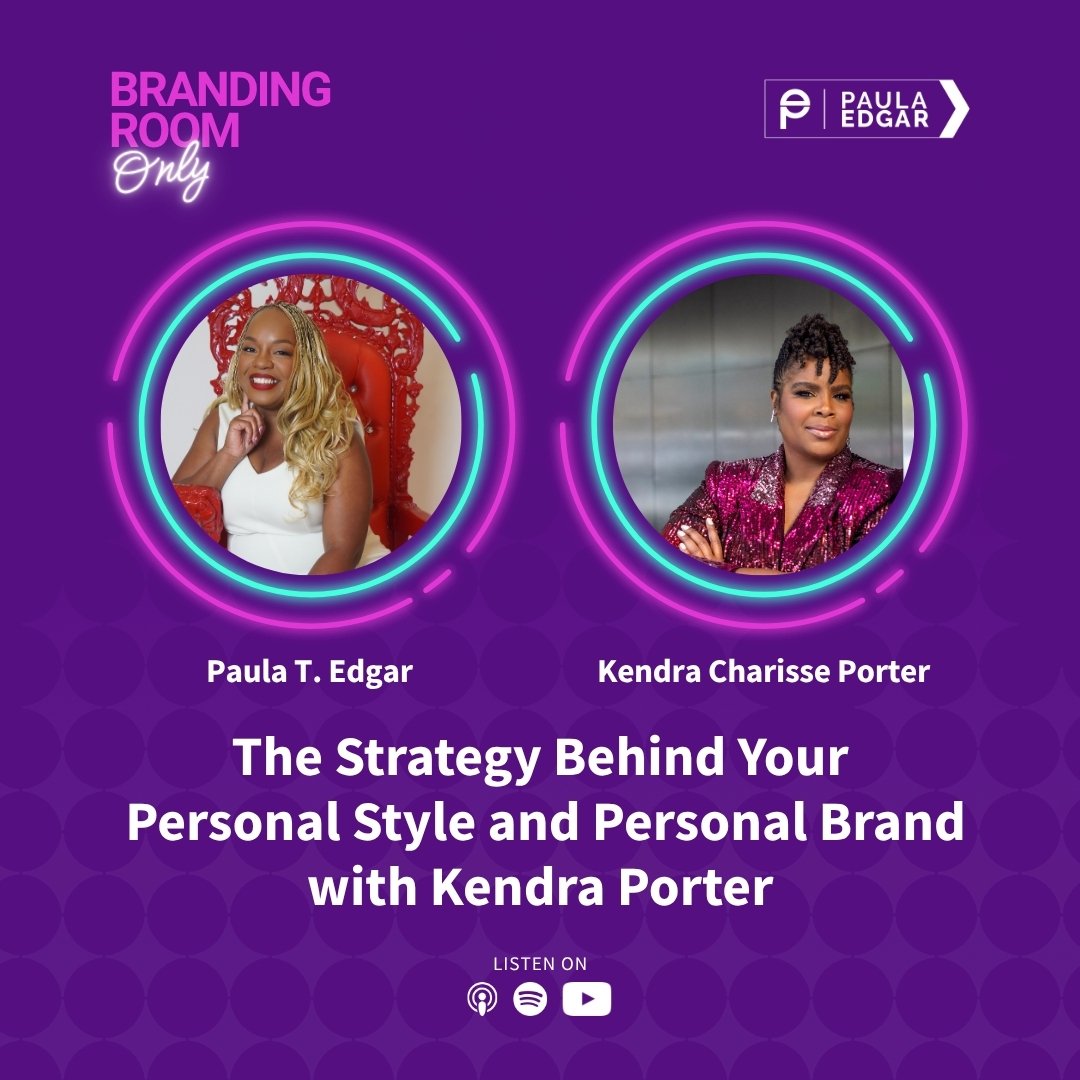
Paula Edgar: Welcome to Branding Room Only, the podcast where your personal brand gets a front row seat. I'm Paula Edgar and if you're here, it's because you know your brand isn't just about what you do. It's about how people experience you. In each episode, you'll hear stories, strategies and lessons from leaders and influencers who built their brands and made their mark. And I'll share the tools you need to do the same.
Let's go. Hi, everybody, and welcome back to the Branding Room. It is Paula Edgar, your host and I'm very excited about my conversation today. Let me tell you about my guest. Most people who talk about personal branding come from marketing or from fashion, but our next speaker built her career in both, implementing campaigns for the NBA, Sony Music and PepsiCo, before taking everything she learned to New York Fashion Week, NBC Sports and the Olympic Games. She's a TEDx speaker, personal brand strategist and founder of HonorU and she has spoken at Harvard Business School to Zeta Global and teaches at the Fashion Institute of Technology. Please welcome my guest, Kendra Charisse Porter, personal brand strategist and award-winning image consultant. Kendra, this has been a long time coming. Welcome to the Branding Room.
Kendra Porter: Thank you. Thank you, ma'am. It's been a minute. It's been a minute. Absolutely.
Paula Edgar: It has been a minute. So I start off the conversation with everyone in the same way. What is personal brand, what does it mean to you? How would you define it?
Kendra Porter: To me, personal brand, personal brand, personal brand name, right? Your personal brand is how people know you, right? It is what they associate with you. So it is all-encompassing. Your voice, your tone, your messages, your etiquette, how you deal with people in the workplace, right? It is not just one thing, it is multiple things.
Paula Edgar: I love that. So speaking of more than one thing, how would you describe yourself in three words or short phrases?
Kendra Porter: So it's funny, I would say trustworthy, thoughtfulness and playful. Here's the thing, I actually do this exercise for myself and for my business, is understanding my brand and how I'm being portrayed. And so I do a survey and ask like about 25 people, clients and colleagues of what's my superpower, right? Tell me three things. And so it's funny, trustfulness, trustworthiness comes in at number one and then everything else actually tied at number two for humor and funny and professionalism. And I was like, that's interesting. But I said, no, that makes sense. I was like, that makes sense. I was like, I'm thankful. But it really is about how do you… How do you portray yourself and how do people also see you? And I think that's the biggest thing, because what we think we are portraying does not always match how other people perceive us. And so, you know, for my brand, I think that stands true to who I am and what I do.
Paula Edgar: I love that. And I love that you did the gutsy thing of asking people about what they think. As doing this for so many people, I recommend that as well. But I also know that it is not necessarily the most comfortable thing to survey folks to get that, because sometimes what you get back is not necessarily fully aligned with what you want it to be. And so it also means that there's going to be work to do. But to that end, definitely exercise that folks should be doing, because scary or not, you need to know or you can't be consistent or fix anything that's inconsistent. So, yes.
Kendra Porter: A hundred percent. I'm going to tell you, I'm a woman of a certain age. You know this. We're about the same age. I've got my fan. It's just, it is what it is.
Paula Edgar: Please do look like a Southern belle. It is all good and it's all fine. And speaking of that, I should tell everybody. So Kendra and I know each other, because we went to college together. And so we literally are women of the same age, because we went to school together, back in the day. Tell me, do you have a favorite quote or motto?
Kendra Porter: So there's a book called “Psycho-Cybernetics”...
Paula Edgar: Okay.
Kendra Porter: … and by Maxwell… Why am I forgetting his last name? I'm forgetting his last name. But in it, he says, it's essentially like you're no more than anyone else. You're no less than anyone else. You are you. And essentially for me, that's, it's really what we should be, right? I think we live in a place where everybody's comparing themselves against someone else and really it's you against you. Like that's really what you're trying to do, right? You're becoming your next best version of yourself. And so forget about everybody else, focus on you and that's how you grow.
Paula Edgar: I a hundred percent agree. And I tell people all the time, I don't believe in competition. I believe that we all run our own lane and the only person I'm comparing myself to is yesterday’s Paula, or last week's Paula, or the five years ago Paula, because, you know, it's not. I do believe that we are, that quote is very aligned with that you're running the race against you, not anybody else. So, yes. What about your hype song? When you're going to get full Kendra, what song is in it? In your head.
Kendra Porter: Yep. So there is Machine by Imagine Dragons. It's one of my favorites. There's another one from a group called Carlton, which is made for this, which is The Other. That is, if I'm about to get on stage, that's what I'm playing.
Paula Edgar: Love it. So tell me this, where did you grow up and how did that shape you?
Kendra Porter: I grew up in Westchester County, New York. Right. So it is not upstate for everybody who's not aware. It's not inside New York City. It's not part of the five boroughs. It's north of the five boroughs, half an hour. I can get there quicker than people from Brooklyn. But yeah, Paula knows exactly why she's laughing. I know why. But it's, you know, it's out in the suburbs. And so I grew up here. And it's one of the things where… My father's from Southern Mississippi, grew up doing Jim Crow. My mother's from the West Indies, went to England, then came here, brought the very polished British aesthetic with her, right? And so they were hardworking parents who wanted the best for their children. And, you know, they did all that they could and put us in a place where it allowed us to grow and flourish. And so there were two things that were important. One was education and success and it really was, you know, my mother, for anybody who doesn't know West Indian parents, if it is not an A, it does not count. It does not matter. If it’s an A minus…
Paula Edgar: Give the shout out, we're in the West Indies.
Kendra Porter: My mother's from Jamaica. My mother's from Jamaica.
Paula Edgar: Thank you.
Kendra Porter: Yes. Okay. So an A and an A minus are not the same thing in this household. And so I grew up with that. But my dad also got his PhD at 70. So every time I was graduating from high school, from grad school, my dad was graduating right along with me. And so that was really important. The other piece is that my dad also really instilled in us is that there is nothing more important than your name. You are your reputation. You are our family. So if you go out there and act a fool, that is our name. That is not just your name. It is what the Porters represent. And so, you know, it's funny because I look at it now and I'm going, it really is about personal branding. It wasn't called personal branding then. It was about building your reputation and making sure that you didn't act any old kind of way. But it's what I teach my clients now, right? It's really about how you are as an entire person and what that looks like. And how do we… How do we continue to build our personal brand and strengthen our personal brand? And so that goes back to that very first question you asked me about what that definition is. It's how people associate with you.
Paula Edgar: I laugh thinking about the dual value household, in terms of education overhead. And also my parents would say, don't embarrass us.
Kendra Porter: Yes.
Paula Edgar: Do not embarrasse… The name Griffith, that's what it was then. And when I tell my kids, when they're leaving the house, my son goes two things. He's like, all right, mommy. Yes, I know. Remember, I'm an Edgar.
Kendra Porter: I love it.
Paula Edgar: And don't do any stupid S-H-I-T. That's correct. So I love that I'm continuing that, but it very much is that excellence is important and also the way that you uphold our name is important and that is branding. And to your point, when people ask me when I started thinking about branding, I'm like, I don't think I never, ever not thought about branding. I just didn't know what it was called. My grandmother used to be like, you got to go outside looking on point. Speaking of like fashion and dressing, my grandmother was a domestic. So she worked for rich people in Long Island and she would see what they would dress their grandkids in. And she was like, I'm dressing my grand… I'm literally saying I'm going to forecast who she's going to be, based on how she looks, which I think is also another part of branding, right? Like how you show up will impact how people look at you, which we're going to get into in a little bit.
Kendra Porter: Yes.
Paula Edgar: But before we jump into that, I want you to tell me I met you in college, start there. What was your professional journey?
Kendra Porter: We met in college. You met me as an engineering student, right? I did three years of engineering, got to my junior year and said, I don't want to do this anymore. And it's crazy, because I was on scholarship. Right, that part. I was like, oh, okay. And it was a number of things, right? That decision to change and leave engineering. It's funny, hindsight's 20-20. I look back now, at that age, I had actually been programming for half my life. So I started programming when apples came out, like I started programming in fourth grade. Because our school had the small Apple computers, right? And we learned how to program a turtle around the screen and do all the things. I never stopped. And so I was also working in the music industry at the time when I was at UMass. And so it allowed me to see just a different side of marketing. And I've been thinking about being a dual major and didn't want to leave UMass. And back in the day, when everything was in print, I literally picked up the course catalog and read the entire book cover to cover and found out that we had a program where you could build your own major. And so I enrolled in BDIC, which is the bachelor's degree with individual concentration and built my major around marketing, advertising communications, hospitality and tourism, because I was doing events for the music industry, sports management and consumer studies, right, consumer studies was the last one. And so for me, it was really about, I didn't want to come out as a generalist in marketing. I wanted to have a niche. And for me, it was events and marketing. And so I took that and moved over into nonprofit, into sports, into consumer product goods. And I have had an amazing journey. You know, the first decade out of school was in that realm of strictly marketing and looking at what that… how I could use my skill set in those areas. And then I moved over into fashion. I moved back to New York twice in three years. And lost my job and was like, I've invested so much money, or not so much money, but so much time working for other organizations. And I was like, maybe it's time to take that and do that for myself. And so I moved over into fashion and had always wanted to launch a boutique. My business mentor at the time said, you know, why don't you consider image consulting? And I had never heard the term, right? Like we all know what celebrity stylists are. We see them on the red carpet. What image consulting is, is different. So while I do a little bit of both now, image consulting really is and how I got started, is really about the person. It is understanding you, your lifestyle, your coloring, your needs and your goals and crafting a wardrobe around you. So there's a difference. You walk into a room, someone notices you and they're like, oh, you look great. That's you. That's Paula Edgar, right? You walk into a room and someone's like, oh my God, those glasses, where'd you get those? Right? That's more of the fashion styling editorial piece, right? People want to know about the pieces, not about you as a whole. And so I happen to do both and my clients get both. They get that pizzazz from the fashion and editorial side, but it's also built around who they are as a personality. So they stay authentically who they are.
Paula Edgar: So you have said often that we are our own walking advertisement and to what you just said, I definitely believe that. So what do you think it really means to be intentional about the way we show up every day?
Kendra Porter: You know, there's an exercise I do with my clients and I have them choose five words. Those five words represent how they want to be seen. So I have them do three personal characteristics. How do you want to be known? Is it trustworthy? Is it, I hate when people say professional, because I'm like, what does that mean exactly? Right?
Paula Edgar: Right, yeah.
Kendra Porter: Be really specific. Is it creative? And then I have them also look at two style words. So we go through understanding style and what that means for them. And so do you want to be edgy? Do you want to be more romantic? Just in terms of styling. And so that by the end of it, when they get dressed, they are making sure that they are crossing off those things that say, okay, this is how I want to show up today. And it's really a litmus test, right? I think that's the piece, when you're intentional, makes a difference. I had someone who… we were talking, she's the owner of her own business, has a successful business at that and potential clients would walk in and would not speak to her, because they thought she was an employee. They'd speak to other people. No one knew that she was actually the owner of the company. And I said, okay, I said, well, what does this look like if we're actually intentional and you get dressed and you show up? And so we had that conversation. A week later, she calls me back and she's like, you know what? You were right. And I said, was I now?
Paula Edgar: Thanks for acknowledging.
Kendra Porter: And she said, it wasn't just… It was everybody. It was her employees started to recognize her in a different way and deal with her in a different manner. People, when they walked in, knew clearly she was not an employee. She was the owner of the company. She was addressed initially. And so those are the things where most people are like, Oh, it doesn't matter. And I'm going for people who don't know you, it makes a world of a difference. Right. And that's where, you know, like I said, personal branding is a number of things. The visual piece is how you get people's attention, right? It's how you pull people in. And you also set yourself apart from who else is in the room.
Paula Edgar: I think, so thinking about that, I thought to myself, what would I say about those five words if I was your client? And the phrase that just came to my mind is I like to be walking confidence. Like I strut into rooms, like I don't just…
Kendra Porter: Yes, you do.
Paula Edgar: I'm coming into a room and I want you to look at my outfit and I want you to think, who is that? Even if, right? Or there she is again, consistency. Although I would say the only thing I can guarantee, when it comes to fashion is that I'm never going to wear black.
Kendra Porter: Yes.
Paula Edgar: You will know I've been kidnapped. Something is wrong. Even to funerals, I don't wear black. I'm like, nah, I can't do that. So, tell me this, you talked about this when I read your bio and before founding your company, you spent years with some of the world's most recognizable brands. And I like to think about branding as the product, the company and then bring that down to the person. How do you think marketing is your background? How did that shape how you perceive and think about personal branding?
Kendra Porter: From a marketing perspective, all of the… it's funny, because when I teach this, I teach this from a marketing perspective. All of the theories that we use in marketing from understanding your STP, which is your segmentation, your targeting, your positioning, understanding the five Ps, right? Product, place, people, placement, all of that still refers to you as an individual, right? So everything that we use in marketing to market a brand, a service, a company, is the same things that we use to market you. So when we think about the product, that is you, right? You are the product, you are your brand. Then it becomes, well, what's your price? Your price is either if you're a business like me, it's our rates, right? That's what our price is. Or if you're an employee, it's your salary. But all of that begs, how do you approach that? The people are your audience. So whether you're talking on stages, whether you're in front of the media, whether it's to, you know, clients and your client facing representatives, those are the people. So how you talk to people and how you represent you and the company is going to be important. Now, the one thing I, the one caveat I will say to that is that you do not, as an individual, if you are working for a company, you do not have to reflect the exact company's culture, right? You do need to be aligned, but you don't have to reflect it. And so I think that's where some people get really, they feel when they're like, oh, but I'm so constricted, because I'm in finance. Okay, yes. Finance is generally, right, navy blue, black and gray. We can wear color. We can add a little bit of flair. And so it's learning how to do that. And so those same marketing principles are what I talk to people about, especially when I have, you know, individuals who are standing in boardrooms, or who are in front of the media. It's understanding who are you talking to? What's the message? How do you want to be seen? And all of that has an impact on the colors we wear, on the patterns, on the prints, everything. And I say this and I tell people and they're like, no, it doesn't make a difference. No, it does. It makes a huge difference, right? And here's, I'll give you a perfect example. I have two clients, both were psychologists, or I should say are psychologists. One is a gentleman who deals with adults. The other is a woman who deals with kids. I am not dressing them the same. Their target market, their audience is different, right? So for the gentleman, he's trying to get older adults who want to feel nurtured, who want to feel supported. So we're putting him in, you know, neutral colors. We're putting him in blues for trustworthiness. We're putting him in browns for comfort. Understanding that palette, right? Soft colors or more muted colors for him, right? Also based on his own personal coloring. For her, we did bright colors. We did bigger prints, because not only does she have to appeal to the kids who are actually going to be working with her, so that they feel safe and comfortable, that they're okay to just play with some stranger that they don't know. And you also have to build trust with the parents, because the parents have to say, okay, this person's going to understand how to work with my children. And so it's understanding who you're talking to and how to dress, so that they feel that you're credible, one, but two, that they can trust you in whatever it is that you're ideally being hired to execute.
Paula Edgar: Yes. Because I think a lot of people think about personal branding as just like what you look like in your style. So, you know, when you're thinking about that, what is it that's… because it's it is a part of it, right?
Kendra Porter: Yes.
Paula Edgar: But it's not just a part of it. So what do you think that they should be focusing on, instead when they're thinking about like that? Kind of like what you were just leaning towards. Like, what should that be?
Kendra Porter: So I think the… along with the visual identity, which is really what I focus on, I also work with partners, right? So having a voice coach, that is important, especially when you're in the media, especially when you're on stages, understanding how to talk to people, what words to say, what's going to make the most sense, understanding your body language, very important, tone, those, you know, we talk about hard skills and soft skills. It's those soft skills that come into personal branding that most people, when I feel like people talk about personal branding, they're like, oh, your resume and your etiquette and work out. And all of that's true, but that's not the only thing, right? There are these soft skills that also matter as well.
Paula Edgar: Yeah, and all of y'all who are listening, you know that while people call it soft skills, I call it concrete skills, because they are the differentiators. You can have the same exact resume, but the way you show up has to do with the, it's kind of the water between the bricks, right? Those are, there's the foundation…
Kendra Porter: Yes.
Paula Edgar: … but it's the je ne sais quoi that really makes that value proposition really strong for the people who have a strong brand. And for the people who don't, you kind of get it too. So anyway, so, and there's that. You, you know, kind of mentioned this in the story you were telling before. The question I have for you is this, like, you know, you work with people in a lot of different places, like boardroom, stage, you know, et cetera. Where do you think a disconnect can happen between somebody's expertise? Like, clearly they know, like, your psychology, all the people, what they know and then how they show up and present themselves. Like, where can that disconnect happen when it comes to intent and then impact?
Kendra Porter: I think it's where most people… truth… are unaware. Right? So to the point of when you asked me what my three words were and I said, I do an assessment and I ask others. So I understand how people are perceiving me. It's the same thing. So I've got actually two stories, but I had a woman who was going to a conference, decided to wear a black suit, right? Ideally professional. It was lunch and she got mistaken for the hospitality team.
Paula Edgar: Oh boy.
Kendra Porter: And she's like, I don't understand. And it was a call and I said, okay, I had, so I don't know what the suit looked like, but my assumption is, is that could have been outdated. It could have not fit her well. And because here's the other piece, she may not have held the energy to hold the space for herself at that moment. Because yes, you can look like a waiter, right? And listen, it happens, I get it. But if you're not holding that space and that energy that says, I am not the waiter, there's a difference, right? And so I find that and I find more so this with women than I do with men, is that especially if, truth, if you're petite now and I say that because listen, I know that you're, you are, well, I'm 5’10 and a half. Let's, let's say that, right. So I stay at six feet in heels.
Paula Edgar: I am lower than that, I am lower than that. I am a little bit shorter than that, I am 5’2 on a good day.
Kendra Porter: Oh gosh, are you really? Wow, it’s been a minute since I have seen you in person.
Paula Edgar: [inaudible 00:24:05] tall.
Kendra Porter: But here's the thing, right? That's important. Because, so my attorney, I met through a community of people. We met initially online doing a Zoom like this. And she had good recommendations behind her and so forth. When I finally met her in person, she's 5'4", maybe, I think, 5'5". But you wouldn't know that, like talking to her on camera, she has an aura, she has energy and a confidence about her, that I was looking for somebody who was like at least 5'7", like I wasn't afraid to be my height. And I was like, oh, I was like, okay. And so there's a part of, we have to hold ourselves in a particular manner, in a certain way and have confidence. And to that end, I talk to people about their credibility stack. So understanding, you may feel some kind of way about who you are, where you should be in life and all the things. But if I go down your list of accomplishments, I'm like, wait, why are we cowering in the shadows? Why are we standing over in a corner? You've done so much, you've accomplished so much. And so being able to have people look at their accomplishments and really take note of all that they've done and then get them into looks that also support how they feel, who they are and where they're headed, it makes a huge difference. And people, it's the thing that I love about what I do is, because I can see that transformation immediately, right? Once I get somebody in something that makes sense for who they are, they stand tall. My joke is, you know, for women, they will usually dance in the mirror. The men stand and pose like they're on the cover of GQ. It happens all the time. And that's the power of getting dressed.
Paula Edgar: I mean, it truthfully is. Years ago, before the pandemic, we had our house organized by an organizer, because we had stuff. I had clothes in everybody's closet. So nobody had their own closet but me and it was all of them. And the woman who did the organizing was like, this is not fair to them, they should have their own closet. And I was like, I don't care. They don't have fashion. It is what it is. What ended up happening was she took all of my clothes and put it in the room I'm in now, which y'all can't see, because it's that way. But all of my clothes are color coordinated and on racks. And it just makes me feel so happy. So when I do therapy and I'm just sitting here talking to my therapist, she's always, she does like that presence thing where it's like, you know, what do you notice? How do you stay present? And I always go, I'm looking at my pretty dresses and it just brings me joy. I kind of think of myself as my own Barbie doll. I like to dress myself up and to think about the where I'm going to wear the thing, going back to like looking at past times I've been at the event and not wearing the same thing, because I don't want the same kind of picture, because there is going to be a picture, that literal intention for all of it. And when I tell people that I do all of that, they're like, that takes a lot of time and energy. I was like, it doesn't. It becomes a part of who you are. However, one of the reasons why I wanted to talk to you, because I realized it's just something that's innate for me. And so if something's easy for you, oftentimes people will think it's just easy for everybody and it's not.
Kendra Porter: Right.
Paula Edgar: That's why I wanted to talk to you, because I'm like, you know what, what you are providing for people is powerful because they need it. And I say that in a place of not judgment, but I just know that people deserve to have that dance in the mirror, GQ pose experience that makes you walk into those rooms that you want to bang power in. Like, you're banging power, like, oh, I'm going to do it. And if you can't do it for yourself, it really is a good investment in your time and your money to make sure you can have that. So I wanted to just say that I really think it's powerful what you are doing and bringing for people, because I think a lot of folks just think, oh, I'm just picking it, you're picking outfits, but you're actually talking to them about the strategy.
Kendra Porter: Right.
Paula Edgar: Talking to them about what and how.
Kendra Porter: Yeah. And I think that's the piece where most people are like, Oh, so you just, you know, you shop and you buy clothes. And I was like, that's not, it's part of what I do, but it's not when I… at this point in time, right. And I think it's, it's different depending on where you are in your career, where you are in your life. For me now, a lot of my clients are executives, or CEOs, or founders, or experts and speakers.
Paula Edgar: Yeah.
Kendra Porter: Middle management I've worked with as well and have had them. And for when you're at that level, I think sometimes it's just, I just need to get dressed. I need to look professional and I'm so focused on my job. And that's where I think people get lost. They get focused on the job and forget about what it looks like to elevate. A lot of the times when, especially if companies are looking to hire internally, they also look at who's going to be the next best representative at this next level. And if you're not dressing in a way that's going to represent you, or represent not only you, but also the company, you may get passed over. I was at a conference in the fall that I spoke at. A woman came up to me at the end of the conference and she said, I wanted to talk to you. And I said, OK. And she said, well, I just went up for a position at this company. And they turned her down. I said, OK. She said, I asked them why and they said, because I didn't look the part.
Paula Edgar: Oh…
Kendra Porter: And I was like, they actually came out and said that.
Paula Edgar: [inaudible 00:29:42] don’t do that, ya’ll.
Kendra Porter: But she came up to me because she's like, I know I need to work on my aesthetic and how I show up. And that's, you know, it's never about, for me, it's never about judging someone because people feel like, oh, they're judging. Listen, I'm not going to dress you like me. I'm going to dress you as you, but that next best version of you that is going to take that next step. Because if you see yourself three years, five years from now, what position are you in? How are you dressed? It's not going to be the same when you first come in, right? To a company. You are going to hold a particular position. You're going to set a standard for the company. And so what does that look like? And if you're a client facing, so there's an internal communication piece, but there's also the external. And that's really important to decide. And most people, I think the other piece is decision fatigue, when it comes to getting dressed. Understanding what they're picking, what they're choosing for you. You love it. A lot of people don't. That's why I get hired, right? And for me, it is also easy as well. What I do for my clients is I help them and I help them to see, one, how to be intentional, what that actually looks like. And then they're like, oh, this is exactly what I was looking for. I just didn't know how to put it together. I didn't know how to actually have this sense of style. And then the other piece is that when you work with me, my clients have a digital wardrobe. So we put together, we'll pull through your clothes, we'll take photographs of everything. It goes into a digital wardrobe. We'll pull together looks for you. So that's already set. So my clients generally work with me on retainer. And every month we go through, where are you traveling? What meetings do you have? What media appearances do you have? All right and we'll plan for those. And so we'll dress those, you know, dress those looks up. And then, whether they're working with me, if I'm on set with them, or if they're going and they're packing on them alone, they have everything. They know everything they're taking. The looks are laid out. There is no, like, there is no, oh, wait, I have to bring this, or should I? I don't do overpacking. I am not the one, right, I do not.
Paula Edgar: I refuse.
Kendra Porter: Yes, I know. She's like, mmm…
Paula Edgar: And you'll be like, girl. I'm like, well, what if there's a ballgown that I need? I need to pack a ballgown.
Kendra Porter: See? See? No. We can bring a ballgown. Listen, I have packed a ballgown in a weekend bag. Not a problem. Listen, there's ways to pack.
Paula Edgar: Yes.
Kendra Porer: But it's understanding and helping people to figure out what's really important, how do they want to be seen and then how do we choose the right pieces. And not just, oh, I'm buying this one piece because I love it. OK, well, great. We love it. What are we wearing it with? How do we put all this together? And that's the other thing. I think sometimes people buy things that they like, not really considering what they already have in their closet, what's going to work. And there are some people who are great at buying pieces that are just one-offs and then they can mix and match together. Fabulous. Most people will buy it and then it'll sit in their closet, because they're not really sure what they should wear with it. And that's where I try to help people to understand how to play with their wardrobe and really maximize everything that they have.
Paula Edgar: So necessary, so necessary. I'm glad, but yeah, we could never do a Paula got a pack thing, because you would be so mad at me. You'd be like, this is not good.
Kendra Porter: Listen, you know what? If I talk to your husband, your husband would get me for a gift and he'd be like, show her. And then you'd be like, oh, okay. I know…
Paula Edgar: He feeds the beast. Listen, I went on a weekend trip for a conference and I had two suitcases. I was like, just in case.
Kendra Porter: For a weekend?
Paula Edgar: Yes. It was like, just in case. I need to have cowboy boots. Just to…
Kendra Porter: Paula…
Paula Edgar: I know. Listen, we all have our things that we need to work on. That's not one of mine. All right, so listen, we have had in the last two or so years, a lot of people who have had to pivot in the workforce, because of layoffs or craziness with the government, whatever the thing is. And so if you are somebody who is going through a transition, wants a promotion, et cetera, how should they think about evolving their personal brand, while still staying true to who they are and their authenticity? What are your thoughts about evolution, given a pivot or something else?
Kendra Porter: So a lot of it is, where are we starting from? So understanding what's currently in your wardrobe. A lot of people have things that are five, 10, 20 years old, right? I've had clients who said, well, no, I've had this since college, or I've had it since high school, because I can still fit it. God bless you that you can still fit your wardrobe from that. But the question that I say to them, are you the same person from 5, 10, 15 years ago? They say no. Well, what's part of that evolution that we need to keep and what do we need to let go of? So I think that's the initial piece is having people really assess what no longer serves them for the role that they're stepping into, or that they want to step into. And then how do you see yourself in that role? What are we really building towards? And as you start to build towards that and as you start to wear, I'd hate to say a uniform, but to wear a wardrobe that is that next future self, you become that next future self. Where I tell people and where people struggle sometimes is, well, I don't know if I can wear that. Why can't you wear that, right? What's holding you back? And sometimes it may be they're not sure if something's going to work for them. And so my job is to help them understand the aesthetic that they like and show them how to make it work for their body, right? It's helping them to see, okay, well, if you like this, you know what, we're not going to do single-breasted, because as a guy, you're a little too bulky. So, or double-breasted, right? But you're a little too bulky. So let's do something that's a little bit more tailored, right? Let's give you some detailing on the jacket that allows you to have that look that you're wanting, but not that exact piece, right? And I think that's where, when I work with people, helping them understand what's going to work for them and their body and their coloring, because there are people who are like, oh, I want to wear neutrals. And then they end up really just blending into their clothes. That's not what we want. You can wear neutrals. You can wear nudes, even. But you should also, your nudes, unless they're a pair of shoes, should not blend into your skin tone. Right?
Paula Edgar: Because it would look weird.
Kendra Porter: Right, you want to look like you have something on, right? Shoes, I say no only because shoes elongate your legs, right? So in that sense, that's the only way where I say that can blend. Everything else should be, there should be a distinction. And so there's playing with styling. There's also playing with fit. The biggest thing and the most important thing is fit. So where a lot of people put things on and they're like, oh no, it fits, because they can actually put it on their body does not mean that it fits, right?
Paula Edgar: Say that one more time, please. Say that one more time for the people in the back. Please, I need a repeat on that one. And this definitely needs to be a podcast clip. Go ahead.
Kendra Porter: So just because you can put it on your body does not mean that it fits, right? Now, what do I mean by that? I mean, it can be too big. So now you have where your shoulders end, the seams on your jackets, on your sleeves should stop there. They should not go over, right? This jacket, truth, right, is a little big now. I've actually lost some weight, so this jacket's a little big on me. But I can wear an oversized jacket and make it work, right? Understanding how to play with things, knowing where your seams are, knowing how things should be tailored. Men, I love you. These have your pants. If you're pulling things off the rack, get your pants tailored. And the same thing for women. Men are usually better at this, because they're buying suits and they're usually getting suits tailored to their body, right?
Paula Edgar: Yeah.
Kendra Porter: Women will be like, no, it should fit. Why? There are six different body shapes for women at different sizes. One dress is not going to fit all of us the same way. So go to a seamstress, go to a tailor, go to your local dry cleaner, right? Have it taken in. It is, when you start to do that, things will look like they're made specifically for you. And somebody will be like, oh my God, you look amazing in that. It's the same dress you had before, but now it actually fits your body. Pants are the same thing. I think sometimes, you know, across the board, people buy things that are too wide for them, there's extra fabric. Again, just because you can put it on does not mean that it fits. It's really having things tailored to your body. And you can still do oversized and tailored. It's about having shape. But you don't want to be swimming in your clothes. And I see that happen a lot. And then I also see the reverse opposite, right? Things being a little too snug.
Paula Edgar: Tell me.
Kendra Porter: Men bulk up. They've got their biceps, right? And now their jackets are like ruching up on their sleeves. Things should skim the body. She's almost like, mm, mm-hmm.
Paula Edgar: For those of you who are just listening, go ahead and go to YouTube, because I am staring in judgment.
Kendra Porter: Same thing with men's dress shirts. Ladies, partners, if you are buying shirts for the men in your life, find out their actual size.
Paula Edgar: Yes.
Kendra Porter: If you bought it for them, they will wear it. It may not fit. The neck may be too tight and so they'll always wear it open, which is okay if they're not wearing something that has a tie. But then there's some times where they're too big and then you've got this gap and they're wearing a tie and it's not going to tighten and it's going to look too loose, right? They'll look like a kid in a suit as a man. So all of those things matter. Listen, I've seen it all.
Paula Edgar: They one thousand percent matter. It frustrates me to know and to see somebody who has on an outfit that on the rack probably looks fantastic. But when it is on their mannequin themselves, it's just not doing what they wanted to do, but they are committed. I see shirts gapping open. I know I'm not a button-down girl. The girls don't like to sit in a button-down. That's just not my thing. It is what it is. So I choose very carefully when I'm going to figure out what I'm going to get, because I don't want y'all to get the show that I'm not intending to give to you. I can see pants hanging off low. I see folks sitting down and their dress is too short. Like there's just so many things that take away from what you know is somebody's great intent, right? It's the way that it is executed is not it. It's not it. And to your point about losing, gaining weight, you got to think about that too. If it's a piece, like, you know, it's what makes me think about like this whole influx of fast fashion is that you're probably not spending money to tailor those things, because they're not expensive pieces, right? But… and still, if you were going to wear them, then it makes sense that you want to have something that looks good on you. And back in the day when, you know, people were spending a lot of money on clothing, they would tailor them, because they had spent a lot of money on clothing. And I just see folks being like, oh, like, so, yeah, no… I could have a whole conversation just on that.
Kendra Porter: Listen, I'm right there with you. And the thing is, is that working with someone like me, it's, you have, it's the understanding of things that we can do, that we don't have to buy a new shirt, so you don't like button downs. Well, because they make a, we can do a hook and eye, we can do a second button, we can do a hidden button. That's easy enough to do without buying something new, right? And feeling like, oh, I can't wear button downs. No, you can, right? We just need to get the right one for you. And then whatever you do have, we may just need to tailor those pieces a little bit. So it's all of those nuances that come with, you know, being a stylist, being an image consultant and working with a team. When I say that this is the most important thing, I have clients across the country. I have a team, wherever my clients are, I will build a team so that there is a seamstress there. There is a tailor who can work with them. We will do virtual fittings, because I need to make sure that you are looking in a particular manner, right? You stand for your brand and what that looks like. And so, that is every woman, every man should invest in.
Paula Edgar: Oh, y’all, everybody needs to hear that. I mean, like I said, I think the reason why I continue to have folks who are working in style on the podcast is because I know that so many people have the goods, in terms of their intellect and their experience and the how they're showing up is what is taking away from how they are perceived. It's a tragedy to let something like your packaging impact the quality and what is perceived as the quality of what is inside the package. And so, yes. So tell me this, thinking about the future, we're in, you know, like most people have a hybrid sort of practice in whatever they're doing, or a lot of people are working remotely. Many people are seen only from this, this, you know, the chest up. What are some, what's one thing you're thinking that more professionals would do to strengthen their like executive presence? Just period. Like as we're thinking about going forward into our, you know, whatever workplace of the future is, what is something that you think that they need to do?
Kendra Porter: I think for those who and going back to the decision fatigue piece, find your uniform, right? A lot of people talk about capsule closets and capsule wardrobes. Find what that may look like for you. If you don't like shopping, if you don't like tons of things, that is fine. No one says you have to have a closet like Paula's, right? But what you do need is you need pieces that are going to work together. So find things that fit you well, things that are tailored to your body, understand how you want to look. I tell people we go through and we create a mood board for our clients so that it's an understanding of this is what this is going to look like. These are your casual looks. These are your more formal looks. And so that when we put things together, whether we're shopping or whether we're putting looks together for them to travel, it's easy to know, oh, I'm going to do, I'm always going to do three pieces. I'm going to do a jacket. I'm going to do, you know, some type of top. And then, you know, for women, it might be, I'm always going to wear earrings, right? Because I want to have… because I have short hair. Like there's all of these things that come into play. And so I want people to be really intentional about how they're choosing to show up. In particular on camera, it is being mindful of your backgrounds, about where you're positioned in the camera. And it's funny, right, you said off camera, right before we started, you talked about the last time we were on and my earrings were banging against the microphone. Now granted, we had tech issues all that day anyway, but it is something to be mindful of. When I have people who, especially on a mic, whether they're on a panel, or what have you, or in front of a camera, we have to take into consideration, yes, you can do long earrings. Yes, you can do big earrings. How big and how long? Where's the mic placement? Where are we putting that? If you're going to be on camera, you can't do something that's super light like this, because the mic is not going to hold. So it's understanding all of those nuances, when you're getting dressed and when you're thinking about your executive presence, how that comes across on screen. It all matters for both men and women. Grooming is also a big part of that, right?
Paula Edgar: Yes.
Kendra Porter: So men, it's the ear hair, it's the nose hair, it is also your eyebrows, please just, I just need you to just, you don't need to shave them, you don't need to come, just the ones that are just straggling out, just peeking out, saying hello over your glasses, you can just snip those a little bit, just a little bit, right? It's that part where we clean you up a little bit, right?
Paula Edgar: Yes, yes. Clean nails. Listen, please, please.
Kendra Porter: That's all we want. We just want clean hands and nails.
Paula Edgar: Yes, yes.
Kendra Porter: So, and this is where, you know, I think sometimes people look at what I do and they're like, Oh, do you work with men? And I said, of course, I'm like, I've worked for NBC sports. We are 90, like 5% men. It is understanding that what I do is for men and women. It's understanding that grooming is for both men and women. Women do a little bit more pruning, because we do makeup and all the things. And here's the other piece. I think social media has people thinking that they have to do all the things to be over the top. And that just gets tiresome. I am not that person. I'm not going to have my clients do that. What I will say is, for women, you know what, even if you don't like makeup, powder is an easy brush so that you're not shiny on camera. And a lip. That's simple. Right?
Paula Edgar: Yes. Yes.
Kendra Porter: We've got Zoom now and so forth that have all these other additional filters. So you don't feel like you have to put on a whole bunch of makeup, but it is just those two things will help even your skin out, not make you look oily and have a pop of color on camera. Then again, it's the grooming. And here's the thing that I find in corporate people will… two things. One, if you're on camera and you're on camera with your company, a lot of people get very comfortable. So that on camera… So one of the reasons when we were first talking, I was going like this behind my back, because I have a pillow behind my back. Because if I don't, I may end up slouching. You're supposed to sit up straight and tall.
Paula Edgar: Yes, yes.
Kendra Porter: And that reads differently, because people will do that on camera and they will do that in a boardroom. I had the head of HR that I was talking to one day for a company that I was doing a workshop for. And he said to me, you know, people always judge him because for him, when he's taking in, he doesn't lean in. Body language is important. Most people lean in to try and talk to you and listen. He sits back and he sits back and it looks super comfortable, like he's not paying attention. And so I said, easy fix. I said, let's get a pillow, put that behind your back when you're on camera. And so it's understanding how all of that comes into play. And so, you know, for the future and as people are being intentional, take a look at yourself when you're on camera. A lot of people do not like to look at themselves on camera. They're like, no, that looks weird. I look funky. If you got dressed, if you weren't in, right, your logo gear from work, it makes a difference. It really makes a difference.
Paula Edgar: It does. It really does. And I will say for the 5’2 people down here, for the taller men, particularly, sometimes women, but the nose hair thing is a thing. Like if I can see it directly up, because I'm down here, it's like, oh, please help me, sir. Just a little grooming would be really great. You know, I knew this conversation was going to go quickly, because it always does, especially when I'm having a good time. I'm going to ask you my last two questions that I ask everybody, which is this this. Well, I guess three questions. One, what is the fun stuff? What do you do for fun?
Kendra Porter: What do I do for fun? Oh, geez. You know, for me, there's a part of me that's simple. A friend of mine said to me one day, she was like, you're simple and complex. I love to sit by the water. Right. Where I am in Westchester, I am 15 minutes from a beach. I'm right to the east, 15 minutes from the Hudson River to the west.
Paula Edgar: Nice.
Kendra Porter: You will find me by water as much as possible and ideally every day if I can. Right. To just sit and relax and just decompress. That is my joy. That and spending time with, you know, I would say friends and family, but it's just I can sit and talk and just laugh all day and I can just relax and read a book. I am a caregiver for my mother. That is stressful. I've been a caregiver for both my parents, right, for the last decade. I like to take time for me. That is really where I find my joy. That and traveling. That and traveling.
Paula Edgar: Love that. Love that. So what is the authentic aspect of your personal brand that you will never compromise on?
Kendra Porter: Supportive honesty.
Paula Edgar: Oh. Supportive honesty.
Kendra Porter: Supportive honesty.
Paula Edgar: Like, girl, that's ugly, but I love you.
Kendra Porter: That, right? It is the, listen, you have hired me to do a job. My job comes with challenging you to step outside that box.
Paula Edgar: Yes. Yes.
Kendra Porter: Right? And not to go back to what you're accustomed to. That's the other piece, right?
Paula Edgar: I can imagine that that's something that probably happens a lot, because people are so in their rhythm of things. But as I think about the services that you provide, if you keep doing the same things, then you'll keep having the same impact, like the same, right? And so if you're trying to do, you know, people are coming to you because of whatever the reason, but you want something new, you got to do something new. And so I'm glad that you said that at the end of the conversation, because I'm sure there's some people who are like, I don't want to do this, but I, no, not but nothing. You need to get another perspective on the what you can do, because we all have these stupid fashion rules that we follow in our heads that are not actual fashion rules.
Kendra Porter: Yes, correct. Yeah. And that's the thing. I think people, what I love and it's a running joke for me at this point, is people are like, you were in my head this morning when I got dressed. Like I get text messages. I had a client who, listen, I have people who've worked with me from the very beginning and have worked with me over the last 15 years. And so I got to know their families and so forth. And so I had a client who texted me and said, my mom asked, what would Kendra say? And that phrase, what would Kendra say, is either what clients say to me, or people who know that they're working with me. They will ask them that question. And then I get the text message. They didn't believe I got dressed by myself. They asked me, did you dress by yourself? So once you know, once you work with me, like the things that I teach my clients, they will always remember. And they're like, okay, wait, what would Kendra say is, does this work? Wait, I need to take this piece off and maybe change it with that. And so listen, if you have worked with me and people will remember my name for years after the fact of our engagement has ended, I count that as a win. I count that as a win.
Paula Edgar: A hundred percent. That's legacy work. I love when people come to me and they're like, oh, I was going to wear this outfit today, but I changed it, because I knew I was going to see you. I was like, whatever works for you. As long as you show up looking better, it's all good. If I'm going to be the bully in your head, sure, no problem. My final question for you is this. The name of the podcast is Branding Room Only, because it's a play on the term standing room only, because I am clever. So what is your magic? What is the thing about you that would have a room full of people with no seats left to experience about you?
Kendra Porter: I can see generally what other people cannot. So it is when someone stands up, you know, I don't judge people. I think, you know, anytime… And so like you, people like, oh, I got dressed, because I knew I was going to see you. Okay. I don't, I'm not going to judge you. Like I don't, that's not what I do, unless you hire me, I'm not necessarily judging anyone. But it is the fact that I can be in a room full of people, do a presentation. Within five minutes of talking to someone, I get who they are as a person, their personality and their style. So when questions come in, people are like, I have this question. I said, no, got it. Because I can understand, I can see their coloring. I can see their personality. I can see where they're struggling. And then I show them how to fix it. And I can see it in the room. And so it becomes this, once I show one person, then I have the next person that's going to ask. And so it's always, for me, that's the fun part of what I do, because I get people to see the perspective shifts in the moment. And then they take that with them and they're like, Oh, they're like, no, okay, now I know how to do this. And then they continue to come back after that. And that's, you know, that's the joy. I think people love to see the transformation. Right? This is why people watch the shows. They love to see the transformation. The transformations are immediate when you're [inaudible 00:55:20].
Paula Edgar: I love that. So tell people how they can find out more about you, how they can connect with you, to work with you. Tell the folks. It'll be in the show notes, but I also want to tell them now.
Kendra Porter: Yeah, no, absolutely. So you can find me at KendraPorter.com. That is my speaking site. So I now get hired a lot to do, to work with organizations and associations. There is also a link to my styling site at the very bottom, which is honoryourstyle.com. And you can find me there on all social media. I am honoryourstyle. So you'll find me talking about fashion, showing you what's what and talking about personal branding in particular.
Paula Edgar: Awesome. Thank you for being on the podcast. Come back whenever you want to talk about anything. And everybody send this to that person who, you know, needs to hear it.
Kendra Porter: Thank you so much for having me as always, honor your style.
Paula Edgar: Yes. Bye y'all.
That's it for this episode. I appreciate you hanging out with me on Branding Room Only. Now, please do me a quick favor. Head over to RateThisPodcast.com/branding, so more people can join this conversation. And make sure to stop by PaulaEdgar.com/events to see what's next. Whether I'm live, online or in person, I'd love to see you there. See you next time in the Branding Room.
And until then, stand tall, shine bright, and always stand by your brand.