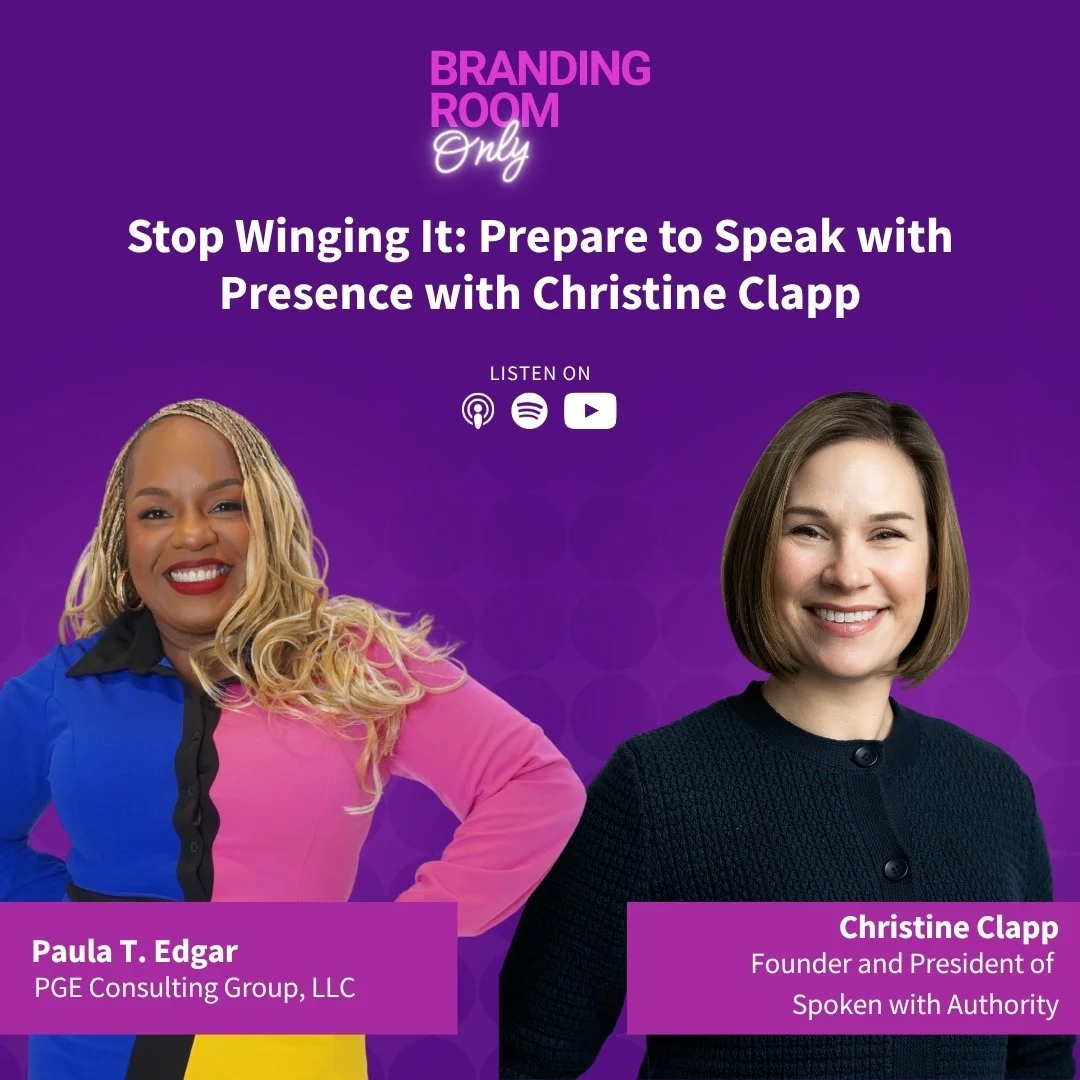
Paula Edgar: Welcome to Branding Room Only, the podcast where your personal brand gets a front row seat. I'm Paula Edgar and if you're here, it's because you know your brand isn't just about what you do. It's about how people experience you. In each episode, you'll hear stories, strategies and lessons from leaders and influencers who built their brands and made their mark. And I'll share the tools you need to do the same.
Let's go. Hi, everybody and welcome back to the Branding Room. It is your girl, Paula T. Edgar and I am going to have a conversation with one of my favorite people. Let me tell you about my guest today. Her name is Christine Clapp. Christine is the founder and president of Spoken with Authority, a Washington, D.C.-based presentation skills consultancy that elevates the presence and expands the influence of subject matter experts, leaders and emerging leaders. She is also the co-author of four books, including most recently, The Present Speaker, which will be released fall of 2026. Christine holds two degrees in communication, a bachelor's degree from Willmanette University and a master's degree from the University of Maryland, College Park. She also taught public speaking to undergraduate and graduate students at the George Washington University, sorry, the George Washington University for 13 years. Christine, welcome to the Branding Room.
Christine Clapp: Thank you for having me.
Paula Edgar: I'm so excited for our conversation. First, let me get into what I ask everybody. What does personal brand mean to you? How would you describe it?
Christine Clapp: Yes, I think there's a great corollary between professional presence and personal brand. And in the world of oral communication, we like to talk about the content. So the what you say, the message, the key points, the stories you tell and then the how you say it or the delivery. So the vocal quality, the body language, your use of fillers, your online setup. So that professional presence piece. And then that along with your reputation as a speaker is how audiences experience you and your communication over time. And I think there's a similar idea at work with your personal brand where there's the what you do. So it's sort of your content, your role, your task, your expertise. You and I, we have services that we provide. There's the how you do it. So it's what's your consistent approach? What are the values that you bring to your work? And I think that that makes your personal brand just that consistent experience that people have with you over time. And I think a great barometer of it is what do people say about you when you're not in the room, I think that's a really great way to gauge what it is.
Paula Edgar: It is a wonderful barometer and I love that you use the word consistency, because that really is the key, right? It's continuing to make sure that people can expect a certain level of quality and how you're going to show up each time is what your brand is. And to your point about people saying things when you're not there, that really is what you're intending following through as well. So Christine, my friend, tell me how would you describe yourself in three words or short phrases?
Christine Clapp: Yes. So I would say for me as a person, I am practical, I'm empathetic and I'm reliable. And then I would say as an organization, my company Spoken with Authority, that we focus on influence, presence and authenticity.
Paula Edgar: I would say that I would also add authenticity to yours individually as well. I think that when folks resonate, it's because they show up as themselves. And so that is an important piece. So I'm interested in what you're going to say for this, because you do a lot of speaking to help other people speak. And I've seen you present many times. Do you have a favorite quote or motto that's resonating for you right now?
Christine Clapp: One of my favorite quotations about public speaking has been attributed to Vernon Jordan, the civil rights icon, Clinton advisor. And I don't know if he actually said it, but I've seen it attributed to him in Vanity Fair and some other places. But the quotation is this. It's, “giving a speech is like sex. You're supposed to be exhausted when you're done.” And I love it, because I think so many people go into public speaking thinking it's just like a day-to-day thing and it's not. It's special, it's elevated and you should be exhausted when you're done.
Paula Edgar: Never going to go on the stage again. It will always be like, I got to be running in place for this one. I love that. I love it.
Christine Clapp: Well, I imagine as a speaker, you can empathize with that, because it really is draining, when you are putting yourself out there on a stage and you're carrying a room and you're connecting with your audience. It's amazing. Don't get me wrong. It's one of the best things that I've... It's great. And it also is exhausting.
Paula Edgar: I mean, what's funny about that to me is that I've been thinking about writing an article about what people need to do as audience members. Because if they come with low energy, it impacts me as a speaker. And so the sex correlation is also fair to some people.
Christine Clapp: That is a very, to like play out that metaphor would be an interesting one. But this is something that I talk to speakers a lot, because oftentimes audience members are not thinking about the way that they're showing up and how they are not demonstrating non-verbals, or even verbals like, mhm-mhm, or, oh, tell me more in a conversation that encourage you on as a speaker. And sometimes people read into that things about how their audience may feel about them or their topic or how their presentation's going, which is not always true because your audience… sometimes it is, but it is not always true.
Paula Edgar: It's true. We live in this world that is multitasking and likes little sound bites. And we're always thinking about some other things. But I do want to give a shout out to the people who are the head nodders and the mhm-mhm members, because they're like cheerleaders in the audience. So that is important. Tell me, what is the hype song that the people get? It runs through your head when they're getting full Christine Clapp, coming with her best self. What are you bringing?
Christine Clapp: I would say “Hey Ya” by Outkast. I'm a product of the 1990s, right? And I love the 90s and early 2000s from a music perspective. The other song that I love before I go and speak is “Pink Pony Club”. I think it's just such a great anthem and I absolutely believe in that we all need a place, a home, and a family, sometimes a chosen family and just the confidence to get out there.
Paula Edgar: I love that. All right, well, speaking of chosen families and on how we kind of show up, where did you grow up and how do you think it shaped you?
Christine Clapp: Yeah, absolutely. I grew up in the Pacific Northwest. So I'm from Tacoma, Washington, which is a little bit south of Seattle. I grew up on Commencement Bay. It's absolutely beautiful by the port of Tacoma. And my high school fun fact is the high school in the movie “10 things I hate about you”. So high school in Tacoma, Washington, it was filmed inside and outside there. And it was in my era. So whenever I watch it, it's a great snapshot in time of my high school life. But both my parents were educators, they worked for Tacoma Public Schools. And my dad, he started as a high school science teacher, he was also the president of the Teachers Union. And my mom, she was a teacher in the school district for kids with special needs, so special education. And she actually helped develop an educational program for kids who were in the juvenile justice system. And then she later helped start as principal a new alternative school for kids who needed different ways to access learning. So they had child care on site. They did online learning. So that was in the 1990s. So a pretty cutting edge thing at the time. Yeah. And she was really, it was really important to her that her school as an alternative school was not a place, where sometimes other principals would be like, oh, this kid is too much or too hard. So instead of accommodating them there, they would kind of shuffle them off and not give a lot of intention to how they were educating those kids. And my mom made it her priority to make it a special place for kids and to honor kids who learn differently. So I would say that the two things that came out of that upbringing was one is I think that there is this value of service specifically through education. And I also think there was this also subtext of that service to people who are in underrepresented groups.
Paula Edgar: Oh, I think that what you just pulled out resonates exactly in terms of how I experienced you and I'm sure others experienced you as well. And so that clicks for me a little bit, when I'm like, ah, OK. So she has been seeing this for a long time. And so all righty. Tell us about your professional journey. So you grew up with these two educators. You knew you were going to be an advocate. You knew you wanted to make sure people learned. Tell me how that played out, in terms of your education and your career.
Christine Clapp: Yeah, I would say that I've always been really motivated by failure. And one example of this was back when I was in high school, when I was a freshman, I tried out for the varsity soccer team. And I'd always played soccer. If you grew up in the Pacific Northwest, it's just a given that from the time you're five years old, you're out there slogging in the rain and in the grass and in the mud playing soccer. And I did that. And so freshman year, I thought that would be my path into just making friends and having an activity that I loved and continuing with it. And I did not make the team. There was a group of us that got cut. And it was really, really devastating. And it also was a moment where a lot of other people decided not to play anymore. And I decided to try to get better. So at that time, there were no teams available to me in my age group. So I started practicing with a younger travel team to help improve my skills that year that I wasn't playing for school. And I also went out and gave a speech and became part of the student government. So I did also pivot, because I didn't know that the soccer thing would work out. But I ended up trying out my sophomore year. I was the only person who came back, who had been cut and I did make the team. And my coach talks about how he mentions me more in his talks to his soccer players for the perseverance and the effort than the players who were really talented, just because the sport is more about the learning, the effort, the persistence, necessarily, than going on and being a professional soccer player or whatnot. So that's one example of how failure motivated me. And then when I was in college, I was forced to do debate as a requirement of my major. And after two tournaments, I had a record of zero and 12. So I lost all 12 of my first 12 debates.
Paula Edgar: Yikes.
Christine Clapp: Yikes is right, it was really humiliating. And I had typically been a pretty high performer in school. So that was very disappointing and humiliating. And also it was motivating to me, because I realized that the people I was debating against, if I didn't learn how to become a great speaker, like they were polished, professional, they made cogent arguments. If I couldn't do that, that those would be the leaders of my generation. And I would always be a behind the scenes person. So I decided I needed to get better. I continued to debate after my first year I came back, I didn't have to, my coach knew I was very serious. And I debated that whole year at the end of the year, my partner and I who is my co author of our four books…
Paula Edgar: Nice.
Christine Clapp: We made it to nationals in our form of debate and we made it to the elimination rounds, which means we went from one of the, I was one of the worst debaters at my college to one of the top 64 teams in the nation in our form of debate in a year. Then I continued to debate regionally, nationally and went to the world's debating championship my senior year. So it was a really transformational experience. And at the end of college, I knew I wanted to help other people by being an educator of oral communication and public speaking. I thought that would be by getting a master's and PhD at the University of Maryland College Park. When I was at Maryland, I had my own public speaking courses that I was teaching as a 22-year-old just out of college and I absolutely loved every minute of it. But my advisor reminded me very quickly that I should do less with my students and focus more on my research, because I was there to become a scholar and an academic. And if you don't go to research one institution to learn how to become a teacher. So I, that was, again, a very eye-opening moment for me. I was not thriving as much as a scholar as I probably should have. I was thriving as a teacher. So I persevered through the master's degree. I did not continue on to get a PhD, because I realized that I wanted to be a practitioner and I was not interested in being a theorist. So I was interested in practice rather than theory. And I didn't know what that would look like. So I lived in the DC area. I had interned on Capitol Hill. So I ended up working in communications on Capitol Hill for five years. And during that time, I started teaching at night at GW. So I was an adjunct and I was still continuing to teach. And I got really heavily involved in Toastmasters at that time to continue building my public speaking skills. So after five years on the Hill, it became very clear that my passions were the work I was doing. I was doing workshops and teaching for Toastmasters for free to other officers and at their conferences. And I was teaching in the classroom at GW. So that's when Spoken With Authority was born. So I was 29 when I started my business.
Paula Edgar: Wow. Wow. I love asking this question to my guests, because while I know their expertise to see their origin story, it's like marvel, like what made you become passionate about this thing is always, I think, very eye-opening for me as the host, but also for the audience and seeing how you can take an interest and turn it into a skill and for you, a business. And what I'm hearing from you and from the brand perspective is something that I definitely want to call out for the audience, which is this. It's not being okay with being okay. Right? Like the having a real thought about building your skill and your practice. It's such a big thing. Like, you know, you can have a brand that's fine. Thinking about how to up your game and to elevate your brand, to innovate and to skill up your craft, I've never met somebody who had a bad brand who was committed to doing that, right? The people who are, you know, my business tagline is engage your hustle. For me, it's always like, what's the next thing? What else can you do? How else can you get better? And that was sort of the embodiment of it, particularly the soccer thing, because I'd have been like, bye, I'm not playing soccer anymore. Get you your team.
Christine Clapp: If it makes you feel better, I did. I played soccer my sophomore year. I had a lot of fun. And then at the end of my sophomore year, I decided to try out for the cheerleading squad. And so I did varsity cheerleading my junior and senior year and I loved it. And I did not play soccer. So it's one of those things where I feel like I needed to prove it to myself. But that I think cheerleading, there's an element of being in front of a room captivating a crowd. I'm a very enthusiastic spirited person, I'm very optimistic and it was a really good fit for me and I think that there's a lot of transferable skills to doing a program for a room of first-year associates or partners at a law firm, that a cheerleader background can actually really help inform. So I'm glad that I had all of those experiences.
Paula Edgar: And now I'm glad that we said that, because we both have that in common, because I was a cheerleader in high school. And in fact, getting the room revved up and getting people together is definitely a skill set that I probably had a little bit before that, but I'd like to say I honed it when I was there. So nice. I hadn't thought about that, but it's true. Yeah. Yes. All right, let’s…
Christine Clapp: We should do a session at some point or write about this. I think there's something there. I love it.
Paula Edgar: Yes. Yeah. How being a cheerleader shaped my ability to captivate a room or whatever. That could be our joint article.
Christine Clapp: I'm in, a hundred percent.
Paula Edgar: All right. So tell me this. So a lot of people, you know, I talk about branding pretty much every day. A lot of people think, first of all, that their brand is only online, which I try to disabuse them of all the time. I'm like, it's online in order to make you, when you're in person, receive better. That's a whole different story. They don't really think about the how they sound as a part of their brand proposition. So tell me, what do you think about how oral communication shapes somebody's personal brand and how they're received?
Christine Clapp: Absolutely. I think it's vital. I think it is a necessary condition for leadership is to have great oral communication skills. And I think that that's relevant at any point in your career, even if you're a junior and whatever your role is, or your organization, showing that you have the capacity for leadership early on, I think is really important. And a great way to do that is through your oral communication skills. The other thing that I would say is that I do think that in the world that we're living in with AI. That AI, I don't think it's a substitute for great written communication at all, but what I do think it does is, I think it can really help elevate, or at least increase the productivity of people who maybe weren't as prolific, or maybe weren't as great as writers. So I think it's helped people come up to a higher baseline standard. I know we could talk a whole podcast episode about the perils of AI written communication. But I do think that what that's doing is it's making oral communication a real differentiator. Because when you get in a room with a client, or when you get on a stage, or when you're pitching, your oral communication skills, AI can't fix that. And I know that people, there are some apps online that are trying to fix eye contact on Zoom and things of that nature. I just don't think that it's going to be a substitute for being able to communicate online and in person. So I think that it goes back to content and delivery. So what you say matters. And I think this is an important thing to talk about. We don't only do public speaking, Outspoken with Authority and public speaking is not the only thing that matters. When we talked about personal brand and consistency, the way that you chat with someone at the water cooler and the way that you show up in your weekly team meeting and when you answer a quick phone call inquiry is absolutely just as important as the way you show up for the job interview and for the formal presentation. So I think all of those matter. But in terms of content, being really clear with yourself about having an audience focus message that's clear, simple and crisp. I think it's important to have content that's both intentional and logical and also that we have a balance of our facts and figures and expertise, but also with stories and that human element of communication. And then in terms of delivery, I think it's really important to a couple of things we like to tell people to do, is just take up space, both physical space and temporal space or time. And then also to be really intentional with your body and voice and try to avoid engaging in behaviors that might detract from your message and not enhance your message.
Paula Edgar: So we're going to get into some common communication habits that are… that we can in just a second. But I wanted to talk about what you just said in terms of AI. Because while I have a ton of opinions about everything, but definitely, definitely thinking about what you just said, I thought you were going to say that, of course, it can elevate your writing and it can maybe support you being better orally. But I'm glad you said what you said, in terms of thinking like this is going to be a differentiator. If everybody's leveling up on that other way, now I want to see, like, if I can choose from five different folks, it's how you show up and your presence being even more critical to being you're a differentiating factor into being a skill set that you can lean on and people can depend on. And, you know, we're all being judged in all our interactions, whether we like it or not and to have that being something that is not judged against you and that is a benefit for you. And I'm glad you also said that you don't just talk to folks who are public speakers, because I actually, when I refer you and I do it all the time, it is referring to folks who are trying to be perceived better, because of their communication in those meetings and wanting to connect with the business side of their organization, or just be received as more precise or more professional. And that requires study and practice and strategy just as much as being on a stage does as well. So I like that you call that out, because I'm sure folks will think, well, she teaches speakers, well, I'm not a speaker. But if you communicate, then you should be thinking about how you're communicating with others.
Christine Clapp: Yes, we are all speakers to some level.
Paula Edgar: Yes. All right. So let's talk about common communication habits that can unintentionally weaken a person's credibility, or executive presence. I have a few that come to mind that annoy the hell out of me, but I want to hear yours first and then I'll add mine in.
Christine Clapp: I'm so curious to hear what Paula's pet peeves are. The two areas that I really want to encourage people to avoid, one is winging it and two is scripting it. And you might think those are contradictory, but the fact is, is that they're not. So winging it, whether you're showing up for that very routine quick update in a meeting, if you're going to a networking event, or you are giving a more formal speech, or presentation, or toast, or acceptance speech for an award, those things should not be off the cuff and shooting from the hip, when we know that they're going to happen. When they're on the calendar, we know like if someone gives you an award and you didn't know you're up for it and no one gave you a heads up, like obviously you can't prepare and you have to wing it to some degree. But whenever we know something's coming up, we do want to take the time to prepare. And then on the flip side is that don't use the preparation as an opportunity to script. So there are very few times for most professionals that a scripted word-for-word speech is going to be the best option, in terms of the amount of time that it takes and the ability to connect with the audience. Because most of us, we have been trained to write for the eye and not the ear, so we're not speech writers. And if we are speech writers and we're good at writing for the ear, we're probably not actors, who have been trained to take a script and then make it come across as authentic and very natural. Because of that, we want people to avoid scripting their messages and putting them on slides or scripting their messages and having walls of text that they're reading from, because it can really make you seem less credible and it's going to really, really inhibit the ability to connect with your audience. So instead of winging it or scripting it, what we like to do is we like to help people prepare intentionally. And that includes coming up with your talking points or your outline, thinking about intentional visuals that you can use, but also rehearsing to a point where you can be present. So we feel that the best speakers are ones who are so thoroughly prepared. They haven't memorized what they're going to say, but they really internalize what they plan to say, so that when they're in the moment, they can be present with their audience, whether it's one, a couple or a thousand and they can pivot and they can listen in the moment and they can really take advantage of opportunities that happen when the speaking engagement or opportunity is unfolding.
Paula Edgar: So I'm going to come back to the rehearsing thing, because that's like really one of the questions I want to ask. I want to ask you about because, yeah. So, okay. So my pet peeves when people are talking is when and it's less of when you are on a stage, because this doesn't happen as much there, but I have done a full podcast episode on best practices for moderating a panel. Because I'm so passionate about the audience experience. And one of my pet peeves is actually in Paula's rules. I have a set of rules that people have to follow when I moderate for them. And it says, do not say the word piggyback and do not piggyback. You must add additional value and I think particularly for lawyers and maybe it's because we get paid by the word and we like to sound smart, is that there's this, I would like to piggyback on that. Seems like a great thing to say. And I'm like, no, if it's already been said, there's no need for you to piggyback on something. I literally cringe. And I see my friends and audiences when we're at events and they'll hear the person say piggyback and they'll look directly at the words and be like, I got it. So a clear one for me. The other thing is and we're all sort of guilty of this at some point, fidgeting. Fidgeting to the point where I'm like nervous for you. So I remember I was watching somebody on a panel and the table, everyone, if you're putting together a program, if you have a panel, please make sure the table is covered so I never have to explain this again, but.
Christine Clapp: A skirt.
Paula Edgar: Right, exactly, a skirt, thank you. One of those things that covers the table. Skirt, certain things.
Christine Clapp: Yes, I don't, like it is very gendered. I don't know if there's another word for it, yeah. I don't know.
Paula Edgar: Table cover that has a skirt, anything. This man was speaking and his leg was moving a mile. And I couldn't hear him, because I was watching his leg move. Now, again, I know a lot of people do that as a coping mechanism, some people because they have ADHD. There's a lot of reasons why, but it is so distracting as an audience member when that happens. And so working on how that sort of shows up is a helpful thing, if you want to keep people present and focus on what you're saying, as opposed to what you are doing. So those are two that jump out for me. Let me ask you this question, sort of out of the flow of what I've sent you, but I want to talk about rehearsing. I used to, when I first started out speaking, rehearse all the time. To your point about scripting, where I'd be like, my name is Paula Edgar. And I am someone who, that much… And I agree with you that I stopped doing it, because it wasn't connecting with the audience. I was so dedicated to what I had to say that I wasn't being present and there with the audience. And so my coach, shout out to Jacquet, is like, but Paula, you still should practice. And I'm like, well. So what is the best practice that you encourage people to do? So if I'm doing a speech, how many times should I practice, if I have the opportunity? Let's say I have it two months beforehand. How many times do you think I should practice and rehearse?
Christine Clapp: Yes. And a couple of things that I want to shout out there is, first, you have a coach and you're a very excellent speaker. And I just want everyone out to know there is that hiring someone to coach you, whether it's on networking or personal brand, or you're speaking, doesn't mean that you're bad at it, it means you want to be a badass at it.
Paula Edgar: Exactly.
Christine Clapp: Like you are. So I just want to say coaching is not only remedial coaching is for high performers who want to be at the very, very top.
Paula Edgar: Absolutely.
Christeine Clapp: Just like we would never think twice about a professional athlete, a soccer player, a basketball player, a lacrosse player, a football player, having an individual coach. No one would ever think of that as being remedial. We think of it as them being wanting the best for themselves and for their team, so that's the first thing. And then secondly, I love your coach, because they encourage you to practice for us, our framework for encouraging people to practice and to give them a meaningful way to remember is six sticks, so the number six is when it sticks. And so if you are practicing for a new presentation that you have not delivered before, new content, or a new way that you are putting it together, new audience, I would say those six rehearsals are really important. The first two rehearsals are really so you're starting to get comfortable with material and identifying where it needs refinement. You might be way too long. Usually, it's usually not too short. You might have logical gaps. Maybe it doesn't flow, maybe it feels a little bit wonky or heavy, or there's not an engagement technique like a story, or a poll question, or an exercise in a workshop. And then the next two rehearsals, three and four, is really where you want to start integrating the technology and the pieces that you'll be using. So if you are going to have slides to start working with the slides, if you are going to be on Zoom to make sure that that's what you're doing to practice. Is it standing up, great, stand up there. Is it going to be in a conference room, great, try to book that conference room or one like it and use the microphone or whatever. So you're getting more comfortable in this situation and you are practicing in a way similar to how you will present. And you're just, again, getting those reps in. And then the fifth and sixth rehearsal is where you're starting to develop that pattern that's not the same every time, but you're going to hit on the same points and you're going to be more and more present. You're going to have fewer times where you need to take a look at your notes, but just know that there's no problem having notes. Known faulty for having notes and referring to it means that you prepared and that you want to make sure that you're giving the audience everything that you'd hope to share with them and meeting their needs effectively. So feel free to glance at your notes. We just want you to not be so wedded to them where you are, you know, nose down in a piece of paper, so you're not connecting with them. And those, you know, those later rehearsals are where you're going to see that reliance on notes goes down quite a bit. And then that's also where you start having the mental bandwidth to focus on the delivery piece. Because until you know what to say, your brain doesn't have the capacity to focus on how you say it. So awareness of those distracting movements, or things that might undermine your credibility. And I would say that fifth, sixth rehearsal is when you would want to do video recording and review. So you record yourself in Zoom or in person. It's so horrible. It's so awkward. It's so uncomfortable. I a hundred percent agree, but there's no better way to identify. I mean, if the person who you'd mentioned had gone to that space and had practice answering a couple questions on the stage as it was going to be set up and they had a friend or a colleague, or even the event organizer, or an AV professional record them on their phone and take a look, they would have obviously seen the leg and they could have said, great, I have some options. One, we could find a tablecloth or something that's long enough, so it doesn't matter. We can go to a different type of chair, maybe a… more of a bar stool type chair, or some other type of situation, or maybe I can find some other outlet for this fidget. So can I have something in my hand and rub it between my fingers in a way that's going to be less distracting to my listeners. So I think that's why six rehearsals is really important. When you're getting ready for a meeting, something that's quicker turnaround, you know, it's a one or two minute update. We still encourage you to practice out loud, but it's a little bit shorter. You do it one time to get the content worked out. And then the second time is where you're really starting to think more about the elements of presence and to do that video recording. So that's for the attorneys that we work with who are turning around really quickly meetings and things. That is a great way to do it. But for anything that's formal, at least six times for our folks who are doing TED Talks or graduation addresses or whatnot. I mean, that's… Six is bare minimum. I mean, I would say, you know, 12, 20, 30 times to really, really feel on stage. When that jolt of nervousness happens, you will be able to still pull a content. One thing that's important to know for those folks who feel nervous and they have that moment where they freeze, they can't remember what they wanted to say. The timing of your rehearsal matters, because if you cram the day before, the day or two before, what's going to happen is that it's going to be on your short-term memory. And when we get in front of a group, our brain is telling us it's dangerous, because not long ago in human history, when eyes were trained on you, it was because you were prey and a predator was coming after you. So our amygdala puts us in fight or flight mode when we're on a TED stage or when we're giving our colleagues an update on Zoom, just like it would have if we were on a Savannah and a lion was staring us down. But when that happens, our cortisol spikes. And this is for good reason, right? It kept us alive. But right now, in the present day, what it means is that that cortisol makes it harder, it inhibits the ability to draw from short-term memory. It has less of an impact on long-term memory. So when you said you have a two month window to get ready, I would try to start rehearsing a month out. So do your content for the first month, the second month really focus on rehearsing. So it's very much in your long-term memory.
Paula Edgar: I love that. And I'm glad that you, that was a really robust answer. Obviously I wanted it for myself. Cause I'm like, if I don't want to do it, what do I do? But, and I take it as like, okay, I know what I can do and six works for me, because I like alliteration as well. So there's that.
Christine Clapp: So the other thing I would say though for you, Paula, is that you have topics that you speak on routinely.
Paula Edgar: Yeah. Yes.
Christine Clapp: Yeah. You've been doing it for years and years and years. So you have practiced for much of your content hundreds, if not thousands of times, which is why you can be so present on a stage. So for people like you, who are in that moment, where you're very experienced with your subject matter, what you want to do is do the six rehearsals for the parts of it that are new. And that's oftentimes the introduction and the conclusion. And then there might be a part or two that are new or specific to that audience. Like the way you're talking about it is a little bit different, focus there. You don't have to say the whole two hour workshop six times. You want to focus on, you said those pieces of the workshop, you've said them hundreds of times. You want to focus six times on the parts that are new for that audience.
Paula Edgar: That is very helpful. So let's talk about what I think most people experience. So, you know, a lot of people are not speakers. They may be in meetings, et cetera, but all the time we're meeting new people, right? And so when somebody meets somebody for the first time, what verbal cues immediately signal confidence, authority, and authenticity?
Christine Clapp: Yes, and I would say that we want to look at both verbal and nonverbal and we like to break it down into six S's. So stance is the physical presence piece. I would say people who stand tall, who put their phone away, have a strong handshake, they move slowly and intentionally and again, they try to avoid some of those nervous movements. Again, we're all different, we come to speaking from different places and if you have ADHD, or you're on the autism spectrum, you may have a self-soothing behavior that you can't get rid of and just note that that's okay, that's great, that's part of who you are and you can work on focusing on other areas of your S's, so that's stance. Sound, people who speak loudly, slowly and crisply, sound more confident, that's the temporal space, they're not rushing or mumbling. Third, we like to use smile as shorthand for just warmth and energy and enthusiasm, sort of that cheerleader piece. And you don't have to be a prototypical cheerleader. I know Paula, you and I, we both have like a big toothy smile when we walk into a space, or when we get on a stage. And that's great, but not everyone from every background and every culture and every person feels comfortable doing that. And that's great, but you do need to tap into how can you convey warmth and energy and enthusiasm with your facial expressions and avoid, we like to call it resting grumpy face. The fourth S is silence, so trying to pause intentionally between your sentences, avoid filler words, ums and ahs, especially the first word out of your mouth. For me, when you start your personal introduction or your presentation, or your update in a meeting with a well or so or um, that, right, lowers the polish right off the bat site. I want you to look up from your notes. So show me that you're not scripted. And again, if it's available to you, not everyone, not every neurotype, not every culture makes lasting eye contact, but trying to look up from your notes and establish some type of eye contact. And even looking, you know, here, here, chin, necktie area can be a good proxy if that's available. And then also set up, so for meeting people online, I look at your background and I can see it's very intentional. You have greenery behind you, you have lighting, you have clothing that is a nice foil from your background. So all of these things, microphone, technology, having your camera on, it's a really important signal. So those are things that I think are important for folks to think about, when they're trying to put their best foot forward, whether they're online or in person.
Paula Edgar: I think those are excellent. And particularly on camera, I was thinking obviously in person and the handshaking part of it, but I am obsessed with folks being more thoughtful about people, like how people experience it on Zoom. You know, we're in a hybrid world now. And we are not going to be not that for the foreseeable future. So we got to make sure we do this better. And like lining up your camera and squaring step off and thinking about your background, all of those things contribute to how your presence is and also why your brand shows up. You don't want everything else to distract from you, who is the talent and the focus of the communication and interaction. So those are good. I love it. Come on, we got some frameworks we're working with. All right. So you coach a lot of, you know, half-lutin' folks who are subject matter experts, leaders, you know. So what do you think, for highly accomplished professionals, what are some of the biggest mistakes that they make, in terms of speaking about themselves and their expertise?
Christine Clapp: Yes, I think there are two really important things to watch out for, when you are a subject matter expert and you're communicating. The first is talking about what you want to talk about, not what your audience needs to hear. And the second one is having too much information, data, facts, figures and not enough story, engagement, interaction, so that it is just a one-way wall of information. Those are the two biggest things that we see and I like to remember, remind people who are experts, is that part of your expertise is curating, so thinking about who is your audience? What do they need to know most and then curating the content? Recognizing that we can only take in so many facts and figures and we have to be really thoughtful about how to take a factor figure and then pair it with an interesting story, or case study, or example, or metaphor, or analogy, to really make it more concrete for people, make it memorable. And I also encourage people, I think a lot of times professionals, they feel like if you open up and tell a personal story in a workspace, that that makes them less professional. And I know it's not for everyone, not everyone has to talk about all their personal things. And I would also caution against telling stories, because it's cathartic for you and it's not meaningful for your audience. I think that can be a problem sometimes, when I hear speakers being vulnerable. It's like, who is this for? But I do encourage you, if you have a story that can be in service of your audience and it's a personal story and it does allow you to open up, that's really great to consider including.
Paula Edgar: Oh, that's awesome. I love sort of reflecting on what I see a lot, when it comes to law firm partners as well, which is that they assume a level of knowledge from the other people when they are talking. They use a lot of acronyms and big words. And so making sure that you are, I think, what is the best practice like eighth or ninth grade, in terms of the way in which you communicate, it doesn't dumb you down. It actually makes you more thoughtful for being able to have people access your intellect. And so, but I do see a lot of folks being like, well, you know, the hyperfragilisticexpialidocious of the thing. And I'm like, I don't know what that means. What did you say? And how am I supposed to understand it? So being smart doesn't mean you have to use the big words. It's all good. It's all good.
Christine Clapp: And I think that that boils down to people doing it for themselves and not for their audience. Because if you really think about supercalifragilistic, you're doing that to signal that you're smart to other people. You're not doing it in service of them understanding what you're talking about. So I do think it's ultimately a mismatch for the audience. You haven't thought about how much background and context does this audience know or need? Can I use an acronym, because they've heard it a thousand times, or is this completely new to them? And the way that you talk to your colleagues in your practice group, there's going to be a different level of context needed from a, so for example, you're a patent attorney and you are talking to some scientists who want to patent a new breakthrough medicine that they've developed. They're really, really smart, but they're not your IP colleagues in your practice group.
Paula Edgar: Right. Yeah. Right. No, that's helpful. It just reminded me of the time I went to the patent ball and I was like, I don't, what? So one question that people often will ask me and I've talked about this a lot on the podcast, is self-promotion and being thoughtful about how you strategically self-promote. Because I'm a big fan of self-promotion. I think people need to do it, in order for their impact to be known. Just doing the work and hoping to be chosen is not usually how it works in any place. But what are your thoughts on how someone can communicate their value without feeling braggy or being uncomfortable in their self-promotion?
Christine Clapp: I would have people think about how they can help their listener. Because if you are thinking about how you can help your listener, whether it's in a meeting, or a call, or a networking event, or any other situation, conversation, difficult conversation, if your intention is to help the other person or the audience members, anything you share with them, will be in service to them. So even if you tell a story about yourself, or what you did, or what you developed, or how you help someone else, the goal of that is to provide something of value to the person you're talking to. So I think that if you take the focus off of what did I do that was so great, but how can I be of service to this person and share things that I know, or that I've done, that can help them. I think that's an important shift that goes from being braggadocious to being helpful, but it has the effect of showing your value to other people, which is what I think that's the difference between bragging and helping, is one is saying you're good at something. The other is actually demonstrating the value in real time.
Paula Edgar: Yeah. And I also think I like that framing, because it also helps the discomfort to go away, because you're trying to be in service, as opposed to feeling like I'm the best thing in the world and you need to know it, which y'all know that's what I tell you to do.
Christine Clapp: But I think the reason why you, Paula, for example, are the best thing is because you do help people so much.
Paula Edgar: Thank you, I appreciate that.
Christeine Clapp: Right, every time I listen to you in a conversation, on a stage, I always learn something new for you that is immediately and spectacularly helpful. And that's why you are magnificent, is because you are doing it in service of other people. You're not there because you want to promote Paula Edgar, you're there because you want to help other people promote themselves. So I think you are very service minded.
Paula Edgar: Thank you. See, guys, why I love her so much. Anyway, but it is true. And I think that that… When folks talk about what's differentiating factor that I have, it is I am passionate about people finding their magic. I really want them to show up better, because I know what happens when you do. And so which leads me into a question, where… or bringing up the topic, where folks don't know that they're magical and often can question themselves. A lot of people struggle with nerves and you talked about nerves a little bit and imposter syndrome. What are some of the things that they should be doing before a presentation or a high stakes conversation that can help with managing those things that might bubble up for them?
Christine Clapp: Yes. So first of all, I want everyone who feels nervous to know that nervousness is normal. We talked already about how human evolution has fine-tuned your amygdala to go into fight or flight, when you are in a speaking situation and that is something that you should expect. And just know that, in fact, I would be more worried if you told me you weren't nervous at all, because to me that's a signal that perhaps you aren't passionate, or you don't have skin in the game, or you're not really fully invested. So I think nervousness is good, but the goal is to manage it, right? We don't want it to cause us to have impacts on our communication that make us less effective. So nervousness is normal. I want you to disabuse yourself of the notion that there is such thing as a perfect speech or a perfect conversation. The goal is always connection and not perfection. So that's something that can really help people break away from scripting, putting everything on slides, or everything on a piece of paper, just accept that there are going to be things that are not perfect. You're going to forget an idea here, or you're going to stumble over an idea there. The slide will have a typo on it there. And the fact is that those little things are not the whole of your presentation and that you can give a fantastic presentation, while you feel nervous and while you aren't perfect either. And then I would just say, keep the focus on your audience. So I never encourage people to practice with a mirror, because that puts the focus on you. I do encourage you to video record and review, so you can raise awareness. But don't look at yourself in real time, because the focus while you're speaking should always be on your audience and not thinking about you, you, you. You should be thinking about them, them, them. Also, I would encourage folks to think about what is the best case scenario outcome for this situation and keep that in mind, because sometimes we are reluctant to do the thing. So have the hard conversation, or do the job interview, or the media interview, or give the speech, because we don't keep that, okay, this is the plus side that can happen if I do this well. So try to keep that in mind as well. And then one thing that I and I'll be curious to get your perspective on this, which is that I think that when we're networking and we're in conversation, that a lot of times people get really stressed out about what they need to say. And while I do want you to be thoughtful and intentional about how you position what you do and having some answers to typical questions like, oh, why do you do what you do? Or some of the things we've talked about. You should have intentional, thoughtful answers to that. But really, networking and conversation, the focus should be on listening and asking questions. Because when people move away from a conversation, if they have not been talking, they generally think the conversation went poorly. When they've been talking a lot, they usually are having a great time. It's really about getting other people to open up when you're in a two-way communication. What do you think about that?
Paula Edgar: Yeah. I agree with you. I agree with you on both parts. One, in the being prepared, one of my… Another Paula's pet peeve is when someone says, tell me about yourself, or how do you add value? That's one of my favorite questions. How do you add value to the world? Because people are like, what? And you're like, uh and I'm just like, you've been you your whole life. What's going on? You know, so have the words, think about that elevator pitch. It doesn't have to be rehearsed, but it should be intentional and thoughtful. And I love when people take a pause. I love when people are like, you know what, let me think about what I want to say to you and then say it, because I feel like I'm important enough for you to show intention to me. And I love that when folks are framing something with intention, but when they're like, oh, and you can see their eyes kind of rolling up to the sky for them to think about it. I'm just like, what is going on here? Haven't you anyways, whole story. And I also love that you said, you know, think about how you're being of service and in terms of making sure that you're more measured in terms of your nervousness, etc. One of the things that I do and I don't talk about this a lot, but I'm in the middle of doing a podcast series called So You Want to Be a Speaker. And so I'm talking about some of the best practices and some of the things I experience. And one of the things that I do that helps me, because I would say, I don't say I get nervous. I do say I get excited, which is the same kind of energy, is I overslide. This is what I do. I'm like, here's 88 slides for 20 minutes. And then I feel like, OK, if anything ever happened, I know I have the slides here. And then I move all the slides that I know I don't need after my ending slide. And then I know that if something happens, God forbid and I've gone through everything in 10 minutes, it never happens. But I feel like it's like a crutch for me to be able to do that. And then I feel better, because I have the content to rely on. And every single time my husband, who is my contractually obligated person, listened to me, he's always like, you always do this. And I realized for myself, it's just my way of feeling better about the information, even when I know it. And there's been times when I've done it and I've been like, I didn't even use any slides. And so, yeah, that piece.
Christine Clapp: And I would say that that is part of that process of curation. So you have all the information there and you said, okay, these are the most important 15 slides. I'm going to keep the others just in case we get time for them. I encourage people to do that, so that they don't get too far in the weeds. But if someone asks them about the weeds, they can hit on a slide past an answer question. So I think it's a really great idea, but you're doing exactly what we talked about, which is curating the experience for your listener, based on what you think is most important. The other thing that I would say is that for people who are getting into speaking, or want to get more comfortable giving presentations in particular, is you really have to approach it. It's a three-pronged approach. So the long-term is just gaining experience getting up there and doing it. So if you don't have opportunities at your current job, or work, is to do Toastmasters, or to volunteer to give presentations pro bono as you are getting your footing and gaining experience, but go out there and do it. In the midterm, it's that preparation piece. So in the month or two months ahead, it's how do I put together my outline? How do I rehearse the six times? How do I do video recording and review working with a coach? All of those things are in the midterm. And then in the short term, those are the types of things that high performance athletes are also doing. How much do I need to sleep? What do I eat the night before, the morning of, what's my exercise, so that I feel really pumped up and ready to go? What's my song playlist? Who do I call? What's the quotation that I read? All those things I think are on the day of and day before and that's the short-term prep, to help manage that excitement and make sure that it is the realm of excitement, positive energy and not getting into the realm of being counterproductive.
Paula Edgar: Yes, so I knew that this time was going to go quickly. So before we jump into my final questions, I do want to ask you about the new book. So talk to me about the upcoming book. It focuses on communication and influence. So what's something about the book that maybe surprised you, or changed how you think about leadership and maybe personal brand?
Christine Clapp: Yeah, so the book is called The Present Speaker. And one of the things that I love most about this book, so my co-author and I, this is our fourth book. And this one, we did two things that were a little bit different. One is that we're talking about communication more broadly. So we're talking about presence in public speaking, but we're also talking about presence in everyday situations, conversations, networking events, meetings, difficult conversations. Talking about it in panel presentations, panel moderation, interviews, special occasions, but also we do legal advocacy in this one. And that leads me to the second thing that was so great about this is that we leaned on the folks on the Spoken With Authority team to really add some great content to this book in areas that Beard and I are not as expert. I am not an attorney, so I do not know how to do a deposition or to do an opening statement. We relied on David, our colleague and our colleague, Robert, to help us with those chapters. And so I think one of the great things that I learned here is that the collaboration is just making it so much better than what it was with one person or two people. So we have a whole bunch of voices.
Paula Edgar: I cannot wait to get my copy of the book. All right. Tell us what you do for fun.
Christine Clapp: Yes. A couple of things that I would say. One is that I'm a longtime runner. I've run 10 marathons and I don't run marathons anymore, but I do shorter distances and it's still the love of my life. Other loves of my life are my spouse and my kids. We are working to get to all 50 states and all of the national parks. We've got our kids to 49 states now and 35 national parks. We're making great progress and having lots of fun going to random nooks and crannies of our very incredible nation. And then also I live on Capitol Hill in D.C. and it's that in and of itself is an adventure. But I love D.C. from a federal city perspective. I worked on the hill for five years and there's so much to do with regard to that. But I love D.C. as D.C. too. D.C. is an incredible city. I love that our kids went to their neighborhood schools. My son is graduating from our neighborhood high school tomorrow. And I love just having that opportunity to live in this. It's just, I think it's a really great city. I think it's one of the best out there.
Paula Edgar: I agree. I love D.C., though back in those days, too and I loved it a lot more. But anyway, OK, so.
Christine Clapp: And I will say that I made the distinction between D.C. as a federal city, which there are pros and cons to that, but D.C. as D.C. as the D.C. D.C., that's always there. The people of D.C., they're awesome. And we put up with a lot of stuff in some eras and right now it's pretty, it's tough.
Paula Edgar: Woo-woo to my DC people. All right, so you listen to the podcast, so you know I'm going to ask you these last two questions. What is one authentic aspect of your personal brand that you will never compromise on?
Christine Clapp: Inclusiveness.
Paula Edgar: I love it. And it's so true. It's so true. OK, so this for you, you are a speaker. You speak in front of people all the time. What is your magic? What is that thing that will have people with standing room only in a room to experience about you?
Christine Clapp: Yeah, I can help people make masterpieces with their oral communication. And what I mean by that is a lot of times people think of the arts as being visual arts, performing arts, culinary arts, but I practice the language arts. And I'm really, really incredible at it. And it's not a painting or a dish or a musical performance that you experience, but it's me helping a speaker put together a presentation that they started at a blank canvas where they have a speaking opportunity, or speaking role that they're asked to do. And it's like a blank canvas and they feel overwhelmed. They don't know where to start. They don't know what to do. And I'm able to help them create this beautiful you know, whether it's a Jackson Pollock or whether it's Jacob Lawrence or Mary Cassatt, whatever your masterpiece is, like I'm able to help you get it out there into the world. And I think that that is a really incredible form of art that I never thought about it as an art until recently. But I do come to think of myself, even though I do, I could not sketch a painting or sing a song, I do consider myself a creative artist, because of the language arts.
Paula Edgar: I love that. And what a wonderful way for us to end this conversation. All of your contact information and links to the book will be in our show notes. Thank you so much for joining me. You can come back whenever you want to talk about anything. Everybody, go tell a friend who needs to show up a little bit better and think about it and you know who they are, about this episode. And, Christine, thank you so much for being in the Branding Room. We'll see you all next time. Bye!
That's it for this episode. I appreciate you hanging out with me on Branding Room Only. Now, please do me a quick favor. Head over to ratethispodcast.com/branding, so more people can join this conversation. And make sure to stop by paulaedgar.com/events to see what's next. Whether I'm live, online or in person, I'd love to see you there. See you next time in the Branding Room.
And until then, stand tall, shine bright, and always stand by your brand.