Paula Edgar: Welcome to Branding Room Only, the podcast where your personal brand gets a front row seat. I'm Paula Edgar and if you're here, it's because you know your brand isn't just about what you do, it's about how people experience you. In each episode you'll hear stories, strategies, and lessons from leaders and influencers, who built their brands and made their mark, and I'll share the tools you need to do the same. Let's go.
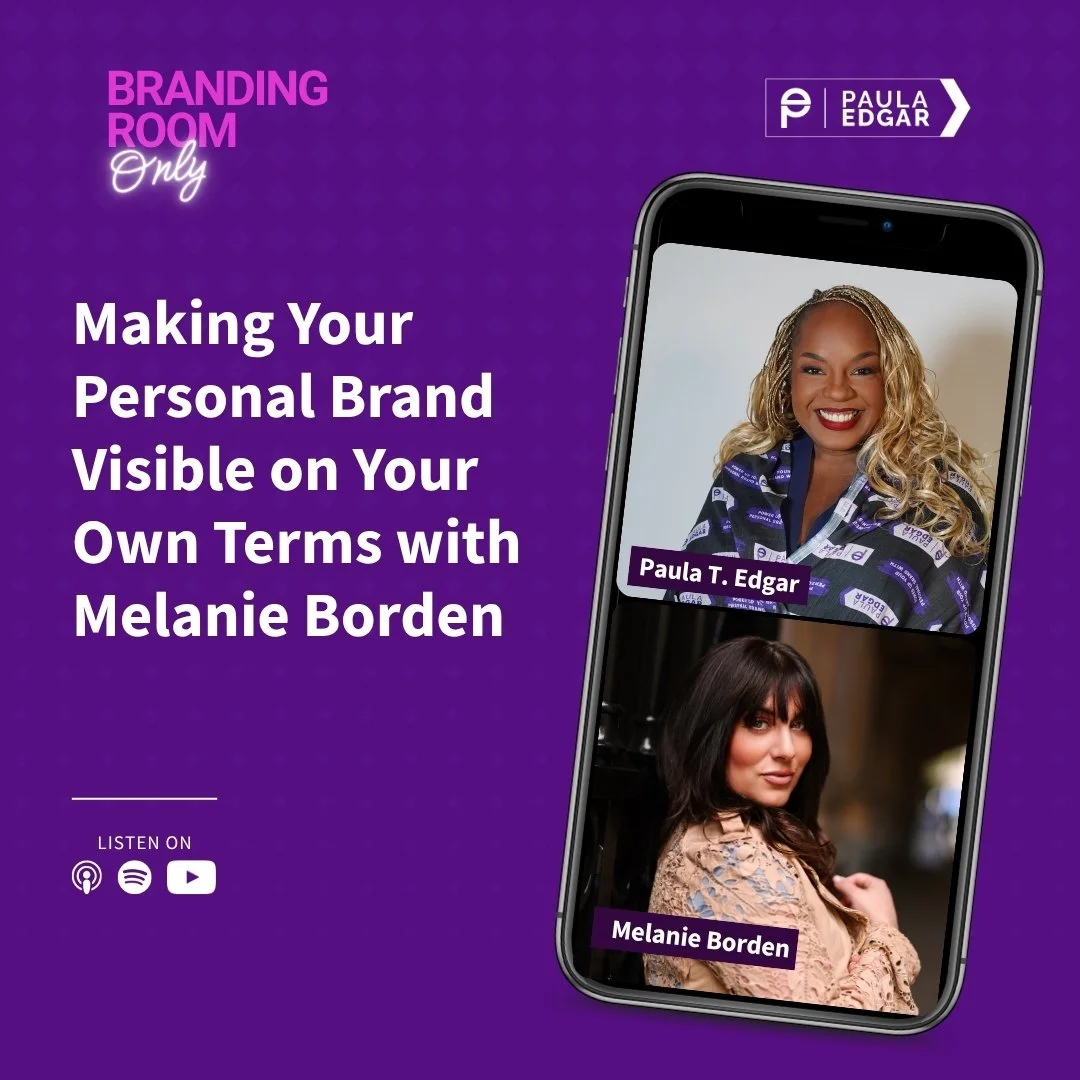
Hi everybody, it's Paula Edgar, back in the Branding Room. I'm very excited for my conversation today, let me tell you about my guest. Melanie Borden is a founder, author, speaker, and executive visibility strategist who has spent her career helping leaders and companies build authority, influence, and trust. She's the founder of the Borden Group, creator of the Visible Leader app, and author of Theater of the Mind. Now she’s also building Dirty Hippie, a tech-enabled market place, modernizing how people discover, book and manage laundry and garment care. Can’t wait to hear about that. Melanie, welcome to the Branding Room.
Melanie Borden: Thank you so much for having me.
Paula Edgar: I'm really excited for our conversation. So I'm going to start off the way I start with everybody, what does personal brand mean to you? How would you describe it?
Melanie Borden: You know, I think that personal brand is really what people think of you, the essence of who you are. When you're in the room, when you're not in the room. But it's really, on an individual level, it represents your aura, and everything about your own operating system.
Paula Edgar: Oh, I love that. Operating system. I love to say magic, but I like operating system too.
Melanie Borden: I like that too, I like magic.
Paula Edgar: So tell me, how would you describe Melanie, in three words or short phrases?
Melanie Borden: You know, I love this question so much. And I had to really think about it, and this is just such a great exercise in general, and I just, it made me think back to one point, doing this exercise about 8 years ago. Okay, I would say I am curious, I am relentlessly resourceful, and I'm willing to figure it out.
Paula Edgar: Love that. Okay, now do you have a favorite quote or motto that you are currently thinking about?
Melanie Borden: Yeah, something that I’ve been thinking about for the last 12 weeks is more of my own philosophy, that I'm living, that I have you know talked about for years is. You don't know, you don't have to know the entire picture before you start working on what whatever that thing is. You can start without knowing. And a lot, a lot of what entrepreneurship is about is starting without knowing. And when it comes to your personal brand, you just don't know what it is going to evolve to and what opportunities are going to manifest as a result.
Paula Edgar: I love that and I, I take that, I like to say, that my podcast is with my own personal therapy. So, so it really is a reminder that you don't have to, you can have progress over perfection. You can move forward when you don't have all the answers. And so thank you for that reminder, and all of you need it too. So I'm glad that you gave it to us. All right, what about this? What is your hype song when Melanie’s going out onto the stage, what is playing in her head?
Melanie Borden: So, contrary to what a lot of people do, for myself personally, I need to be in a mental space of calm and relaxation, and I would say, you know. I would say, when I'm, even when I'm working at home, I have iHeart on, and I have classical music playing. Because for me, listening to you know, I imagine like in the 90s like Yanni, you know? I imagine like, something calming. Because when I'm calm, it's easier for me to get done what I need to do. And especially when I'm speaking, or pitching, or whatever the case is, I need to have a clear head. So for me, you know piano music, classical music, that kind of helps me get there.
Paula Edgar: I love that. I’ve been listening to the Bridgeton soundtrack, like for each season. And how they have all the pop, pop culture songs but they're done, you know, that old-timey way. It actually is very calming. When I get on the stage, I have to feel like I'm going to run on like football player. And I like Prince, I like Prince, Baby I'm A Star is my hype song. Like, I’m playing it, I’m running out, I’m like “hey, you’re a star, lets go!” But I’m going to try to do a chill one and see what happens. I don’t know. I have a whole ritual of like, what I have to wear, all the way down to the underwear. And, I’m in a thong. I have issues, it’s all good. So tell me this, where did you grow up, and how do you think that shaped you?
Melanie Borden: So, I grew up in Northern New Jersey, where I currently reside. I actually moved back to my hometown after living in New York City for years, and then I also lived in Hoboken for a long time. I moved back to my hometown. I'm living in the neighborhood actually, that I grew up in. And you know, there is a reason there's so many famous people and successful entrepreneurs who are from New Jersey. I don't know if it's something in the water in New Jersey, or it's just, people are so direct that you just kind of get it and keep going. But I definitely think that it's helped me become more resourceful. You know, a lot of my career, I feel that has required me to go into situations where, I'm not comfortable. And I do believe that kind of being thrown to the wolves you know, in many situations. And also the time that I grew up. Like, I grew up in the ‘80s and the ‘90s. So, it was just a different time where, you just kind of had to figure things out.
Paula Edgar: Yeah, I think of Jersey Girls as like hustlers.
Melanie Borden:Yes, yes.
Paula Edgar: They’re going to get it done. Similar to us Brooklyn girls. Speaking of your career path, tell me about your career path. You've worked sales and marketing, tech companies, retail, you've done a lot. And now you are an executive visibility strategist. Tell me about that path?
Melanie Borden: So I mean if you had asked me in 2002 what an executive visibility strategist was, I probably would have said “I have no idea what you're talking about.” But growing up I wanted to be an artist. I went to the Fashion Institute of Technology for jewelry design. I do hold a degree from the school, that I have never once used, but it was really great from a social perspective. And also, kind of seeing things happen in real time it exposed me to so much culture. As, you know, New York is a melting pot of everyone from every background, and when I was growing up in northern New Jersey, it was not like that. And so, living in New York City gave me exposure to just, this other world that I never had access to. So, even though I never use my degree, it was great from the access perspective and really just understanding what other possibilities are. And I've always worked, I worked all through school. I had probably like five or six different jobs when I was in college, just to afford to live in New York City.
Paula Edgar: I get that.
Melanie Borden: And at one point I came to a crossroads where I decided I didn't want to be in school anymore.
The school that I went to, it's a four year school, but you can get a 2 year degree. And I had opted for a 2-year degree. My parents wanted me to go for four and I said “I really don't want to do school, I want to work.” Because I was in, I wanted this lifestyle in New York City. And my dad was like “Well, have you thought about how you're going to afford to live in New York City?” And I said “I don't know. I mean you're going to help me.” And he was like “No. You're not, we're not, we're not helping you. You have two choices–
Paula Edgar: Oh geez.
Melanie Borden: –you can move home, and you can commute to New York City, so you can still have your lifestyle that you're dreaming of. Or you can get a job, and you can pay for your own way.”
And so, I went and looked in the New York Times, and I found a job in advertising sales. And that was my first job. I was, you know, under 21. It was my first real job, you know, earning money. At the time, it was so much money, for a single person living in New York City. But as you know, as someone who lives in New York City, how expensive it is. And how it’s always been. And, that's really how I got into advertising and marketing. And then one thing led to another, and I just, I started working in the Auto industry. And then in the Auto industry, I held different roles from working in sales and business development, to working in marketing, building an in-house agency in retail, to working at a tech company as their veep of marketing. And during the pandemic, I started posting a lot on LinkedIn.
And people got to know me through LinkedIn because I talked about what I was doing, I talked about the things that inspired me, as you know at that time there wasn't a lot of people leveraging LinkedIn like it is today.
Paula Edgar: Yeah, yes.
Melanie Borden: And everyone's trying to figure it out now, and I was trying to figure it out in 2020.
Paula Edgar: Yes.
Melanie Borden: And what started happening to me, Paula, people would come to me and saying “Hey Melanie, can you do for me what you did for yourself?” Because I created something from nothing, just from showing up. And it created opportunities for speaking, you know, podcasts, conferences, just opportunities that were coming to me. And I really couldn't take them, because I was working at the time for someone else. And when you're working in tech, and a lot of times not even just limited to tech, but even if you're working for someone else, they don't want you to be doing something on the side.
Paula Edgar: Yep.
Melanie Borden: And it's usually written in the agreement. I mean this is the case across legal, healthcare, it's very common in many industries. And even though I was at a VP level, I didn't have the ability to do what I wanted to do, which was, you know, kind of figure this out. So I quit my job in 2021 and I started a consulting business called Melanie Borden LLC, which quickly turned into the Borden Group, because I got really busy and I had to hire people to help me. And you know, the rest is kind of history.
And I've done a lot of different things over short period of time, but I really attribute a lot of it to really, what we were talking about before. Like, being from Jersey, putting yourself out there, making yourself uncomfortable, and getting used to being in situations that you don't necessarily want to do, but you do them because it's another way for you to get where you want to be. And it just, every time I see it with clients, every time I experience it myself, it's that magic that you talk about. But it's also, something that enables you to create something out of nothing. But it’s not nothing, because you have years of experience. And so, in earlier this year, in January I wrote a book called, well it took me a couple years to write it. But I published it in January, under my own publishing arm, which is House of Lola, and the book is called Theater of The Mind. Which is about what happens to you when you're putting yourself out there, and I use client story case studies, I use my own stories and strategies and tactics and all the things that someone can expect when they are going to market for themselves and putting themselves into this new situation of building their personal brand in front of everyone.
Paula Edgar: And there’s so much to your point about, people leveraging LinkedIn now, and they were doing it that much now, and of course with AI there's, so much is going on. People are really thinking about this now. One of the things that you have said is that you built your brand at the time where a lot of people, like you said, so many were losing their jobs. So what are you, like thinking about that uncertainty that comes from that, like, not having a title, not having a role, and then how do you use that uncertainty to have those marketing frameworks that you apply for other people and for yourself?
Melanie Borden: Yeah, so I started thinking about if this job disappeared tomorrow, what would I do? I mean, what would I actually own? And I had not spent any time, really, working on my presence. I had spent so much time working on, at one point I was working for a CEO, and I was handling all the marketing for all of his businesses, in the auto industry and related industries, and I just never thought I needed it. I just thought I know enough people and, what I started to think was okay you know who is the audience? I started really treating everything as if, you know, everything that I was doing, as if I was a company. I was watching people lose their jobs. Where I was working there was about, you know, we'll call it 400 people who were laid off. I was not, I feel very guilty at the time that I was not laid off. And that all these other people were, but I started thinking well, what's, you know, and even though I have, I still to this day have a great relationship with that CEO, but what if I lost my job? What am I going to do? Am I going to go chasing recruiters? I didn't want to do that. And I really just felt so strongly around LinkedIn, and I had just created a training for the sales team, and I really had to start putting the, you know, turning the table back on myself and just saying to myself “You know, what do I want to be known for? What do I want to do? What's the point of me doing this?” “How am I going to let people know? And how I'm going to find people?”
I didn't want to go via Facebook or Instagram, or even X, because you couldn't really see into who you were talking to. Versus if you know you and I are engaging with each other's posts, and I click on your post, I can see who you engage with, I can see your job history, I can see who you work with, I can see the company work for. And so, that really changed my career. I mean it really did. And everyone always says “Well, you did it so quickly.” It wasn’t that quick. But I just, put a lot of focus, energy, and time. And I'm not unique either, anyone can do this if they really want to do it. They can do it.
Paula Edgar: Yes you are unique.
Melanie Borden: Thank you.
Paula Edgar: You know, I think that I started to follow you on LinkedIn during that time. ‘Cause I saw you, or something, that I joined your mailing list. And you're one of the people who I'm like, I really wanted to get you on the podcast. Because I love what you talk about when it comes to, number one, you got to, no one's going to talk about you for you. You got to talk about yourself. You gotta put yourself up, gotta make sure people know who you are and how you add value. And I think that a lot of people think of this as self-promotion and braggy, but. You say that visibility is about being understood, trusted, and chosen by the right people. What does that look like in practice?
Melanie Borden: I mean, what it looks like in practice is having an understanding of why you're doing, what you're doing, right? And understanding and having specific goals that are structured, that are able to bring you closer to whatever those goals are, and being able to speak to those people that you know. You know, a lot of times, and I'm sure you hear this too Paula, because you work in the same space with personal brand. You know, it's not just putting out a post and saying “I have a personal brand.” It's being intentional, it's being thoughtful, it's understanding who you're talking to, and knowing like, what keeps them up at night. And being able to craft content so that, brings them closer to you. And it's not just content, it's, it's everything. It's color psychology, it's fonts, it's logos. I mean it's, but it's also a feeling that people get, and know that when they think of something specific, they're thinking directly of you.
Paula Edgar: Yeah, yeah. I love that. That’s a perfect way to describe how to put it into action. And you know, I'm sure you find this too, there's a lot of people who are like you know “I don't I don't want to be on LinkedIn, I don't want to put myself out that way. Can I still build my brand?” And the answer is yeah, like we're building it online to have it in real life, as opposed to the other way around. Do you hear that resistance often?
Melanie Borden: Yeah, I mean, listen. It's not comfortable for anyone in the beginning. Everyone has to go through some part of this, you know, they call it cringe, or you know, embarrassing yourself, or being unsure, or not knowing what the end looks like. But that's the process. And, if you know, it maybe it's like maybe it's podcasts, maybe it's Instagram, maybe it's Facebook, you know? Maybe it's, you know, it’s writing op ed’s in a specific journal that your clients or potential audience are reading. But you have to start somewhere. And it's just a matter of, there's, a lot of people wait for the timing. They wait because, you know, they are looking to get funding from investors, and they're afraid that if an investor researches them, that they might post something that might not get them funding. Or perhaps they're looking for a new role, and they're afraid that the board where they are working are going to start questioning them or giving them a hard time. These are all entry points that you kind of have to just walk through the door anyway, with just not knowing what the answer is going to be on the other side of those doors.
Paula Edgar: Yeah.There's no matter what, even if those things are happening. I think there's still more benefit in putting yourself out there consistently, than not. And waiting, and being concerned. You know, my therapist, love her, so, says “Growth begins where comfort ends.” And so, she's like “Never be comfortable.” But you have to always be doing something that's pushing you in a new space, entrepreneurship journey, certainly that.
Melanie Borden: Yeah, it is. And. And listen. It’s not, you know no one is judging someone who’s already doing the thing. And I think a lot of people get nervous about what's happening in their career that, you know, their family might not understand, their friends might not understand, the people that they're together in life with, you know, they might not understand, your business partner might not understand. But it's not, it's something like, people buy from people they know, like, and trust. People invest in people they know, like, and trust. It's, you just have to just, kind of, get comfortable with being uncomfortable. And that's really, yeah that's, that's definitely the entry point.
Paula Edgar: So speaking of the know, like, and trust framework, AI has been everywhere and talked about by everybody, all right? You can't go walk, you know, going to the corner store Bodega and they're like “We got a new AI.” I think everything is, okay what do you think about how AI is changing how professionals established productivity, how they become discoverable, and how they become a trusted authorities like, basically all the things that we were talking about in terms of the need for branding?
Melanie Borden: So, for years we thought that we were basically only speaking to humans and that's the only way that we are going to be discovered, is by other people. So hiring committees, or you know those in HR, founders, executives. But essentially, the way that I think about it is, we're speaking to three audiences. You have that human layer, you have Google search, and then you have the machines. And so, the machines are interpreting us too. And it's changing every day. I mean AI is moving so fast, that it's just synthesizing information across, everywhere. And it’s really helping humans, make those decisions. So that means you have to be clear. You know, I was talking to a client this morning and I said “You need to think of three to five topics that you are strongest in, because it's going to be easier for machines to understand what you stand for, what you can speak on.” And then it also helps potential, you know, employers, that helps potential HR, when they do a search for you in a large language model, like ChatGPT. You want to like, you want to know that it’s going to come up the way that you want yourself to be represented. And transferring that. So. What sometimes happens is, when they're finding people it's not interpreting them. And so, it's not understanding what you're the expert in. And that's really something that people aren't necessarily thinking about in their day-to-day, because they're like “Well I just finally started posting on LinkedIn, now you have to tell me that I have to start worrying about showing up an AI?” And that's a conversation that I have frequently. But there are micro tweaks that you can make, like going on a podcast to talk about what you're doing,
Paula Edgar: Yeah.
Melanie Borden: Having a landing page that talks about what you're doing. And then just making sure that you're continuing to talk about those three to five things consistently.
Paula Edgar: Yeah, I think that intentionality is where a lot of people get lost, right? That, that not having that framework. And I, I at times am guilty of this too. I would say, I have my pillars, and then I have like, whatever the hell I want to talk about. Which is still fine, as long as the pillars are there. But given the frameworks, and how they're shifting with all these algorithms, it is more of a risk of not being found, things not being seen, if you, outside of the places that, in which of the machines know you for. So everybody listening, be think about what it is that you would like to be found for. And even if you are employed right now, you’re still on expert in something. You still can share, and you can still have that, that trust established, even if you're not sure of the specifics of what you're going to talk about, in terms of you or your expertise. I hear this from a lot of lawyers who are experts in a lot of places, but they're like “But what should I talk about? I'm like “Look, just talk about something first. And then we can figure out all the other narrowing pieces.” But you have to make sure people can find you, and now people and AI and other robots.
Melanie Borden: Yeah, I know. It’s really like the Jetsons.
Paula Edgar: Excellent. I love the ‘80s baby. That’s exactly, yes. It is like the Jetsons.
Melanie Borden: Yes.
Paula Edgar: So tell me, because it's my favorite question that I ask people, which is, what mistakes do you see people make when it comes to building a brand or establishing their visibility or not visibility. What are the biggest mistakes?
Melanie Borden: I think it ties back to what we were just talking about. I think that number one, people think that content equals visibility. And so that's, that's one piece of it. And then take it a step further, they think that volume equals visibility. And so what we're seeing and this is how, we now have an AI slop button on LinkedIn. People are like “I haven’t posted anything, and I need to get content out because I’m supposed to post 7 days a week, 5 days a week, 2 times a day.” However many times. So, people are putting out content, but really what they’re doing is they're actually watering down their message. And what they're actually good at, because they're using something for volume versus, or just finding someone else's post copy and pasting. You know, reimagining it. And not really using their own perspective. And they're outsourcing their voice essentially. And they're not, they're not authentic. And people pick up on that. I mean listen, I use AI all the time. I use it as an editor, I use it to find gaps where I might be missing something, I changed the flow all the time. I want to make sure that it's, you know readable for an algorithm. And I do that across posting, I do that across my newsletter, and my blog. But what I will tell you is, that the biggest mistake that people make is completely outsourcing their voice to AI. And then the mistaking the, the volume piece with visibility. Whereas, it’s better to have your authentic natural voice once a month, versus having, you know, five posts a week that are just coming from AI.
Paula Edgar: So, how often should people post on LinkedIn, Melanie? What do you think?
Melanie Borden: So, –
Paula Edgar: Authentically.
Melanie Borden: –people might disagree with me, but this is what I tell my clients. You want to be seen and you want to be ranked by the algorithm. However, you also want to be realistic, and understand what you can do. Listen, if you have an agency posting on behalf of you, that's different ‘cause you can have the agency post three or five times a week. But if you're doing it yourself, you want to post to what you can commit to for 6 months, realistically.
And if that's once a week, then post once a week. If that's once a month, or once every two weeks, then do that. And then, as you build momentum you're going to want to post more. But what happens a lot, and this happens with me a couple years ago. I was posting so much, I had so much content, and I wasn't creating anything new because I've been posting for so long that I was just reposting content, maybe changing a few things, but posting the same content, because I didn't want to create anything new. Because I was so busy that I just, kind of, had it on autopilot. But I think when you can commit, realistically, to a cadence and a schedule that works for you, and timing that works for you, that's what I think the best method is.
Paula Edgar: I love that, because it gives people the agency to do what it needs to be done, but for them. And you know, people ask me all the time “Paula, you post all the time.” I actually don’t post all the time. I post 3 times a week, consistently, and thats why you see me. Because it’s consistency versus the volume. So I’m glad I do think it is the mistake, that you, you called out is, is a correct one. That, you’re losing voices. Like LinkedIn used to be like my, I loved, love LinkedIn. Not used to be, I love it. But I feel like it’s lost some of it’s pizazz, because of that AI slop. I don't know how they're going to navigate that button. Because I do think it's it's a subjective in terms of what people perceive. And, and we shall see how that navigates. But I do think things are changing swiftly, swiftly, swiftly.
Melanie Borden: Yeah. I also. I mean LinkedIn changes so many features they put out features for everyone to try and test and then they sunset them. Like the one feature I wish they would bring back or the stories.
Paula Edgar: Yes! Yes that was–
Melanie Borden: It was such a great feature.
Paula Edgar: –Yes, agreed. Agreed, agreed, agreed. And I liked, like it the way they showed videos before. Now they show videos, at least in your mobile feed. It looks like Instagram, and I’m like, I don’t want. I already got an Instagram. I don’t want, I don’t want two. Like –
Melanie Borden: Yeah.
Paula Edgar: So.
Melanie Borden: Yes.
Paula Edgar: But anyway. So. You told me about Theater of the Mind and what it’s about. What do you think, the role is that fear plays in keeping accomplished leaders invisible?
Melanie Borden: Oh it's a huge factor in keeping them invisible. That's the main reason that I wrote the book, is because when I started doing this work, I started experiencing over and over, and over again ,different people at all different levels, who were coming up with reasons why they couldn't move forward, or they didn't move forward, or telling me the reasons why they didn't up until that point. I will tell you that when I'm working with clients my sales cycle is very long, in terms of before someone hires me. And what I usually hear on discovery calls is “I've been following you on LinkedIn for 2 years, 3 years, 4 years, 5 years and I didn't hire you because I wasn't ready.” And that's something that I hear a lot of, and I bet you hear it too.
Paula Edgar: I do, I do.
Melanie Borden: Because people think that you have to have this perfect moment, or the deal has to go through, or there's something very specific that's going to happen in order for them to kind of take shape, the next level, you know? A lot of things that I've experienced, again as a founder and I'm working kind of through it with myself is. What if no one cares, what if it looks like I'm bragging about this? And that's something that is real. I mean this is really real. What if it affects potential investors, you know? Am I saying the right things? But ultimately what I always tell people, and what I know is, if you do a post it could turn into a conversation. That conversation can turn into a referral to someone else, or it can turn into a partner, it could turn into an advisor, it could turn into a podcast, it can turn into some other form of visibility, it can turn into revenue, it can turn into investors, it could turn into anything.
And so, I think the perfectionism loop that people have, don't even call it perfectionism or don't call it fear, because they don't necessarily know that that's what they're doing. Because a lot of it is very subconscious, and I think also Paula, people who were born in the 1900s, like us. People who’re from the 1900s, you know, this isn’t something that is inherently part of the growth process, in your career when you first started working. It wasn't visibility equals leadership. Today that's what it is. If you're putting yourself out there regardless of the industry you're in, regardless of the role that you have, it doesn't. Everyone who does a post, doesn't mean that they're looking for a new job. It could be that they're leading, you know and helping or supporting talent acquisition, or retaining talent at their existing organization. Or maybe they have people on their team who really want to put themselves out there, and they're just kind of figuring it out in real time, to kind of lead as example. But that's not something that people are really brought up with, now it's very different because you have this whole different generation of people who are unfazed by these things. And just say “I'm going to do it anyway. Because I know that if I don't it's going to be prohibiting me to get to where I need to be next.”
Paula Edgar: Facts. I mean, truthfully, I do think the generational conversation around branding and, and it being a skill set is something that needs to developed and can be consistent on, is something I have over and over and over again. Because there's a bit of a resistance like “Oh I just put my head down, and I did the work and, and then people found me.” And I'm like “Well that's not how it works anymore, and I don't think it would be like that for the foreseeable future.” Just because we live in this fast pace, we want everything now, all kinds of different reasons as to why that's not the case. But the clash within workplaces, and I think just societally, is becoming very evident in this branding space. So tell me. You, in the book you're talking about psychology backed systems for showing up consistently, speaking with clarity, and turning attention into opportunity, without posturing. And I love this, or burnout. ‘Cause, again, it gets tiring. What are some of the core elements of that system? Tell us about it.
Melanie Borden: Sure, it really starts with understanding what you want to be known for, and why it matters to the people you're trying to reach. Whenever someone comes to me that has, let's say, they already have a successful online presence, and they're telling me that their presence isn't doing what it may have done for them years ago, or maybe months ago. A lot of times it's because they're talking more about themselves, and not helping the person on the other side.
So that's really where you can build some of the evidence around your positioning. Listen, you want to tell stories, you want to share your experiences, you wanna share your point of view, you want to show content, and search presence, and all this third party credibility. But, you also want to be of a mindset of a servitude attitude and really leveraging your experiences to think about that one person who's watching your videos, who's reading your posts, who's, you know, reading your newsletter, your blog, that you can really help. And I think it's a mindset shift of, it's not, in order for you to get to where you want to be. You can also lift others up with you along the way, and that's really helping others in your, in the process.
Paula Edgar: I love that. And I, I think, and listen to the helping piece. Also I, also encourage people to have gratitude, about where they're at right then, right? Like, not where I'm going to be 10 minutes from now, but where I'm at right now. And, also thinking how can I, how can I be helpful. I just think those mindsets are really helpful in just, navigating pretty much everything. And given that the world is doing what the world does. And we also have goals and ambitions. I say “I’m ambitious with a capital A.” We still have to remember that there are things to be grateful for, and there are people that we can be of service with. Or service to, with our voices as well. So. I love it–
Melanie Borden: Yes.
Paula Edgar: –I love it, I love it.
Melanie Borden: Absolutely.
Paula Edgar: What’s one strategy from –
Melanie Borden: Certainly.
Paula Edgar: – the book that you think somebody should begin, should begin, could begin using immediately?
Melanie Borden: Search yourself as if you don't know yourself. There is a feature in Google called Incognito. So Google your name, search LinkedIn. Log out of LinkedIn and search LinkedIn. Ask an AI platform who you are and what you're known for. And then really look at those results objectively. And would a stranger, who you want to be speaking to, understand what you do, what your credible in, and what you're known for? This would be a really great way to identify any gaps, that you could potentially be missing. And it also gives you a baseline for where you need to work, if you're not coming up the way that you want to on these given platforms. You could see exactly where you're missing the mark. And that's one of the exercises that's in the book. And it's an exercise that I talk about a lot because, you don't know what you don't know.
Paula Edgar: Yeah, yeah.
Melanie Borden: It's a great place to start for anyone who's kind of, trying to figure out “Okay how do I do this? Like, where, which way do I go?”
Paula Edgar: Yeah. Like what that, that self-assessment, self-awareness, then you get to “Now what are the things I want to do?” But what are the visioning, and then the, we hit the strategy. But a lot of people skip the self-awareness, self-assessment piece and just want to go to the vision things. Like, yeah, that's not going to work.
Melanie Borden: Yeah. Absolutely. I think a big misconception is that people think a personal brand, equals narcissism and look at me energy. And that's not what it is. And if someone thinks and believes that, they just need to be educated, and they need to watch what someone else is doing. And so, that's a great way to kind of explore what's happening and how your brand, you know, appears online.
Paula Edgar: So, how has your personal brand evolved, as you have expanded from executive visibility strategy into speaking, writing, developing an AI-powered coaching app, and now building a technology startup?
Melanie Borden: It’s definitely changed a lot. But the reason it has changed is because I've shown up. And the showing up has really helped me with growing not only in my career but growing as a human. It's helped me grow, you know, as a mom, it's helped me grow as a friend, it's helped me grow as a partner, it's helped me grow in many ways. And, if I was still posting the same way that I was 5 years ago, that's okay. But for me, I have just really taken the opportunities that have come to me. I've said yes a lot, and as a result, and just from doing some of that internal work, it has changed. And as you grow and change, your presence is going to change too.
So, I primarily built my personal brand around, personal branding, talking about personal branding, and executive visibility. That resulted in me writing a book about the work that I was doing, it also resulted in me launching an app earlier this year called Visible Leader. And it's really, and talking about it, I mean like all my talks and the workshops that I do, are all about visibility and personal brand. And now that I've been building Dirty Hippie, I'm building in an industry that I'm totally unfamiliar with. I'm also a non-technical founder, although I know enough to be dangerous, with certain types of tech. But I definitely, I'm feeling things, and realizing that you don't need to be locked into one category, you can do anything. And you can make changes as you grow and change, your businesses will grow and change, your brand will grow and change, and that's what makes the world go round, is change.
Paula Edgar: Isn’t that the truth. I, I think –
Melanie Borden: Yeah.
Paula Edgar: –that through all of the different changes, it still seems like the core values that you have are the consistency, right? All the other pieces can shift, but that the core of who you are stays the same. Which I think that that’s important, how the people being able to trust you and your brand and whatever you're doing.
So, I'm very interested in this. So you had this idea about Dirty Hippie while you were driving home from a camp visiting day, and thinking about the mountain of laundry that was waiting for you. So, how? Okay, my son just got back from six weeks of camp, this resonated very deeply. So I’m like, okay. How did you take that frustration that we all have, to becoming a business idea that you just couldn't put down? Tell me about this?
Melanie Borden: Yeah so, I could. So, both my kids now are going to sleep with camp, and I just want to preface this with I currently in my garage have like 10 garbage bags full of their stuff, that still need to get cleaned. But, when I was driving home last summer, my kids go to sleep away camp in New Hampshire. When I was driving home I was like “Okay there's got to be some sort of a marketplace app, like a Doordash, or an Uber Eats.” Because it's, if I need to get groceries I press a button, and it's on demand. If I want to order from a restaurant, I press a button and it's on demand. But if I have laundry, my own dry cleaning, maybe specialty items, like I have boots, or you know leather jacket or fur coat, or whatever the case is.
There is no on demand button, and I couldn't stop thinking about the fact that, there was no service that connects people with local businesses that will come to your home, pick it up from you, bring it to one of the local cleaners, get it cleaned, bring it back, and you don't have to do anything. I mean Paula, you're busy woman, I am too. And I don't have time to do laundry, and dry cleaning runs, and you know, someone might say “Well, why don't you just have a personal assistant? Or why don't you just have a housekeeper?” Well, I want something easier than that. I want to be able to press a button, and it, just get what I need. And I know that I'm not the only one. So that’s how Dirty Hippie was born –
Paula Edgar: I love that. I love the name, and also you are not. As I’m sitting here I’m like “Yes, yes. I need that, yes.” –
Melanie Borden: Yes!
Paula Edgar: Yes. I need that. Yes. And I know a lot of people need that. It’s also, I always think about this. It’s also, it's like I could do it. Is that a good use of my time? And how can I outsource the things that frustrate the heck out of me, so I can put my power and my magic into the things I’m building for me and my family’s legacy. And that ain’t laundry.
Melanie Borden: Exactly!
Paula Edgar: So.
Melanie Borden: And you know the more I've done, the more research that I've done the more time that I've spent in this industry. It's a space that hasn't been innovated in 50 years. In the United States, there's about 30,000 laundromats. There is no technology layer that sits on top of laundrymats, dry cleaners, specialty cleaners, eco friendly, there’s nothing. So I've just decided that I'm going to be the one to innovate it.
Paula Edgar: Love it.
Melanie Borden: There's lots of competitors that do it in a silo, right? There's local cleaners where you can have schedule pickups and delivery. There’s local laundromats that can do it. There's apps where you can press a button, and they'll pick up your stuff, and they'll bring it to a warehouse. But, I want to use local businesses, just how when I am on Doordash, I'm ordering from restaurants that, I might not necessarily have found before. So you know, maybe my children are allergic to things and I need someone who's eco-friendly, but the closest eco-friendly cleaner to where I live is 45 minutes away. So, there's so many pieces to this that haven't come out yet. And so, I'm just so excited about it and the name. Everyone loves the name! Which is actually, was a nick name for myself from my mother when I was a child. So–
Paula Edgar: Oh, I love that.
Melanie Borden: So. So that’s why it’s, it is what it is.
Paula Edgar: Oh, that’s hilarious. Speaking of brand, oh my goodness. Well, I’m excited for when you bring that to, to your point about being able to see what people need. People definitely need this, and. You know. I think about the fact that when I was in law school. And I was pregnant and I was like, local people with the bodega I was like “You have to bring me food, to class, ‘cause I have his baby inside me but I can't leave.” Right? So that was like Uber Eats before Uber Eats was there. But I was just making a thing. And again, all it takes is and idea, and somebody entrepreneuring, like yourself to take it and go run with it. And so I'm excited for what you're going to build with this. Awesome.
Melanie Borden: Thank you. Thank you.
Paula Edgar: So, what about the fun stuff? What do you do for fun?
Melanie Borden: Oh, That's a good question. Well, I’m a life long runner. I’ve been running since I was 12. I’ve been getting into running with my 12-year-old, –
Paula Edgar: Oh!
Melanie Borden: -it’s a lot of fun. I also love fashion, you know, I did go to FIT. But, I'm excited about the fact that, now I think I can classify myself as working in the fashion industry, big full circle with Dirty Hippie. But I am endlessly curious about health and fitness, and I've been on a fitness journey, I would say probably, since the pandemic time. So, I run in a lot of races. I'm really into endurance sports.
Paula Edgar: Okay.
Melanie Borden: And, and yeah. And I love working. Part of why I think you see so much from me. It’s fun to me.
Paula Edgar: I love this answer, asking this question because, some people are like “I love tequila.” And then some people are like “I love to run.” And I'm like, I'm only running unless somebody is chasing me, and then I'm just going to throw my wallet at them.
Melanie Borden: That’s so funny, yeah.
Paula Edgar: I love that –
Melanie Borden: I will tell you –
Paula Edgar: Yeah
Melanie Borden: – I will tell you, Paula, that I stopped running for about 4 months because I had a doctor tell me that me running is me telling my body that I'm being chased by lions in the jungle–
Paula Edgar: What?
Melanie Borden:-- so I stopped. I listened to this doctor and I stopped running. But I recently started running again, ‘cause I was like “This is crazy.” I love to run.
Paula Edgar: Being chased by. Well okay. I get that they trigger that thing in our brain, that fear thing, I guess? Like. But still, that’s, that just sounds odd. So okay, I ask everybody these same two questions. One is, stand by your brand. What is the authentic aspect of your personal brand that you will never compromise on?
Melanie Borden: Being recognizable as myself. I don't want to create a version of myself, that is one way online and is another way in person. I will tell you that over the years, I've met a lot of creators on LinkedIn and other platforms where they are not the same people that they portray themselves to be. And I do believe that you can be fully yourself, and also be fully professional in what you do.
Paula Edgar: Yeah. It’s so disappointing when that happens too. You know that whole likability thing when you feel like you know somebody, and then you meet them it's like “Oh yeah that's not what–
Melanie Borden: Agreed.
Paula Edgar:-- you look taller online. Like, sorry I’m 5’2”. I talk–
Melanie Borden: Yeah!
Paula Edgar: I talk tall, I talk tall. So as we mentioned before we got started, the podcast name is Branding Room Only, which is a play on the term standing room only. Because I’m clever. And so, tell me what would there be, what’s about the magic of Melanie would have a room filled to the brim? Standing room only, to experience about you?
Melanie Borden: I believe I can see things in people, and I can lean into my intuition and connect dots that people don't necessarily see about themselves. I can listen to someone's career, their experiences, their ideas, and I can find a thread that connects it. And I do believe that, leaning into the intuition part and kind of just trusting my instincts has really helped benefit me in ways that I only started realizing in the last year so that were beneficial.
Paula Edgar: I love that. I love that. Well, tell everybody, how they can find out more about your work. Obviously we’re going to put all the links in the show notes, but I’d like for you to say it yourself, too. Where can they find ya?
Melanie Borden: Sure, you can find me, everything that I do is on my website, which is melanieborden.com so you can find information about the Borden Group. You can find information about events that I'm doing, anything that I'm speaking on, Dirty Hippie, House of Lola, pretty much anything, my blog, newsletter it's all on melanieborden.com all my socials, all the things.
Paula Edgar: Fantastic. Melanie, I knew this conversation was going to be one that I love, I loved it. You’re welcome to come back anytime you want to talk about anything. I’d love to have you back on. Thank you everybody, tell a friend, tell a friend, to tell a friend to listen to this podcast. And I’ll stand by your brand, we’ll see you next time. Bye.
That's it for this episode appreciate you hanging out with me and Branding Room Only. Now please do me a quick favor head over to ratethispodcast.com/branding so more people can join this conversation. And make sure to stop by paulaedgar.com/events to see what’s next, whether I’m live, online or in person. I’d love to see you there. See you next time in the Branding Room. And until then, stand tall, shine bright, and always stand by your brand.