Paula Edgar: Welcome to Branding Room Only, the podcast where your personal brand gets a front-row seat. I'm Paula Edgar, and if you're here, it's because you know your brand isn't just about what you do. It's about how people experience you. In each episode, you'll hear stories, strategies, and lessons from leaders and influencers who built their brands and made their mark. And I'll share the tools you need to do the same. Let's go.
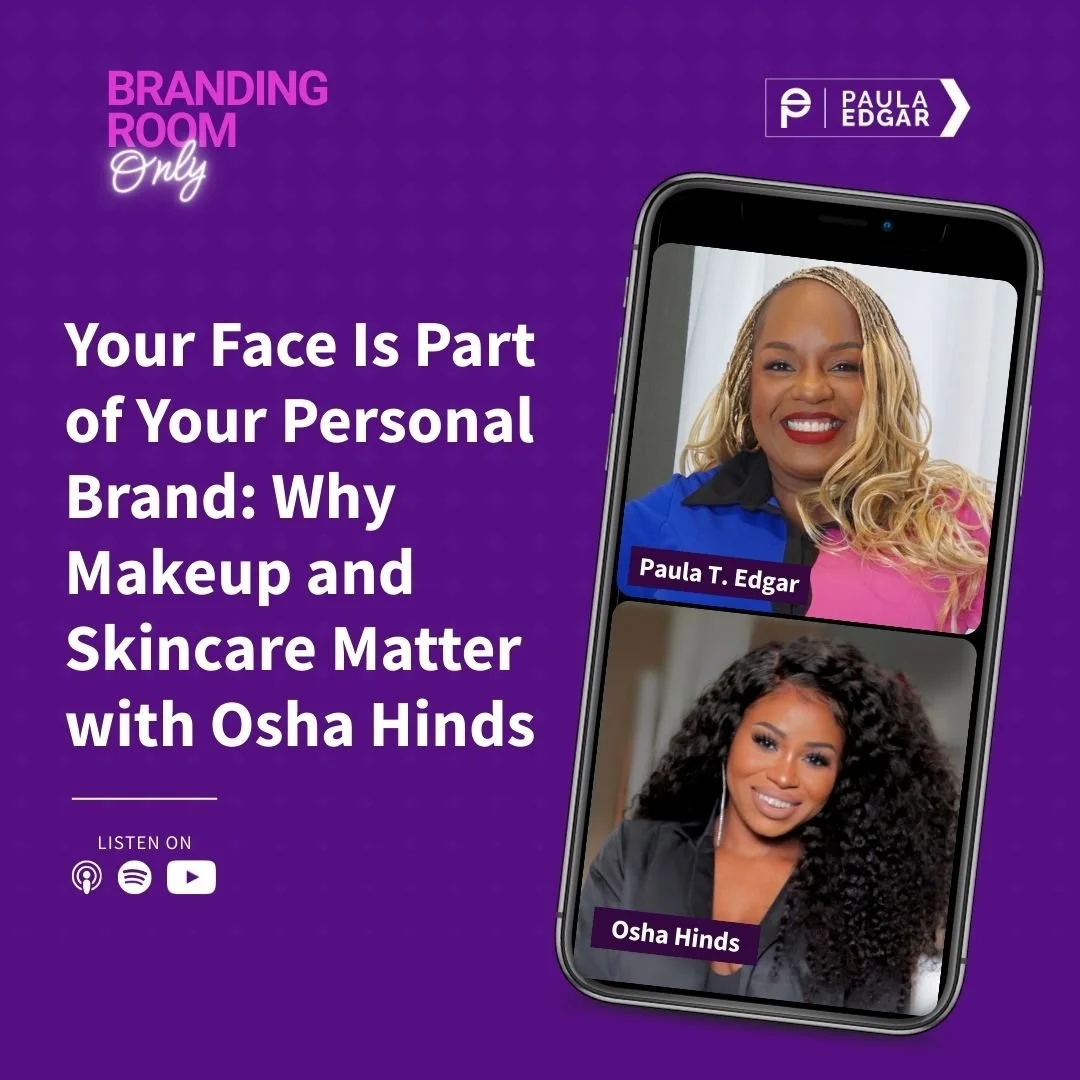
Hi, everybody, and welcome back to Branding Room Only. It's your girl, Paula T. Edgar. Happy to be here with one of my favorite people and one of your favorite people, too. Whether you know it or not, you're going to know it in a minute. My guest today is Osha Hinds. She is the creator of That's My MUA Artistry. Most importantly to me, she is my makeup artist. She's been doing my makeup for over 10 years. So anytime there's something important happening in my life and I am in New York, she is the one who is doing my face, so you're welcome in advance. Osha, welcome to The Branding Room.
Osha Hinds: Hey, everybody.
Paula Edgar: So you've probably heard me talk more than most people about what I'm annoyed about when it comes to personal branding. But what does personal branding mean to you?
Osha Hinds: So personal branding for me is the utmost representation of your brand, your image.
Paula Edgar: So, okay. That's a wonderful baseline in terms of representation of who you are. So how would you describe yourself in three words or short phrases?
Osha Hinds: For me, let's see. Dedicated, for sure. Hardworking. Talented. That sums it all up.
Paula Edgar: I would agree. I sometimes take the privilege of defining the three words for you, for me as well. I would say definitely put the A in artist. Also, uplifting and consistent as well.
Osha Hinds: Absolutely. That much I do know.
Paula Edgar: Tell me, do you have a favorite quote or mantra that you use to navigate your life?
Osha Hinds: Absolutely. So for me, I like to think about “the time is always right to do what is right.” That's from Martin Luther King himself. So for everything I do in reference to making decisions in life, I never hesitate to be like, "I'm not going to do it. No, let's just do it. The time is right."
Paula Edgar: I love that, especially in the times that we're in now. There's so much in terms of people thinking about what is right and what needs to be done in terms of rightness. So I like that as a quote. What about this? So I'm really excited to hear what your answer is here. So I ask everybody what their hype song is. This is the song when they're going to get full Osha, 100% Osha, what's playing in your head? Or if you're having a bad day, what song are you using to pick it up? It could be the same song or a different song.
Osha Hinds: For me, there's one song that I—my sister even knows, like, that's my jam. It's a soca song called—
Paula Edgar: I knew it was going to be soca. I knew it.
Osha Hinds: Give It To Ya by Marzville.
Paula Edgar: Come on. Yes.
Osha Hinds: If you walk in my studio and it's playing, we are on the up and up right there.
Paula Edgar: A fan as a Bajan girl. Love me some art. Like, that's a good one. I won't sing it to y'all because that wouldn't be fair. Okay, so tell me about your career trajectory. How did you get into makeup artistry? You know, when you were a young child growing up in X, what is that? Tell me about that path.
Osha Hinds: So my path didn't start off in makeup artistry. I wanted to be a fashion designer. I told everyone I was going to be a designer. My family, they're all designers. I was like, "I'm going to move far away." So I went to school in L.A. What happened is every time I went somewhere, I also picked up modeling on the side. That's what paid my tuition. Every time I went somewhere, someone was always like, "You look like a makeup artist." I was like, "I don't do makeup." I had on, like, some Wet N Wild eyeshadow that I loved.
Paula Edgar: Shout out to Wet N Wild. First makeup [inaudible].
Osha Hinds: It's like an iridescent purple.
Paula Edgar: Yes.
Osha Hinds: I used to wear that with some mascara. One lash up, one lash down.
Paula Edgar: On purpose?
Osha Hinds: No, I didn't know how to do lashes.
Paula Edgar: I was like, "That's different."
Osha Hinds: Then that era was when very thin eyebrows were in. So that's when I got my basics into getting into artistry. But I still wouldn't have considered myself an artist. But everywhere I went, it was like that. That's it. I was like, "I'm a designer. I'm not a makeup artist." However, I finally gave in and got my foot wet a little bit and had a little, little kit. This photographer was like, "Oh, I actually need a makeup artist for this model. Would you be able to just help me out?" And I did. Lo and behold, that opened up the door. I said, ta-ta. I was like, "Ooh, I get to make money. I still get to be a creative." People love getting their face done.
Paula Edgar: Well, we'll hold on that because I love getting my face done. I don't know that. The reason why we're doing this podcast is because not enough people. So there's that. So I want to make sure I close the circle because I didn't ask you the baseline question I usually ask, which is where did you grow up? How do you think that shaped your brand? So I know the answer, but tell the people.
Osha Hinds: Well, I grew up in Maryland. I'm from Brooklyn, New York. I grew up in Maryland. Very different back then. Very suburban. So I never had the vision of makeup, per se, because that's not what was the norm in my neighborhood. Like, we were kids. We were teens. We couldn't even walk in heels. It was so many things. But I just knew that I loved to make clothes. I loved to design them.
So I would say when I was about 18, 19, that's when I was like, "Wow, it all ties in together." When you get your experience on set and you're like, "Okay, the model needs hair. The model needs makeup. The model needs clothes. The model needs a stylist," I even became a stylist temporarily in D.C. So that's where I'm from.
Paula Edgar: But you're from Brooklyn. I got you.
Osha Hinds: But I'm from Brooklyn, yes.
Paula Edgar: It's an important piece. I was just talking to this woman yesterday and she was challenging me about the fact that people are part of your brand. So when I'm talking to people about personal brand, I always say your network is a part of your brand. She was like, "Well, I don't believe in that." I was like, "Let me show you it quickly. Where are you from?" She was like, "Brooklyn." I was like, "What part?" Then she said Brownsville. I was like, "I'm from East New York." Then all of a sudden we were connected. Because there is a shared experience and understanding when you have that background, whether or not you're from the same place, et cetera, it helps to help the navigation of what we know about each other.
Osha Hinds: So true. I would definitely say like New York, the Mecca of beauty for sure. I had to move back here to really get into makeup.
Paula Edgar: Tell me about that part. After you had your little kit and you hooked that one person up, what made you—
Osha Hinds: It was a ripple effect after that. I started working for Sephora. I was walking by. They're like, "Hey, you look like you know how to do makeup. You want a job?" I was like, "No."
Paula Edgar: Which Sephora was this? They're just doing our job?
Osha Hinds: Right. This was in Rockville, Maryland. My best friend was with me at the time. She was like, "Girl, I had took my first job at Macy's making $7.50, folding up men's clothes. I lasted four days because the check was absolutely nothing." So when Sephora came around, she was like, "Girl, just do it." I was like, "But I'm not a makeup artist. I don't know why." So she was like, "But you do know a little bit. I mean, just do it and see where it goes." Once they gave me the open door and I went to the interview, got the job, the pay was amazing. I was like, "Oh, there's—"
Paula Edgar: I'm a makeup artist.
Osha Hinds: Yeah. That also stems back to growing up in a Caribbean household. They don't view artistry as a career. You know, so I've been told, become a doctor, become a nurse, get a city job. But my mind always led me with being creative. My mother also pushed me in that because she was just like, "You're going to do you. Just find your way. "So I took the job and that opened up. I started to build a little bit of clientele there, which once again, makeup is very different back then than it is today. So that little kit was great for that era. Today, it's like, you need to come with the whole nine yards, designer and everything. So, yeah.
Paula Edgar: So then you went from Sephora to working for?
Osha Hinds: Sephora to booking more shoots. Booking more shoots behind the scenes and in front of the camera as well. That really, once I got into that network of photographers and models, that is what gave me a majority of my expertise, right? Because once again, different makeup era. So we did that for a little bit.
My ultimate goal is like I wanted to work for MAC. They didn't hire me. So they said I was too soft, too timid, I didn't know enough about the products. But I was like, "I want to be a MAC girl." They look so cool. They dress so nice. Once again, fashion and makeup. I was like, "I want to be a MAC girl. That's what I know I want to do." So I went through about ten interviews.
Paula Edgar: Wow.
Osha Hinds: Ten interviews all over the DMV area and New York. Once eventually I got to New York, I finally got in many years later. But the transition was crazy because from leaving the DMV area, which is D.C., Maryland, Virginia, coming to New York, I was walking by Sephora on Fifth Avenue across from Rockefeller over there. They were like, "You look like a makeup artist. Do you want a job for the holidays?" I was like, "Here we go again. This question just keeps following me."
So I was so grateful. I mean, at that time, I didn’t even have my friend to ask. I was like, "Yeah, I need the money." You know, New York is way more expensive at the time than the DMV. So I did it. They put me through a lengthy interview process because that was like one of the celebrity locations. So it was like complete a face within this five to ten minutes.
Paula Edgar: Complete a face in five to ten minutes?
Osha Hinds: Yeah, but it’s different because it’s like you’re selling the product. Remember, these places are not really artistry. They’re artistry-driven, but on the consumer side, you need to be able to sell these products, especially whatever you put on the client’s face. So I knew what I knew, a little bit of something. I did it. I aced it. I finished in time. I got the job.
This was around Hurricane Sandy time. My journey just opened up from there because that opened the door to dealing with celebrity clientele and doing little one-offs. I got a few photographers that were here. I started working with them as well because I realized that’s where I wanted to be. But I took the product knowledge, took the tools, every single thing you could possibly think of. I was like, "I’m going to do this, and I’m going to find a way to do this. I’m going to get to MAC at some point." I went right back to MAC and I was like, "I’m ready. Interview me. I need a job."
Paula Edgar: Do not go into MAC saying that, y’all.
Osha Hinds: They’re going to look at you like you’re crazy, right?
Paula Edgar: This is her special story.
Osha Hinds: One of my family members at the time was working for MAC. I was like, "She could do it. I can do it. I have the product knowledge." But Sephora is like MAC’s number one competitor. So they were like, "So what do you bring to the table?"
I did the first interview, didn’t get the job. Second interview, didn’t get the job. I was like, "Why does this keep happening?" So my grandmother says to me, "If you know this is what you want to do, you’re going to have to fake it till you make it." So I was like, "What do you mean?" She was like, "Well, if they told you that you were too shy, you didn’t have the product knowledge, take those key points and walk in there and just throw it in their face so they don’t ask you any other questions." I was like, "Okay, fake it till I make it, great." Put on six-inch heels, 30 inches of weave.
Paula Edgar: Oh, yes. Bundles.
Osha Hinds: A full face of, I don’t know, 30-something products. I went in there, and they said, "So why should we hire you?" I said, "Because I wake up and I sleep in Ruby Woo lipstick."
Paula Edgar: Ooh, come on. Dropping the names.
Osha Hinds: That got me the job.
Paula Edgar: Yes, yes.
Osha Hinds: That got me the job. That’s when I was like, "Oh, my gosh." Once I got in, it was like I got so many opportunities because MAC deals with a lot of Fashion Week and any type of—they’re leading in makeup for any type of event, especially New York City. This is the Mecca. So they bounced me around from store to store. I was a freelancer. I got to build clientele because once people got in my chair, they were like, "Oh, I’m going to follow you wherever you go," which is hence how I met Paula.
Paula Edgar: I love that.
Osha Hinds: So that was amazing. I just took it from there, to be honest. I never looked back.
Paula Edgar: There are a couple of branding points I want to pull out of that. One is that sometimes you are saying in your head, "I’m X," and other people are seeing the magic, the skill set, all the other pieces. So that’s one takeaway. Eventually, you listened.
Osha Hinds: It took me some years.
Paula Edgar: The other one is what your grandmother said. So I always tell people fake it until they become it. But it’s just like Beyoncé herself, who, Queen Beyoncé all the time, she has to fake it to go on stage. She has to become Sasha Fierce, right? So we have to show up in a way in order to get the opportunity, then you can bring your authentic self into that space when you’ve already gotten the opportunity.
So I wanted to make sure we’re calling that. I love that in terms of that story. I mean, not for nothing, I think that you’re fashionable, so it’s putting all that stuff in there as well. But it is clear to me, having seen not just my face being done but you doing other people’s, that that is where you have many skills, but that’s definitely where a core skill is. I’m glad you listened to the man with the little kit and that Wet N Wild and all the other things and everybody who said you look like a makeup artist, because whether we know we’re right or not, they were right.
Osha Hinds: Oh, yeah. Imagine being young and strong-headed, as we all go through that phase.
Paula Edgar: As you know, I have a 20-year-old daughter, so I do know the young and the strong-headed. And also, remember just being that too. I remember my parents saying to me that they would always tell me the opposite of what they wanted me to do because they knew I was not going to do what they said to do. And I was like, "Hashtag Aquarius." Anyway, so we talked about the journey and how you got there.
I wanted to get into makeup and talking about why I think it’s important, why you think it’s important. So why do you believe that makeup and skincare is a part of somebody’s brand?
Osha Hinds: First of all, your image is the number one thing on your brand. Anybody can miss. You can be a hairstylist and have your hair messed up. At least they’d be like, "Oh, she could do good hair." Makeup, you’re not necessarily going to take me seriously if I don’t portray what I am, in a sense, right? That was the thing with MAC. They’re like, "When you go on the floor, you need to have a full face of makeup." Because when a client comes in and you don’t have anything on, they won’t know what to address with you. Because what they see is pretty much what they want. That goes with branding. Literally, what people see is what they want.
Paula Edgar: Yeah. It’s true because I recall when I went in. So first of all, no one is ever going to see me outside without makeup on. You may not see me in a full face of makeup like this, but you won’t see me without makeup. I can’t remember the specific prompt because I’ve been getting my makeup done for a long time. But whatever happened, I think somebody must have canceled on me.
I was like, "Oh, my God, I have to actually go downtown to downtown Brooklyn." So I was like, "Downtown Brooklyn, like, nobody look at me." Oh, my gosh. I came in. I was like, "Somebody help." But I remember seeing you and being like, "Yeah, she knows, like, with a similar color. She’s not going to mess up my face." Then she did my face—one of my favorite makeup looks the first time.
I love prints, as you all know. I was going to a very special event, and I was wearing purple, and I was like, "I need you, and I want you to do it up." It’s surprising that I did that with you the first time I met you. Because usually I’m like, "Just do the basics so I can make sure that you’re not going to have me out here looking crazy."
But Osha did like a purple sparkly lip. I mean, people stopped me over and over again at the event I went to, like, "Who did your makeup?" I was like, "I’m not telling you her information. She’s my makeup artist now. How dare you?"
But no, it’s a thing. The artistry part of when you do makeup is such—I love it because I’m always like, "I don’t care, just go ahead and do it." I tell you what the focus is, I tell you what the event is, then you just go ahead and do it. Without a doubt, people have taken pictures of me, posted it on Instagram, and been like, "Who did this?"
Osha Hinds: Yeah. I will never forget that.
Paula Edgar: Yes. You know, I’m a gala girl. Osha’s done pretty much all of my galas in the past nine years that have been in New York. So people stopped me. This happened last week. Anyway, okay. So talk to me about what you see in terms of folks’ transformation when they go from bare face to—again, you all are looking at me, if you’re not listening to the pod, if you’re looking at me. You see, I on purpose have a full face of makeup today because it would be wild to talk to my makeup artist and be like, “I just feel like doing a little vaseline.”
That would be wild, right? So I have this face of makeup on. But I think people think makeup has to be at a ten. There are varieties of where you are. I’m a good fan of 9.5. Let’s put it that way.
Osha Hinds: She’s a showgirl.
Paula Edgar: I’m like, I got to talk about the walk. But tell me what you see when you see whatever the transition is from nothing to something.
Osha Hinds: To be honest, it’s one of the most fulfilling things as an artist because there are many different levels. I think a lot of people’s perception is that it’s supposed to alter your image in a sense, in a negative way, like too much. Which—there are different artists, there are different styles, but communication is key, right?
So if you say, I’m not a makeup person, I just put on eye cream or BB cream, and that’s my thing—which BB cream is a form of makeup, has a little foundation in it—I can know where to take you from there. I won’t take you to a ten because that may scare you, right? So I’m going to take you close enough to a five and then let you tell me from there, like, “Oh, okay,” once you’re feeling yourself.
Because it’s a motivating thing. It’s an empowerment. When you put your face on, it’s an empowerment. It’s a statement. You want to step outside. You don’t want to sit inside.
Paula Edgar: Yeah, that part. That part.
Osha Hinds: I let you take it from there. Then I’ll say, you know what? Okay, so the next time I know, we could tweak it up a little bit, which is where we started with you. We started—it was basic, but the color is what made the statement, right?
Paula Edgar: Yes.
Osha Hinds: Then Paula went, damn. She was like, "Okay, for this gala, give me crazy lashes. Just something crazy. Just give me everything." We went there, and we streamed it back. What I was taught is called style stepping. So style stepping to the client's needs instead of what I can envision, which could be amazing. But listen to what they need.
Someone that doesn’t wear is not going to go all the way to a 10. But they may just want a little spruce up so they can see what they actually look like with a small enhancement.
Paula Edgar: I remember when I got married a full 22 years ago, the makeup artist came to do—so I said to all of my bridesmaids, "I don’t want to take this to chance. Like, this is my wedding. I’m only getting married once. Like, at this point, that’s it." But not everybody had gotten their makeup done before. I remember being like, "My bridesmaids are not ugly people." It’s all good, right? But all of a sudden, they were like stepping differently. I was like, "Okay, y’all, it’s my wedding."
Osha Hinds: Yeah.
Paula Edgar: Take it down a notch. But it does. It puts a little straightening in your back. You walk into a space.
Osha Hinds: Just like your hair.
Paula Edgar: Exactly.
Osha Hinds: Yeah. They go really hand in hand with one another. Even if you’re not a makeup girl and you get your hair done, you’re stepping different. You want to be seen in a sense.
Paula Edgar: Yeah. So let’s talk about those people, the ones who are like, "I don’t wear makeup. I don’t need it." So we’ve had this discussion before. People don’t need makeup.
Osha Hinds: You don’t need it.
Paula Edgar: However, it’s like not needing frosting on a cake. You don’t need it. It makes the cake better.
Osha Hinds: Right. Who wants just a cake with no frosting?
Paula Edgar: So what’s your pitch for just a regular old person who is, “I don’t wear makeup. I never thought it was important,” for why they should at least try to step it up a little bit?
Osha Hinds: Because it’s a part of your image. Honestly, an audience will remember you when you don’t have anything on your face more than when you do have something on your face, in a negative, positive way. So why would you not? You can’t go to a photo shoot and not have no type of makeup. When you watch the news, they all are wearing makeup from the males to the women. Straightforward. So don’t downplay it. Just try a little bit. It doesn’t have to be drag queen or extreme in a sense. It can be softer.
Paula Edgar: Yeah. When it’s an important thing—so I know what you just said, audience—you might be thinking, “Well, I don’t go in front of audiences.” You do. Anytime you have a stakeholder that you’re interacting with, that’s your audience.
Osha Hinds: Correct.
Paula Edgar: So on a date, check. On an interview, check. If you have a big meeting, check. Where you want to be seen in the way in which you are at your best, I just feel like you’ve got to do something.
Osha Hinds: It doesn't hurt.
Paula Edgar: I mean, I’ve seen it hurt when it’s been done wrong, but that’s why we’re talking to a makeup artist here because I want to talk about the way that it should be done correctly. What are some big mistakes you see people make when they do their own makeup?
Osha Hinds: Too much eyeliner. Not cleaning the previous eyeliner from the night before. Right? The raccoon look. The next day, it looks completely crazy. The incorrect shade match. That’s like number one, to be honest. Oh, Sharpie eyebrows.
Paula Edgar: Sharpie eyebrows. Tell us what Sharpie eyebrows are. What does that mean?
Osha Hinds: Sharpie eyebrows. So if I look at you and the first thing and the only thing I notice is your brows, it’s too much. Now, not talking about those who have naturally full brows—you can see the hair—but if it looks like you filled it in with a Sharpie, especially a black one, we don’t do that anymore. This is a different time.
Paula Edgar: Let’s talk about the color match thing because my husband and I, we laugh because when I lived in California, I worked at a tech company for a little bit. There was someone who was there who, the first time he met her, he asked later on—he was like, but I don’t know what the etiquette is, I was like, "What’s going on?" He was like, "Is the makeup supposed to look different color than her?" I was like, "No, it’s not." It’s a really hard thing to tell somebody that their makeup does not look the way that it’s right. Some of it is your own personal aesthetic, what you like. Others is just wrong. So I want to talk about—not like you might decide that Sharpies is your look and that’s what you want to do. Don’t do that. But you might decide that.
I mean, again, it might just be your thing. But I think it’s really important for folks to be thoughtful about how they show up generally and understanding what they should and shouldn’t do. Color match is an important one. The people who are like, “Oh, I don’t need foundation.” No, you don’t need it.
Osha Hinds: You don’t need it, but you should try.
Paula Edgar: It just makes a nice clear palette. It just makes it a good foundation.
Osha Hinds: Right. It doesn’t have to be heavy based on your skin concerns. Some people have acne. Some people don’t. Some people have really flawless skin. But putting a little bit of tinted something on there, whether it’s bronzer to add some warmth, will give you an even canvas. You know what I’m saying? So try something.
Paula Edgar: That’s the name of the podcast—try something. Please.
Osha Hinds: Color matching.
Paula Edgar: Yeah. I want to go back to the “I don’t wear makeup” people because there are some people who are like, “I don’t wear makeup because that’s just not how I was raised. I’ve never done it.” There are some people who are like, “My face is flawless. I don’t need makeup.”
Osha Hinds: Right.
Paula Edgar: So the pitch is to try it. I would say if you’ve never done it before, go and have your makeup done.
Osha Hinds: Professionally.
Paula Edgar: Professionally. Because then you will see some of the best practices. I mean, I have been doing my makeup for a long time before I went to you, but you’ve taught me so many things about the what, the how, the when. So I don’t tell this story a lot, but I’m going to tell it quickly. Back when I lived in California, I was a—what’s the call where you get the—a Mary Kay.
Osha Hinds: Oh, yeah.
Paula Edgar: I sold Mary Kay for like 20 minutes, y’all.
Osha Hinds: I just found this out this year.
Paula Edgar: I forced every friend of mine to buy everything I had in that little suitcase because I was going to get that car. But I was not a good person in terms of knowing what I was doing. I had no idea. I knew I was wearing the right lipstick, but everything else, I had no clue in terms of what I was doing. So there are probably people in California still looking crazy because of what I sold. I’m sorry.
Hopefully, you’ve moved on. It’s been years. But I had a lot of people who would say, “Well, I just don’t. I just don’t. Don’t wear makeup.” I’d be like, "All right, well, let’s just try this lip on you."
Osha Hinds: Right.
Paula Edgar: That. That part. Okay. Let’s talk about men and their skincare. Because I think a lot of men—you just mentioned that men who are on television, of course, they’re made up. Most men, not all obviously, most men are probably not going to be putting on a foundation, etc.
Osha Hinds: Depends on their skin concerns.
Paula Edgar: However, there are definitely some who do. What are some grooming things that you recommend for men that’s outside of putting on foundation? What are some things you think they should do?
Osha Hinds: So typically, you start off with some great prep for their skin. Hydration is key, so maybe like a hyaluronic acid serum as the base. Then if they have open pores, we use a smoothing primer. This is all for when they’re in front of the camera, right? I know for the men that I have sold products to before, they typically like high-definition makeup. May not look the greatest in person.
Paula Edgar: I was going to say, in real life, it’s a little fun.
Osha Hinds: But when you’re on TV, the color, the smoothness, everything reflects better on TV. So they would use some sort of—and then a blot powder, which removes oil. So for men, and then when I do weddings and stuff where I may have to put something on the groom, it’s probably a quick concealer, something really, really close to their complexion, nothing to highlight or anything. Just a blot powder to take down the shine. That’s it. Give them some lip balm and they’re good to go.
Paula Edgar: I was going to say, you have to say—maybe this is just my pet peeve—but ashy lips.
Osha Hinds: Yeah.
Paula Edgar: There’s just no excuse.
Osha Hinds: You can’t take away oil and your lips would be dry.
Paula Edgar: There’s no excuse. That lip balm piece is such a big deal. Again, I know we’re just talking about in front of a camera, etc., but I’ve been in enough meetings with folks where I’m like, “Oh my gosh, the shine from the light on the forehead or the actual bald head.” So there is something that men should do too. Especially with the moisturizing just generally, I think that makes sense. But please, them lips. Them lips.
That part. My mother said, "No ashy lips, no ashy elbows. Those are the rules. Those are the rules." Okay. So let’s talk about makeup prep. What the difference would be if I’m getting my makeup done to be in a boardroom meeting versus prepping for getting headshots or something like that. What’s the difference? What might you do differently in terms of a makeup prep when you’re in front of a camera versus not in front of a camera?
Osha Hinds: Okay. So, boardroom, which means people are actually seeing you face-to-face. Ultimately, the prep is very, very similar. The only difference you're going to make when you're in front of the camera is making sure there are no hot spots. The complexion is always going to be the same because once you match your foundation and stuff, that's what you're going to rock with forever. Certain tones in your clothes may show up different complexions in your skin. So knowing that and color matching color theory.
But honestly, it's just about making sure you still look presentable. You don't look like you're melting. That's another thing. Skin prep is key to all makeup services. Honestly, back in the day, we didn't have—like we probably did have primers, but it wasn't something that was sold to be like, oh, you have to put this on your face before talking almost 18 years ago. Now it's like you have to because it's just like building a home with the foundation. It's the same thing in reference to makeup. Inside your home, you're painting your walls. Put the primer on before you paint the walls in order to get the best, truest color of your paint.
You know what I'm saying? So with makeup, in order to get the most long-lasting and the best tone of your makeup application, prep the skin. That's it. Eye creams, moisturizers, serums, and a good primer. That's it.
Paula Edgar: Okay. So, Osha has been doing my makeup for a really long time. One of the things that I like about it is that you spend a lot of time—like, it'll be like, she's always like, “bare face?” I'm like, yes. But then she don't trust me, so then she still wipes off everything else so that we're always starting from that.
I love that because, again, when I'm not in New York, I get my makeup done in other places too. Not everybody has the exact same strategy for it. I do see more people now asking the question, thinking about, like, what type of skin? Like, I'm an oily T-zone, right? But there have been times when I’ve said to Osha, I’m like, "Okay, let’s make me to last from 7 o’clock in the morning until 10:30 at night." She’s like, "I got you."
Osha Hinds: We take longer with skincare. At least when you say that, that means we take 15 minutes at least just to prep her skin before we put any foundation on. That is key for her to get longevity. Powder, of course, and setting in between. There are little tricks and stuff there.
Paula Edgar: But it works because I have been like, yes, I did not just get it done. It’s been this morning.
Osha Hinds: She’ll send me a picture like, “Girl, I took a picture. This was me last night. I came home after two days.”
Paula Edgar: Yes, yes.
Osha Hinds: Well, not two days quite, but at least 24 hours.
Paula Edgar: You just reminded me. So the last time I did my makeup before this, I was debating back and forth between whether I was going to keep my—I was going to homecoming, and she did my makeup the day before I went, and I wanted to—I was like, "Maybe I could just keep the lashes or the eyes." I woke up the next morning like, “You lost your mind. I don’t want to wash my face.”
I was like, "I was going to do my own makeup." I tried, but I was leaving at 5 o’clock in the morning, and I was like, "You know what, just forget it." And to that end, it’s not good for your skin to do that either. I knew that I was going outside of what the norms are, but I wanted to keep my lovely lashes and my face.
Osha Hinds: Correct. If she would have, it would have stayed throughout her—
Paula Edgar: No, again, it would have been, but I would have looked crazy, like I got punched later on, because my eyes would have just been red generally from the fact that I didn’t get enough sleep.
Osha Hinds: We did a gala [inaudible].
Paula Edgar: We did, yes.
Osha Hinds: That was a gala [inaudible]. It wasn’t like it was a natural something where she could finagle it.
Paula Edgar: There are a lot of misconceptions about makeup.
Osha Hinds: Right.
Paula Edgar: I have one that I wanted to bring up, but I want to know, what are some misconceptions that you hear people saying or that you might have heard about just generally that you want to tell the folks about, to give them the truth about?
Osha Hinds: Well, the number one I always hear is, “I can’t wear red lipstick.” That’s the number one, though, for real. A lot of women think that they can’t wear red. It was put in their mind from growing up family.
Paula Edgar: West Indian.
Osha Hinds: West Indian.
Paula Edgar: West Indian people.
Osha Hinds: Don’t wear red.
Paula Edgar: That’s right. You look like somebody’s—
Osha Hinds: Yes. Then a lot of people need to know that there are different reds for everyone. There are different shades, different tones, different colors. You have more orangey reds. You have more blue-based reds. It’s really about finding the right one for your complexion. Then you’ll have your favorite red. But it’s always good for every woman to have a statement red lip in their bag.
Paula Edgar: I have a statement red lip.
Osha Hinds: Paula has her classic.
Paula Edgar: I love my red. I have two reds that I love. Remember, I used to come out and be like, “This is what you’re putting on my lip.” That was when I first started getting my makeup done. I was like, "I only wear this red lip."
Osha Hinds: Exactly.
Paula Edgar: We have moved on from that. But I first was MAC.
Osha Hinds: Ruby Woo?
Paula Edgar: No, not Ruby Woo. Which one? Oh, my gosh.
Osha Hinds: MAC Red?
Paula Edgar: It’s a red.
Osha Hinds: Lady Danger?
Paula Edgar: Feel So Grand. No. Oh, my gosh. Dance With Me.
Osha Hinds: Dance With Me.
Paula Edgar: MAC Dance With Me. It was like my lip.
Osha Hinds: Which is more like a deeper burgundy-ish red.
Paula Edgar: Then she moved me to the Feel So Grand, which is more of like an orangey, like reddy red. Now, since the pandemic, because I was testing what would make my lipstick go off and on with wearing a mask—Stila. Baso. Kiss in Spanish. If I have a red on, usually that’s all I’m wearing. I love it.
Osha Hinds: That’s her shade. That’s her color.
Paula Edgar: Again, people ask me all the time. So now you have the answer, and Stila, you’re welcome.
Osha Hinds: She keeps them. One in the purse, one in the wallet.
Paula Edgar: One in my office. There’s one everywhere. So in case there’s a red lip emergency, I never want to be without my red lip.
Osha Hinds: That’s her norm.
Paula Edgar: That part. So yeah, so we had the same thought about a norm. I just remember being younger and folks being like, “Good girls don’t wear red lips.”
Osha Hinds: Of course. Even like red nails.
Paula Edgar: So it’s appropriate that I wear red lips now.
Osha Hinds: Absolutely.
Paula Edgar: I’m not a good girl, so there’s that. But I do think that it’s about finding which red it is for you. But you know what I just thought about? The first lip that I think the black girl starter kit for a lip period used to be the black liner, the brown lip liner.
Osha Hinds: The brown lip liner with Oh Baby lip gloss.
Paula Edgar: Exactly. And that was when I couldn’t afford lip gloss, so it was just Vaseline and some Wet N Wild.
Osha Hinds: Wet N Wild lip gloss. There we go.
Paula Edgar: Anything that was 99 cents was willing and able to be in my home. Skincare was Noxzema or Ivory Soap.
Osha Hinds: And St. Ives scrub.
Paula Edgar: We were tearing our faces up with that apricot scrub. Why? Why? We’ve come a long way. Well, those two I want to ask you. Okay. So now, what are the basics that every professional should have in their makeup or skincare toolkit?
Osha Hinds: Great set of tools. Your brushes are your life. Remember that day I came to you and I forgot my brush kit and I was like, “Oh, what am I going to do?” Paula was like, “I have—” I was like, “No, no, no.” Couldn’t even function.
Paula Edgar: She was like, “No.” Not whatever you have.
Osha Hinds: Like, Uber that kit to me right now.
Paula Edgar: She Uber delivered her brushes.
Osha Hinds: Your brushes are your life. They’re your tools because they paint the cabinets for you. I will say though, over the years, you don’t need a million brushes. That’s probably the one mistake I’ve made is I’ve purchased every single tool. When you’re trying to streamline things down to—because you cannot walk with everything—it comes down to probably a good seven or so. You can complete a good face.
Also, MAC taught me that too. Streamline your products because the client’s not going to be able to relate to a million things on the table.
Paula Edgar: Oh, that’s a good point. It needs to feel accessible.
Osha Hinds: Exactly. So they taught me to use a napkin, literally out the tissue box. Put it on the table. Yes, you have all this table space. Use a napkin. All your products need to fit on there.
Paula Edgar: Ooh.
Osha Hinds: Which you’re going to use on the face because if she sees 50 and you can fit 15, she’s going to be like, “Oh, what’s that? What’s that? What’s that?” They trained me that way. So that’s why my kit is small. I’m not lugging around luggage and all that kind of stuff unless I need to know what I’m working with too.
So, good tools, a small amount of tools, a good set of foundation. I wouldn’t say you have to purchase everything. You can get little samples. At least when I started, I got sample jars of different colors because everyone’s clientele is different.
You may not deal with the lightest complexion the most. You may have more dark-complexioned clients like myself. So I have a few for that. Then I have my staples, which is stuff that I run through on a regular, right? So I would say if you can get travel-size or sample-size foundation samples of every majority of the colors you use, then you can start off that way. Because honestly, you don’t use a full bottle on the client.
Paula Edgar: So you’re talking about if another makeup artist—what they should have. But what about regular people? Like what are the go-to things that they should have? Brushes are great still. What else?
Osha Hinds: Brush, a sponge for sure. The Beautyblender is really good for blending foundation, concealer. It’s like a multi-use tool, right? What else? You need to have a good foundation for yourself. You need to have a great primer. But you need to be educated on what you're purchasing because when you go into that store, ask for assistance. Not every primer goes with every foundation. Sometimes what we fail to notice is that we step out and our face starts to crack, or we're producing excessive oil. It's because we're mixing two different formulas. It's not really meant to go with each other.
Then also, you got to know your skin type. So you can ask a makeup artist. You know, if you're shiny in the T-zone, dry on the sides—combination. Oily all over—oily. Dry all over—it's dry.
Paula Edgar: Yeah. Definitely asking the professionals is an important part of this. Because you remember I told you I got my makeup done one time? This lady spent so long on my—and I was like, "It's going to be fire. Oh my God." I looked like I had been under a heat lamp by an hour and a half after she finished my makeup. It was because I think, she spent a lot of time on the skincare, but it was the wrong thing to go with. Especially because when I travel, I'm doing this because it's for a reason. So I'm at the client's like, let me try to powder this down. It's not working. I'm melting. No, that was not a thing.
Osha Hinds: Correct. Not good. Then also for yourself, have a good lippy. We all have our go-to lippies. A powder, like a mineral powder, is always a really quick thing. It can give you the illusion of having a little foundation on.
It can touch up any excess oil, so that is something I always would recommend. And it's very soft—a soft finish—so it works with dry skin too. Doesn't make you look casket-ready or anything like that.
Paula Edgar: Casket ready. That's definitely not the look that you want to be going for. What about lip primer or lip stuff that people should, you know what I mean—to make sure the lips are not dry?
Osha Hinds: Lip balm.
Paula Edgar: Yeah, do you have a lip conditioner go-to that you love?
Osha Hinds: Yes. So I like the Clinique Moisture Surge Lip Balm.
Paula Edgar: Okay.
Osha Hinds: It's like a lip jelly. Really good. It hydrates, doesn’t overly shine the lip, and it stays on for quite some time. So then by the time I go and I apply the lipstick, it either wears in or I blot a little bit off if we're going for a matte look like what you have on. Then apply a lip primer on top of that.
Paula Edgar: Yeah, I always complain because my lips get so dry. Especially with the time of year, whatever the shift of season is, my lips are so dry. She puts it on, I'm like, uh-huh.
Osha Hinds: It's like a cooling effect.
Paula Edgar: Yes, thank goodness, thank goodness. Oh, speaking of cooling, why would someone need lip plumper?
Osha Hinds: I love lip plumper.
Paula Edgar: She literally will be like—and I'm like, why is she looking like that? I'm like, my lips are tingly.
Osha Hinds: Yeah, I just started putting that on. So, okay.
Paula Edgar: I'm Black. Why do I need lip plumper?
Osha Hinds: It helps plump. So sometimes when our lips get dry or we are dehydrated, it creates excessive wrinkles in the lips, right? Plumper fills that up because it rushes the blood to the surface. That tingling is to open up the pores.
Paula Edgar: Okay.
Osha Hinds: That's really what it is. It's not a permanent thing.
Paula Edgar: I was like, I was born with these lips.
Osha Hinds: Her lips looked really extra juicy that day, too.
Paula Edgar: You know what? They really did. Because I was like, "My lips are tingling. What's going on?" But I never thought about the wrinkly piece. It was a Fenty one.
Osha Hinds: It was Fenty, yeah.
Paula Edgar: Shout out to Rihanna, Barbados, holler. Okay, this is good. This is good to know. Okay, so let me think. What else? This question—if somebody has just five minutes before a Zoom call, what's the quickest routine that they should use to make the biggest impact when it comes to just showing up with a baseline?
Osha Hinds: You need a good concealer. Your Zoom call—they need to look like you did not just get up out the bed. Concealer is our best friend because it hides the eye area. People's eyes; your eyes gravitate to someone else's eyes. So you see dark shadows, excessive wrinkles. You're like, “Ooh, what's going on? She had a rough morning,” right? Conceal it. Concealer, throw on a lippy, nice juicy gloss, some mascara—you’ll instantly look awake.
Paula Edgar: Yeah.
Osha Hinds: But make sure your concealer looks close to your complexion and not super white where it looks like you slapped something underneath your eye.
Paula Edgar: I love that.
Osha Hinds: You’re baking.
Paula Edgar: I love that. So, a couple things. Via Zoom—because a lot of people will think about makeup or the baseline for being in a room.
Osha Hinds: Correct.
Paula Edgar: But you should also be thinking about how you're showing up brand-wise on a Zoom. But Zoom is my favorite platform because it has a beautifier.
Osha Hinds: It sure does.
Paula Edgar: Right? Where you could be like, yes, beautify me all the way to 10 so that there's still a little bit of a haze. It's a smoother outer. It also has like this makeup that you can put on. Don't do that. Because it is so weird.
Osha Hinds: It looks like AI.
Paula Edgar: It does look like AI. Also, sometimes your lips are over here, but then the lips that it's put on are over there. I'm like, "What is going on?" So don't use that part, but definitely use, I think, I can't remember what it's called. It's something like beauteous or something. I don't know, but use that. It's why I don't like any other platform to do virtual stuff because I'm like, "Well, how am I going to get my beautifier on there?" Every other platform needs to—so Teams and all the rest of you—you need to step it up and get a beautifier.
Osha Hinds: Correct. Because today's world is 2025.
Paula Edgar: Correct. We're in a virtual world.
Osha Hinds: Exactly.
Paula Edgar: So what is—if there was an emergency? God forbid. Emergency. You had to run, and it's only four things that you could take from your makeup kit. What are the four things?
Osha Hinds: For me or for a client?
Paula Edgar: For you.
Osha Hinds: Oh, my Fenty lip gloss. My Too Faced concealer because that’ll get you through everything. Like, that concealer, you can do your whole face with it. Fenty lip gloss, concealer, Huda Beauty setting powder, and mascara—Extended Play by MAC. That's it.
Paula Edgar: That's the blue one.
Osha Hinds: The blue one, tiny brush, and it pulls your lashes out.
Paula Edgar: 100% Sometimes I’m like, “Oh, I look like I might have a little lash on there,” and I didn’t have a lash—but I do now, though. So, okay, that's good. That's good. I'm going to answer the question for myself. My red lip, my blot powder if it's an emergency, concealer most definitely, and—
Osha Hinds: Brow pencil.
Paula Edgar: Brow pencil, yes. And a brow pencil, yes. That part.
Osha Hinds: Yeah, she could work with that. Red lip is number one.
Paula Edgar: Yeah, if it means something to me, it's going to have a red lip. If not, if it's just a regular—like, if I'm just going to go drop something someplace, I use the, I'm showing the tin.
Osha Hinds: Carmex?
Paula Edgar: Not Carmex. But it's in the tin like that. But it's the—
Osha Hinds: For your lips?
Paula Edgar: For your lips. It's a lip mask by the people—
Osha Hinds: Sephora?
Paula Edgar: You buy it in Sephora, but it's not—anyway, insert lip mask here. That's the one. It's supposed to be for overnight, but I just wear it all the time, and I love it. Why can't I remember? It starts with a C.
Osha Hinds: C?
Paula Edgar: I don't know. Maybe—you know what? It is what it is. Okay. What advice do you give clients who might struggle with self-image or confidence? How does makeup help shift that? Like the people who are like, “Well, I don't like my pictures and my face in pictures. I don't like to whatever.” How do you—Obviously, it got to you.
Osha Hinds: I talk them through the whole process, to be honest—get them out of that. But the one thing that I would say, this ties into something else that's on there—they love that I do—is I am really good with photography. When they see those pictures in the video after, they're like, “Oh my gosh, I have to come back to you again.” That's when you notice the light bulb clicks for them.
So I do have those clients who feel a little insecure about certain things. “Whatever you want me to do—contour your nose?” Sure, absolutely. That's also another number one thing people ask me to do all the time. Apparently, I'm great at contouring noses. I have no clue. That's not something I really even practice on like that. But they know me for that. So that's just something, you just got to walk them through the process. Then show them how beautiful they are.
Paula Edgar: I mean, I feel like that's the thing, right? I was at a session yesterday where a woman said, “I don't like pictures of myself.” I turned into Oprah Paula, and I was like, “What happened to you? Who hurt you? What's going on?” Because I think that everybody has something about them, right? It may not be traditional, all the put-together, what we consider beautiful, but everybody has something. When you love whatever that is about you, it lights up.
So one of the things that I do in terms of confidence building for people like that is I always say, "What is your favorite thing about you?" Like, for me, it's easy. I'm like, it's my smile. I love my smile. Whatever that person says, they start to light up based on that. And you do that too, though. I like when you do my makeup, and you're like, “Okay, the eyebrows are doing it,” or “The eyes are doing it.” I'm like, "Okay."
Osha Hinds: I'm complimenting, you know, to the process.
Paula Edgar: I mean, I'm like, it's my eyes, but you did it. It is a combination.
Osha Hinds: Yes. Okay. Clock it.
Paula Edgar: Yes, that part. You need a hype person who is a makeup artist as well.
Osha Hinds: Very true.
Paula Edgar: Okay. So let's go into what I ask everybody, which is this: What do you do for fun?
Osha Hinds: I love going to the spa. I'm a Cancer, so we tend to retreat in our shell a lot. But in order for me to come out my shell sometimes—because working and dealing with multiple different clients per week can be a lot because I feed off of everyone's energy. They come to me sad; I'm feeling sad. I'm like, “How do we do this? How do we get you out of that?” So I have to find a way to retreat. That's always to the spa.
Paula Edgar: I love it.
Osha Hinds: Day spa. I'm staying the whole day. I come out rejuvenated. It's almost like taking a trip, like a vacation, a five-day trip or something somewhere. For me, SoJo Spa in Jersey.
Paula Edgar: Yes.
Osha Hinds: That's it. That's it. When I do that, I'm the nicest person ever. I'm wonderful. I'm so zen.
Paula Edgar: You're never not nice. I've seen you at 5 o'clock in the morning. I've seen you at like 7 o'clock in the evening.
Osha Hinds: Yes. Yes. That's with Starbucks. I also love going to 4DX movie theaters, which is the theater that has all the shaking and the water on you and smoke. I love that.
Paula Edgar: I have not done that yet.
Osha Hinds: I can't watch it any other way.
Paula Edgar: Really?
Osha Hinds: Yeah.
Paula Edgar: So there's water on you?
Osha Hinds: Well, it's like a mist, right? If you go to the one in Queens, they put essential oil, like a mint essential oil, in the mist. Let's say you're watching a movie and in the scene, they're diving into the ocean. That dive, that splash that comes back—you'll feel a splash. Not fully, but it's just to activate all five senses. It's really nice. You can turn off that feature.
Paula Edgar: I was going to say, I'm like, do not splash nothing in my face.
Osha Hinds: You ain't messing up my face.
Paula Edgar: I worked at Great Adventure when I was 18. I realized the water rides that splash in front of you? That water does not get cleaned as often as you might like.
Osha Hinds: No, it doesn't.
Paula Edgar: So I immediately thought about that, and I was like, "Ah." But that sounds interesting. I've seen the shaky things, but I didn't know about the mist.
Osha Hinds: It's super cool. It's like a roller coaster.
Paula Edgar: I love that.
Osha Hinds: My son loves it. I'm like, "Let's go."
Paula Edgar: Speaking of cancers, our sons have the same birthday. The July 5th boys. One of my favorite Osha stories is when I was president of the Black Bar Association, she did my makeup, I think, my entire term. Yeah, my entire term.
But my final gala—and those of you who are listeners who have been to my gala, I always changed my outfits. Always changed my outfits. I was like, "I need you to stay for the entire time because I'm changing from this color to this color to this color." I decided I was going to wear red, black, and green. I was like, power to the people. But Osha was like seven months pregnant.
Osha Hinds: Yeah. Literally.
Paula Edgar: Yeah. I told the staff there, I was like, "Make sure she eats. Make sure she doesn't ask for any—like." I come back and, “You all right? They're treating you okay?”
Osha Hinds: I was like, "This is the life, okay?" I was pregnant.
Paula Edgar: We had her in the suite.
Osha Hinds: She was on stage doing her thing in between the looks. They were like, “Do you need anything? Would you like to eat this?” I was like, "Wow. Wow."
Paula Edgar: I had family members who were there and they were like, “Can we go in the suite?” I was like, "No, Osha is in the suite." Priorities.
Osha Hinds: She was like, "Uh-uh, my artist." Then she made sure I got home safe. That set the tone for me with Paula. Because Paula's like, "No, you're going to be good. You're going to be fine. Whatever you need, let's do it." I was like, "She's a ride or die."
Paula Edgar: It's probably something we should talk about. Because we're talking about the experience of makeup artists and my makeup, but also being a good client is an important thing. Because I have heard stories and I've seen things. It's really important to me to be the good client because I want, number one, not to look ugly.
Osha Hinds: Bingo.
Paula Edgar: I don't want that.
Osha Hinds: Like right before I was going to deliver, I think it was my baby shower, you needed your face done the day before, the week of, or whatever. At that point, I was extremely swollen. I came over, did Paula's face, and then you handed me, I think, it was a gift card or something and you said, "Oh, by the way, here you go."
I was like, "Well, what's this for?" And you're like, “Girl, you're about to have a baby.” And I looked at the—I was like, "But why?" And you were like, “You're about to have the baby. You're going to need it. Okay? Don't ask me anything else, just take it and go.” And I was like, "Oh." I left there, but I was like, "Oh my gosh, my client just really gave me such a wonderful gift." And she always made sure I was good, so she gets first dibs for her appointment.
Paula Edgar: That part Because I know I said I'm risking a lot by putting Osha on my podcast because I have a big following—they're all based in New York for the most part, although there are some other people. However, know that if it's an event that you know I'm going to be at, unless you're getting your makeup done before or after me, I get priority.
Osha Hinds: She surely does. It's been a decade.
Paula Edgar: Thank you very much.
Osha Hinds: Literally. She is the most—one of my clients that just—
Paula Edgar: Here are all the dates I need you for the entire year.
Osha Hinds: She communicates. If I'm sleeping and she'll re-communicate, “Hey, just checking in.” I go and I put it in. Listen, I can't ask for anything better.
Paula Edgar: Right, because when you think about it, it's supposed to be a partnership. You want it to be that the relationship is such that every time you collaborate, it's going to be a good thing. Not enough people think about who and how they show up as a client. In fact, I have heard horror stories from lots—from Osha and from lots of other people—in terms of makeup artists about how people have shown up very—like, what do you do with attitudes, et cetera.
So the way in which you approach it is the product that you're going to get back. So I'm encouraging you, brand-wise. Also, makeup artists talk to each other. So if you get shunned on one list, you might get shunned on another list.
Also, I'm very protective of my makeup artist, right? I'm like, if it's somebody who I know is—in a way—I'll be like, "That person is not somebody who you should work with." I'd rather say that so that you're not messing up my stuff than that.
Osha Hinds: I appreciate that, too. For sure. Because you want to be professional all the way around. Honestly, being joyful, being happy, just having a client book you—you should be more than grateful. And not bring your drama to the table.
Paula Edgar: That part. Okay, so I ask everybody on the podcast the last two questions. One is this. I call it the “stand by your brand” question. What is one aspect of your personal brand that you will never compromise on?
Osha Hinds: Ooh. Trust. That's something that when you book me, you sit in my chair, you have to trust me. If you don't trust me, it makes the experience so bad. Not where we're fighting or anything, but the energy is off. Don't book me and then have other expectations. Go all in and say, “Girl, I trust you.” When I hear those words, I'm like, ding, ding, ding. Okay, what do we do? What are you wearing? Blah, blah, blah. But if it's, “Oh, I'm not too sure. I'm going to try to do the best I can,” but we got to make it best.
Paula Edgar: Trust is exactly right. Because we just mentioned, I trusted you from the get-go, which I—
Osha Hinds: She surely did.
Paula Edgar: Surely don't do that with everybody.
Osha Hinds: She was all happy in the little [inaudible] I took of her, too.
Paula Edgar: Surely don't do that with everybody. Trust me on that part. I agree with you in terms of this, and I wanted to highlight something else, too. You mentioned that communication is a big part of—people should communicate. I have had, not a lot, but enough where I've had my makeup done, not by Osha, but other people, where if you do not like what's happening, when you see it, say that.
I remember one person tried to draw a lip over my lip, and I was like, "But I have a natural lip line. Why are you doing that? I look like Betty Boop." It was a very weird thing. I was like, “You got to take that off and do this again.” I know that oftentimes, sometimes societally, women don't feel good about speaking up. But if you're paying for a service, and I believe that you should, then make sure you get the service that you're looking for.
Osha Hinds: Correct.
Paula Edgar: Yeah. Yeah. Okay, my final one, and I think I know the answer to this one anyway, but my podcast is called Branding Room Only because I'm clever. It's a take on standing room only. What is the special thing about you, your magic, your thing, that would have people standing room only in a room to experience about you?
Osha Hinds: We can definitely say image for sure because they see, “Oh, she looks nice.” Let's say I'm doing your face in public. The other thing is that there's something I do with eyebrows that I don't know if others really do it, but I don't fill your brows in first. I create an illusion, and then I get to see where it needs to be filled. I will say throughout the years of working in MAC, people always stop and they're like, “Ooh, why does she do brows like that?” Because initially, you'll think to do your brows—you’re going to go and get your pencil and start filling in. I do it completely opposite. So that's my little niche. That's me. Then I'm always playing some good music, and we're having a good time. My playlist is lit. So that's what I'm known for as well.
Paula Edgar: I love that. So tell everybody how they can find out more about you and your work. How should they stay in touch with you? Period.
Osha Hinds: Go on Instagram. Instagram is my visual business card. Literally, people don't even really ask for business cards anymore.
Paula Edgar: No, nobody's trying to have a business card.
Osha Hinds: Well, you got IG? Even the older people, you got Instagram? Yes, I do, @thatsmymua. That's where you can find me. That's where you can book me, to, let's say you have an event, you have a wedding. You can DM me. My phone number, everything is there. So you can reach me directly.
Paula Edgar: Fantastic. Well, Osha, I knew this was going to go quickly, but we were going to have a fun time. I so appreciate you, number one, being one of the core pieces of my personal brand. I love having you on the podcast, and everybody go tell a friend, especially the one that doesn't wear concealer, that needs to wear concealer, they need to listen to this podcast. Until then, stand by your brand. Thanks, y'all.
That's it for this episode. I appreciate you hanging out with me on Branding Room Only. Now, please do me a quick favor: head over to ratethispodcast.com/branding so more people can join this conversation. And make sure to stop by at paulaedgar.com/events to see what's next. Whether I'm live, online, or in person, I'd love to see you there. See you next time in the Branding Room. And until then, stand tall, shine bright, and always stand by your brand.