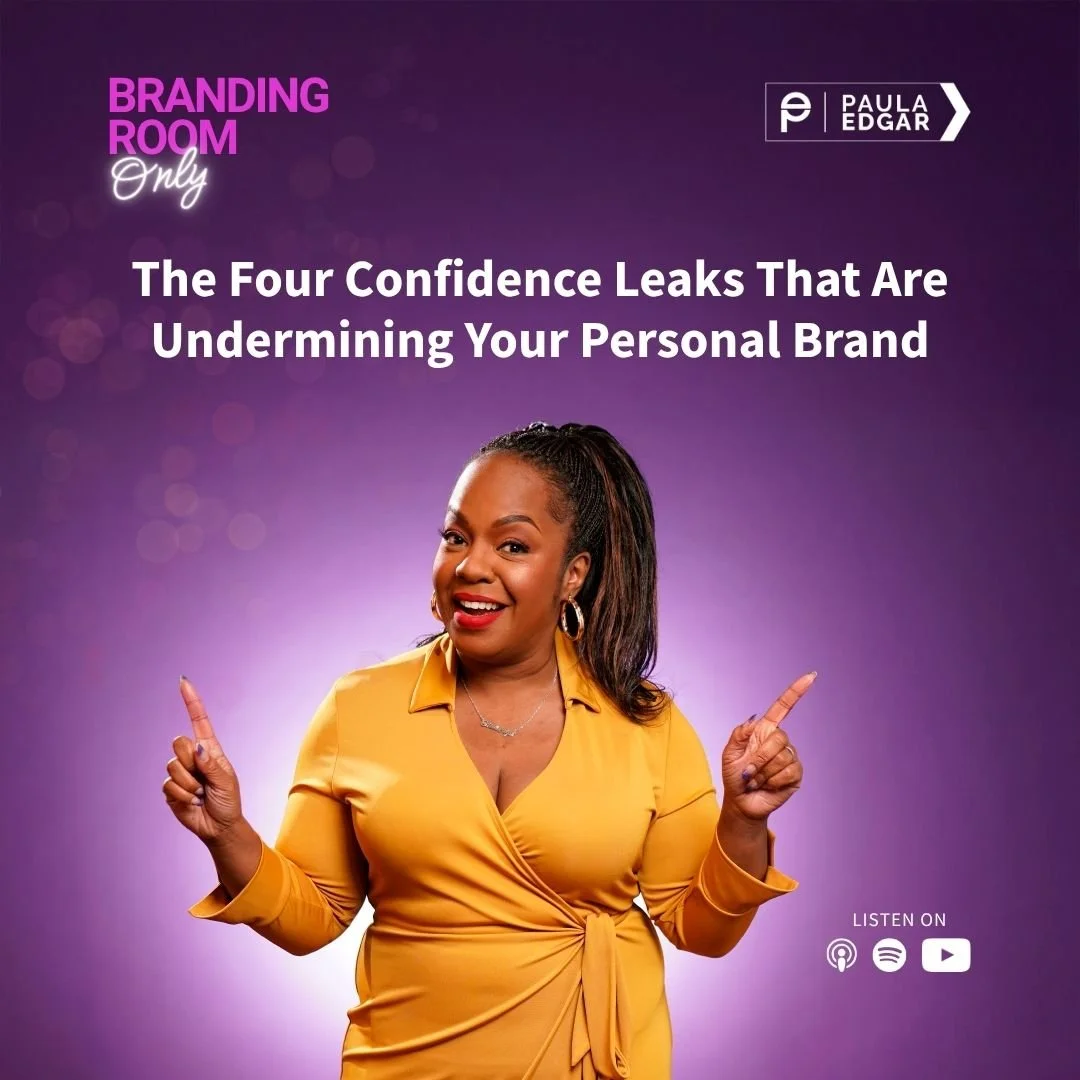
Welcome to Branding Room Only, the podcast where your personal brand gets a front-row seat. I'm Paula Edgar, and if you're here, it's because you know your brand isn't just about what you do. It's about how people experience you. In each episode, you'll hear stories, strategies, and lessons from leaders and influencers who built their brands and made their mark. And I'll share the tools you need to do the same. Let's go.
Hi, everybody. It's Paula Edgar, and welcome back to The Branding Room. So this is the second episode in the Confidence Factor series. In the first episode, we established something foundational: that confidence is built, not bestowed. Now I want to take this one step further.
If confidence can be built, it can also leak. Many people are trying to build confidence without first identifying where it's already quietly draining. Because here's the truth, and you know I only ever want to tell you the truth, is that you can be talented, prepared, experienced, and still feel uncertain.
That feeling doesn't always mean that you need more skill. Sometimes it means that you haven't diagnosed the leak.
Over the years in strategy sessions and keynotes and workshops that I've done, I have noticed patterns. When someone says, “I don't feel confident,” I like to listen carefully for what is underneath that sentence. Usually it's one of four things.
The first leak is comparison, or the thought of there being competition. Before I even delve into this, if you've ever heard me speak before, you know that I don't believe in competition. Your only competition is you yesterday, previous you.
But let's get back to comparison. Comparison is really constant now. You open LinkedIn and everybody's announcing promotions, speaking engagements, board seats, awards, launches. They're saying they're so honored and proud.
Even if you intellectually understand that these spaces are curated spaces, as people curate their highlights and we don't get to see their down times, emotionally it can chip away at you. You might start questioning your pace. You might start questioning your positioning. You might start questioning whether you're behind.
But what's happening isn't a loss of capability. It's a distortion of the context. Your confidence shrinks when you measure your behind the scenes against someone's highlight reel, right?
I always say to people, this is an exhibit that you see when you're looking at somebody's social. Even when you're interacting with somebody in real life, oftentimes they're not going to say things have been challenging. They're going to talk about what they're excited about, what they're working on. So it seems like they may have everything all together.
Remember, your behind the scenes—challenges, flaws, and all—cannot be aligned to someone's highlight reel.
The second leak I often interpret is invisibility. You're doing the work, you are delivering, you're producing results, but your contributions are not being named. They're not being amplified, and they're not being clearly tied to you.
I often talk about strategic self-promotion. I've done podcasts on it. I know people can often be uncomfortable about it, but when there is a consistent lack of visibility, that culture of invisibility, even if I'm on the side cheerleading you to be more strategically self-promotional, you might after a while start to internalize that silence.
You might start thinking that maybe you're not as strong as you thought. But I find that the issue is very often not performance. It is often positioning and strategy.
So if your personal brand is unclear or your visibility is inconsistent, your confidence, of course, is going to wobble. Not because you lack value, but because the feedback loop is weak. Humans need feedback loops. We need to see how we're doing. We need to be able to feel as if we're being valued.
The third leak is perfectionism. This one is a big one, especially common amongst high achievers. You tell yourself you'll speak more when you're ready. You'll apply when more qualifications that you have are aligned with the job. You will post about the thing when it's more polished. You will pitch when a proposal is airtight.
But perfectionism often disguises itself as professionalism. What it produces is hesitation. Hesitation prevents you from making those reps that you need to make you more confident.
Let me give you an example. I worked with a senior professional who had been invited multiple times to submit an article to an industry publication. They had strong ideas, deep, deep, deep expertise, and a clear, distinct point of view.
But every time the deadline approached, they convinced themselves they were not ready. They asked for delays in the deadlines. They said that they needed more research. They needed more citations, and they needed to refine more.
So they missed the first opportunity. Then they missed the second opportunity. Guess what? Yes, you guessed it. Eventually, someone else wrote on the topic.
My goodness, that person has now become associated with the thought leadership space that this professional had actually been thinking about for years.
When we unpacked it, it wasn't a lack of intelligence. It definitely wasn't a lack of insight. It was perfectionism. They were protecting themselves from potential critique. They were not confident about how they would navigate that critique.
But in protecting themselves from potential critique, they also protected themselves from visibility. Without visibility, their confidence never had a chance to continue to grow, because confidence needs evidence.
Perfectionism starves you of that evidence because you are delaying. You cannot build confidence in silence or in silos. You have to build confidence through exposure and through a little bit of vulnerability and bravery.
The fourth leak is environment. This can come up in a lot of different ways. Sometimes you feel less confident, not because you have changed, but because the room and the environment has. This could mean a leadership shift, a culture shift, expectations shifting. So behaviors that once felt valued in the community environment that you're in start to feel overlooked.
When that environment changes, your confidence can dip while you are figuring out how to get steady and recalibrate. This does not automatically mean you are less capable. It does not mean that you are less capable. It may mean, however, that you need to reposition or renegotiate your visibility or reassess your alignment with your organization or your team.
Because not every dip in confidence is an internal thing. Some of it is contextual, and that's why it needs to be strategic.
Oftentimes when people are talking about having imposter syndrome and not feeling confident, it is because of the environment, because of the context, and not because of them.
So here's where this becomes strategic. If you don't identify which leak you're experiencing, you may try to fix the wrong thing.
If the issue you're having is comparison, you do not need another credential. If the issue that you have is about invisibility, then you definitely don't need new skills. You need clearer signals.
If the issue that you're having with your confidence is perfectionism, you don't need more preparation. You need more exposure.
Finally, as I mentioned, if the issue in your confidence is the environment, you don't need self-doubt. You need clarity and recalibration.
This is why confidence cannot and should not be separated from personal branding. Your personal brand is how your value is articulated, demonstrated, and associated with you.
So when your brand is intentional, your confidence stabilizes because you're not guessing about your worth and your skill and your value. You're not waiting for random validation.
You have clarity about what you bring. You have evidence of your impact. You have positioning that travels with you.
I want to say something important because people often assume that I just always had this level of confidence. It's true. I love speaking on stages. I love being in front of a camera. Before I keynote, I feel energy, excitement. Sometimes it is the same physiological sensation that people call nervousness—elevated heart rate, heightened awareness—but I interpret it as readiness because it is.
I know the stakes matter. I know the room matters, and I know my message matters. Underneath that energy that I'm feeling is my certainty, because I am confident, because I trust my preparation, and I trust my skill as a keynote speaker and facilitator.
So if you think about the fact that excitement and nervousness can show up in the same way in the body, then why don't you interpret it differently? The interpretation can change the outcome.
Reframe it so that you understand that you're building your confidence as a skill. Confidence is not the absence of activation. It is the presence of trust.
Trust in the fact that you are prepared. Trust in the fact that you know what you're talking about. Trust in your positioning and in your ability to navigate whatever is going to unfold.
So instead of asking, “Why am I not more confident?” ask, “Is my confidence leaking? Is my confidence leaking someplace? Is it in comparison and visibility? Perfectionism? Is it the environment? And what is one strategic shift that I can make this week to plug that confidence leak?”
Because I want you to remember that building confidence matters, but protecting it is just as critical. If you got it, you don't want to lose it. That, my friends, is the second episode in the Confidence Factor series. So as always, remember to stand by your brand. In fact, confidently stand by your brand. I will see you next time in the Branding Room. Bye, y'all.
That's it for this episode. I appreciate you hanging out with me on Branding Room Only. Now, please do me a quick favor: head over to ratethispodcast.com/branding so more people can join this conversation. And make sure to stop by at paulaedgar.com/events to see what's next. Whether I'm live, online, or in person, I'd love to see you there. See you next time in the Branding Room. And until then, stand tall, shine bright, and always stand by your brand.