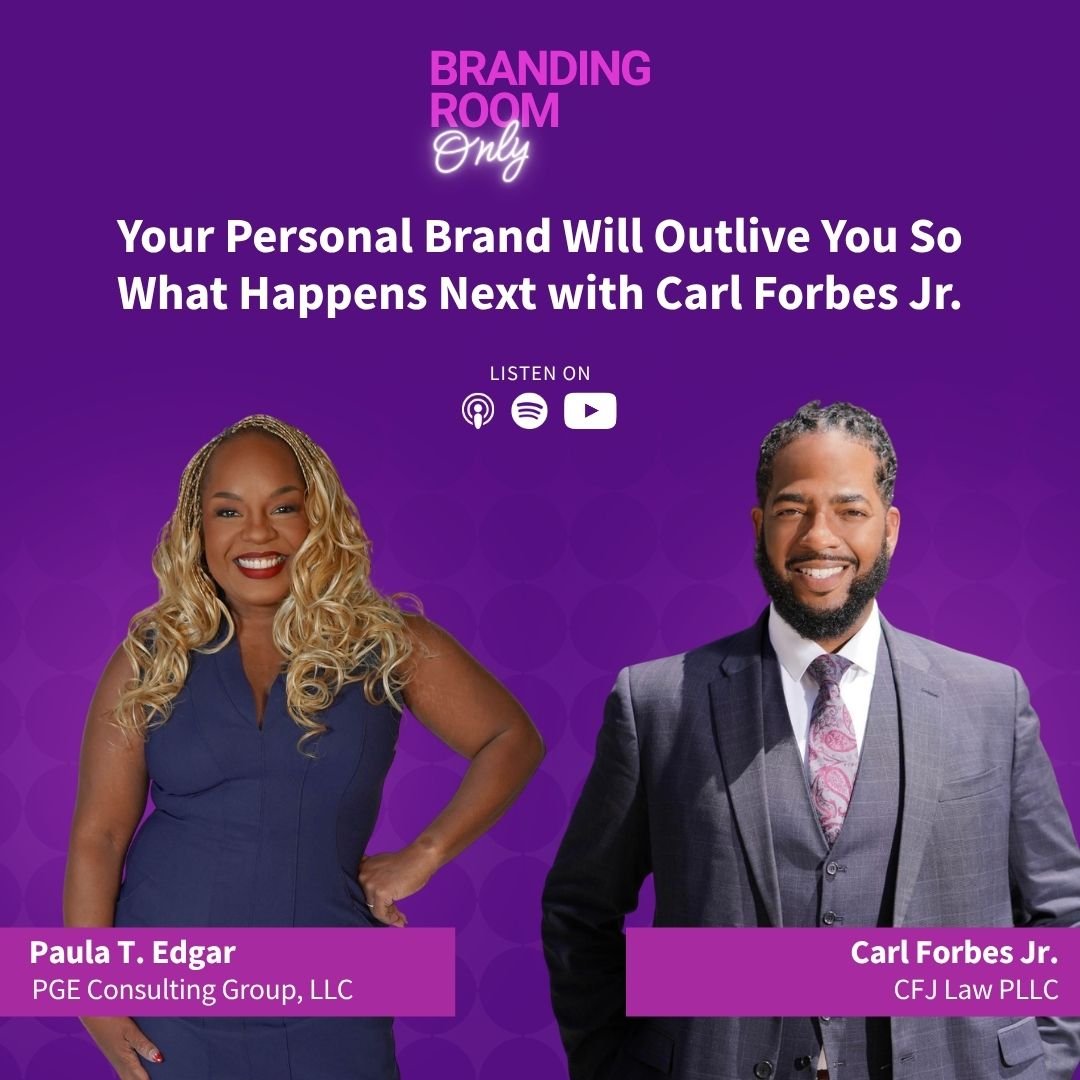
Paula Edgar: Welcome to Branding Room Only, the podcast where your personal brand gets a front row seat. I'm Paula Edgar, and if you're here, it's because you know your brand isn't just about what you do. It's about how people experience you. In each episode, you'll hear stories, strategies, and lessons from leaders and influencers who built their brands and made their mark, and I'll share the tools you need to do the same. Let's go.
Hi, everybody. It's Paula Edgar, and welcome back to the Branding Room. We are in for a treat today because I said so. We are having a conversation with one of my best friends, Carl Forbes, Jr. Let me tell you about Mr. Forbes, Jr. Carl Forbes, Jr. is the founder and managing attorney of CFJ Law PLLC, a Brooklyn-based firm focused on real estate, estate planning, probate, estate litigation, and guardianship across New York.
A first-generation American of Jamaican heritage and past president of the Metropolitan Black Bar Association, Carl is a recognized leader committed to advancing equity and excellence in the legal profession. And like I said, he my friend, y'all. Welcome to the Branding Room, Carl.
Carl Forbes, Jr.: Thank you for having me. Good to be here.
Paula Edgar: I'm so excited for this. So, we have been talking about doing this for a very long time. So, we're finally here. Let's start—
Carl Forbes, Jr.: Life be lifing.
Paula Edgar: Life be lifing.
Paula Edgar: Let's start with number one, which is what does personal brand mean to you? How would you define it?
Carl Forbes, Jr.: It means everything, right? To me, I define it as what people say about you when you're not in the room. And so, for me, it's what have I cultivated in terms of my reputation that precedes me. And so, to me, there's nothing else personally or professionally than your brand. It says everything about who you are.
Whether you think your brand is one thing, if it shows up as something else, you gotta reevaluate. And I learned that from a good friend of mine.
Paula Edgar: I was about to say, “Look at me out here doing God’s work.”
Carl Forbes, Jr.: So, yeah
Paula Edgar: So, that being said, how would you describe yourself in three words or short phrases?
Carl Forbes, Jr.: I am a compassionate, introverted extrovert who deeply loves people.
Paula Edgar: Let me go ahead and take dealer's choice 'cause it's my podcast and let me think about how I would describe you in three words.
Carl Forbes, Jr.: Okay.
Paula Edgar: Intense in all good ways, and this is a line, I guess. I would say dedicated to the core. I feel like when you put your mind to something, I know it's gonna get done. And finally, fun.
Carl Forbes, Jr.: I like that.
Paula Edgar: All right. What is a favorite quote or motto that you have?
Carl Forbes, Jr.: It's actually one that I've had for a long time, and I don't know where I got it from, so I say I made it, which is, “Be better today than you were yesterday and better tomorrow than you are today.”
Paula Edgar: Love it. And when I think about that, it's particularly connected to brand. I always tell people, “You don't have any competition but you.” So that aligns like that.
Carl Forbes, Jr.: And that's how I tend to focus, right? Is how can I be better than my previous self and aspire to continue to achieve things that only I can dream of.
Paula Edgar: So, this is gonna be an interesting answer no matter what. So, when they're about to get full Carl Forbes, Jr., what song is playing in your head? What is your hype song?
Carl Forbes, Jr.: So, I wanna say anything dancehall, right? Being Jamaican and in thinking about this in advance. Since of course you being you, you gave some prep. I was thinking about "Welcome to Jamrock," but it's not really appropriate. So, I think back to when I used to travel, more so commute for work and what I would be playing, and it's Rick Ross, “Every Day I'm Hustlin'”.
And I don't know if you remember that meme where person's all dressed professionally, and they might already be in the office. They've got headphones on, but what's blasting in their ears is something a little ratchet.
Paula Edgar: Yes.
Carl Forbes, Jr.: Right? And so that because, again, I look at life as a hustle. In order to achieve, I've gotta hustle, so every day I'm hustlin'.
Paula Edgar: I like it, especially 'cause it's a line. So, I have multiple hype songs. Everybody knows that “Baby, I'm a Star” by Prince is mine. But I have a playlist of when I need to get myself hyped up, and one song on there is Cassidy, “I'm a Hustla.”
Carl Forbes, Jr.: Yeah.
Paula Edgar: Which quotes Jay-Z in there, and so I like the hustle alignment.
Carl Forbes, Jr.: And we know how I feel about Jay-Z.
Paula Edgar: Yes. Yes. Also, my tagline for my business is “Engage your hustle,” so we have a lot of hustle going on here. Tell me this, where did you grow up, and how did that shape you?
Carl Forbes, Jr.: Brooklyn born and raised, again, hence why I love Jay-Z. I mean, Brooklyn shaped me in such a formidable way. I think that you have to be a little gritty, right? Even if you're not necessarily in the streets. And street adjacent, as I would say. But it teaches you a resolve and a toughness that has carried me through life.
And so being able to be book-smart, but street-smart at the same time I owe to my upbringing in Brooklyn and Jamaican heritage, which I think has impacted even more so being in Brooklyn. So, when I'm in Jamaica and people think I was born there, and they're like, “Where are you from?” I'm like, “Brooklyn.” They're like, “Oh.” I'm like, “Yeah, right.” It's like the third city of Jamaica, basically.
Paula Edgar: Yes. Yes, it is. So, tell me, us, about your career path.
Carl Forbes, Jr.: Very condensed version, I knew since I was a kid I wanted to be a lawyer, probably 10, 11 years old. And I was attracted to the courtroom, right? That is definitely what sort of drew me in. I argued a lot as a child.
Paula Edgar: Still.
Carl Forbes, Jr.: In a more productive manner, right? And so that was part of what led me to fall in love with the law is realizing that I could argue constructively, so I did debate team in high school. My high school, shout out to Sheepshead Bay High School in Brooklyn. Technically doesn't exist anymore, but they had a law program.
So, we did mock trial, and as I got older and started to understand a little bit more, didn't know exactly what I wanted to do, but I was still attracted to the law because of the diversity, the fact that there are so many practice areas that you could move between, and not realizing I ultimately would do that in my career and practice in many different fields.
And so, I was blessed enough to have my sights set on that dream and ultimately accomplish it. Even though my mother wanted me to be a doctor.
Paula Edgar: Jamaican mothers.
Carl Forbes, Jr.: Yep. And so.
Paula Edgar: So that is the highest high level of a career trajectory that I've ever heard, so I'm gonna go because I know the answers to this.
Carl Forbes, Jr.: Okay.
Paula Edgar: So, after Sheepshead Bay, then what happened?
Carl Forbes, Jr.: Yeah. So, I went to Binghamton University, State University of New York in upstate New York, was a philosophy, politics, and law major. So of course, again, knew I was going to law school. This interdisciplinary major was attractive to me. And then I went to Columbia for law school.
Paula Edgar: Let's go back one. I'm just thinking about brand alignment—
Carl Forbes, Jr.: Sure.
Paula Edgar: And all of the brand things that I know about him. So, you're gonna go maybe two, three minutes without hearing something about Binghamton, Brooklyn, Jamaica, or your fraternity.
Carl Forbes, Jr.: Sure. Okay. Good point. I left out 'cause I wasn't sure how high level, how much time we actually had.
Paula Edgar: This is about branding.
Carl Forbes, Jr.: And so, when I was at Binghamton… I'm a spring 2007 initiate of the Binghamton University, the Mu Kappa chapter of Kappa Alpha Psi Fraternity Incorporated, the greatest fraternity known to God and man.
Paula Edgar: Okay, Psi.
Carl Forbes, Jr.: Which again played, or has played a formative role in my life. I've mentioned the word achievement a lot, and it's part of our creed and not just a buzzword. And so, my development or professional trajectory has been impacted significantly by my brothers and the focus on supporting one another and achievement.
And so that has been a critical part of my leadership and legacy, which I know we're gonna get to speaking about in terms of thinking beyond just myself, right? And focusing on the greater benefit of others in the community. And so, Binghamton, likewise, has been great for my development. I was president of the Caribbean Student Association there.
And as a 20-year-old, we used to throw a carnival in the sense that you'll see celebrations throughout the diaspora. And we managed, as a 20-year-old, $100,000 budget for artists and performers—
Paula Edgar: Wow.
Carl Forbes, Jr.: For that. And so, it was my first real taste, I'd say, of leadership in a way that didn't really make sense as a 20-year-old. And I always harken back to that because for me, it's like that was the sort of path that started to where I’m today and building that confidence and experience to feel comfortable doing anything, in reality.
Paula Edgar: So, because I know the story more. Leadership in terms of how it impacts your brand from a young age is gonna teach you communication, people, stewardship of responsibility, all those things. And I know that catalyst speaks to who and what you are now. Talk to me, we’d stopped at Columbia. Now keep going.
Carl Forbes, Jr.: So just to go back on one other point.
Paula Edgar: No, please. Go ahead. Yeah.
Carl Forbes, Jr.: 'Cause you just reminded me of it in terms of communication, people. That's something that I have at times struggled with and focused on as a result of sometimes being too much of a people pleaser, sometimes not being direct enough. You made me think about my time with CSA and challenges I had with a few other board members that in ways became quite personal negatively.
But in growing from that, I've become best friends with one of those people, right? That I had challenges with from a leadership perspective because we had different styles. We would butt heads all the time in meetings. And over time, I realized that, again, you have to figure out how to not make it about yourself.
Paula Edgar: Personal.
Carl Forbes, Jr.: I don't like when people say, “Don't make it personal.” Everything's personal, right? In business, you go, “It's not personal.” Of course, it is. It's personal and professional, right?
Paula Edgar: It's money. Yeah.
Carl Forbes, Jr.: Personal and professional oftentimes align or converge.
Paula Edgar: Yeah.
Carl Forbes, Jr.: So, it's not that it's not personal it's that you have to remember the broader goal oftentimes being not about you individually, about the greater good or community again. So, post Columbia. So, started my career in the Great Recession. Worked at the New York City Law Department initially in the Manhattan Family Court practice for a little over a year, and then, started at Proskauer Rose, where I had summered or worked as a summer associate during law school.
And I was a commercial litigation associate there. So doing almost everything in terms of litigation, your general breach of contract, some securities litigation, antitrust litigation, bankruptcy litigation at one point. So almost anything. And a small bit of trust and estates litigation, which was sort of my first taste into what has become a major part of my career at this point.
From Proskauer, went back to the New York City Law Department, where I then practiced in the Brooklyn Tort Division, so personal injury cases, mainly property damage for a number of years. Went back to Proskauer, and then in 2018, I started my own firm, which you highlighted in the beginning focusing on empowering families and protecting legacy.
Paula Edgar: Yeah. So, I'm gonna pull out Proskauer before we jump into the meat of the conversation because as I mentioned that Carl is a past president of the Metropolitan Black Bar, and so am I. And when, I was president, we had somebody who was on our board who was a representative from Proskauer, and he was done with his term. He said he was done, and he had the right person for me.
And when I think about branding, he basically said, “Don't worry, this is the person.” And I was like, “Who is this person, I gotta call them,” 'cause I trust but verify 'cause I'm from Brooklyn. And there's not a lot of times when I think that we go from exactly what was said to it being even beyond my expectations. And so, I didn't know that that call was gonna end up being one of my best friends 10 years later.
But when I talk about the power of community and collaboration, but also the power of trusting based on a referral and a recommendation, because I took that, right? I did make a call, but I said, “Usually this would not be the process that I would go through,” and I was right. So that when somebody's talking about your reputation, you make sure you show up in the way that aligns with them putting themselves on the line with you.
So, I wanted to pull that out before we jump into the conversation. All right, so what led you to specifically make big part of your practice wills, trusts, estate planning, and real estate law?
Carl Forbes, Jr.: So, it's two things. Originally, when I started my practice eight years ago, which is now basically half my career, which is crazy to me, I was thinking about being a generalist, right? Again, my experience had been varied in terms of the litigation in various areas of the law.
And so, I felt I could do a little of everything. But it was two things leading up that helped me really focus. One when I was still at Proskauer. Two of my friends separately, one fraternity brother, one friend from college, both asked me to do wills for them. And I told them, no. I could not. One, I had not had experience actually doing them. And two, I was working for Proskauer and could not moonlight as a result of that.
But the more I started thinking about growing my practice, that sat with me, and they kept saying, “We're waiting.” I was like, “Okay, keep waiting,” because at the time I wasn't sure what I was going to do or… And then I got some experience, as I mentioned, on a trust, an estate litigation. Proskauer has a Boca Raton office for high-net-worth individuals.
So here in New York, we were supporting team there on a litigation that had some snowbirds, basically who originally lived in New York, retired to Florida, so there were issues here in New York that they needed our assistance on.
Paula Edgar: Okay.
Carl Forbes, Jr.: But mainly in 2017, my grandmother passed away. So, my mother's mother. And my mother, as the executor of her estate, hired a law firm to assist her, but me being the lawyer in the family was coming to me about everything that they were doing and that she was dealing with related to Grandma's estate.
And it strangely comforted me that while we were all grieving, I had a purpose in helping my mother formally or through that process. And I decided at that point I had to make it a part of my practice because not just the estate planning piece, which I think I was already thinking about, but the probate estate administration because I needed to do that for other people, to be a comfort through the legal challenges while you're dealing with the fact that you are living with grief. Right?
And figuring out whoever the loved one is, how to carry on. And so decided that while initially I was still gonna try to be a generalist, that had to be part of my practice. Maybe I'm jumping, but naturally my practice coalesced around areas that just made sense from a community building legacy perspective. And I'm grateful for it.
That same friend who asked me to do his will, I did. I did do plans for both of them. But that one's a business owner who told me from the beginning, “Don't generalize. Figure out your niche.” And I was like, “I can't. I gotta take whatever comes in the door.” Right? I have to make a living. This is new. I'm starting out on my own.
And within two years, I was specialized, and he goes, “See? I told you.” And I was like, “You were right,” but I had to learn for myself.
Paula Edgar: It's a brand lesson.
Carl Forbes, Jr.: Mm-hmm.
Paula Edgar: Because you can't be all things to all people, and if you are, then that means you're not great in all of the different things because you're not delving deeper in developing expertise. Also, I think part of what you said, what drives you in passion and value helps you to put more into something. So, you talking about the catalyst from your grandmother passing away makes it show up differently than if you were just like, “La, la.”
Carl Forbes, Jr.: Absolutely.
Paula Edgar: Right. Right.
Carl Forbes, Jr.: I care more about it at the end of the day, which is important, and I'll say for people thinking about the area of work or just thinking about your brand, part of what makes it authentic is I struggle at times with the emotional parts of it. And the guardianship work I do are for adults.
So, you see a lot of folks with cognitive decline, mental health issues, dementia, and it's taxing emotionally. If I did not care about it the way I do because of that catalyst you mentioned, I wouldn't still be doing it.
Paula Edgar: Yeah.
Carl Forbes, Jr.: It just becomes overwhelming if you're just focused on doing it because of the money at the end of the day. It doesn't justify it enough to make it worth it.
Paula Edgar: True. So, you and I both have had many discussions, and we know how important legacy is. How would you define legacy, and how do you see it as connected to your personal brand?
Carl Forbes, Jr.: So, to think about a quote again, Maya Angelou is one of my favorite people ever, said that she's learned that people will forget what you said, and people will forget what you did, but they'll never forget how you made them feel. Right? And I think about legacy in that way, in terms of what are people gonna say or think or feel when I'm gone. Right? And that's brand personified.
Again, your brand carries on after you are gone, and so what I care about is that I'm ultimately remembered, one, by what I've imparted in my children. Shout out to Savvy and Trey. And two, what I have done to better my community. At the end of the day, I don't need to be famous, right? I don't need my name in lights.
But if there are people who can say, “He made a difference in our community. He helped impact someone,” that then continues it forward. To me, that's really what legacy is. The other way, of course, of thinking about it is from a financial perspective, which plays into the estate planning. Building wealth, generational wealth, and passing it down to generations in hopes that you will provide a better life for those to come after you.
Paula Edgar: Yeah. Yeah.
Carl Forbes, Jr.: So.
Paula Edgar: I think that was a really succinct way of putting it, and it's—
Carl Forbes, Jr.: I feel like you think I'm being too succinct in this conversation.
Paula Edgar: No, no. You know, if that's the case, I'm just gonna call it out and pull the string—
Carl Forbes, Jr.: I appreciate it.
Paula Edgar: A little bit more. So, all of you know my mother was killed on September 11th, and one of the things that I reflect on a lot about that experience and my mother's legacy is that my mother had gone through the process of engaging an attorney with my father, and they did have wills, but my mother died before signing her will.
And I often reflect on the fact that if she didn't have a husband who loved her and was willing to do what she asked her wishes may not have been carried out. And so, when you talk about legacy and what is left over and what you leave behind, I think about this probably more than most people because it's personal to me.
And so, I wanted to have this conversation around estate planning, real estate, and legacy as a part of your brand because it truly is. Who were you, and how did you add value? And how did you make sure that value that you amassed continues on, or it went to wherever you wanted it to go to.
And so why is estate planning not just about legal documents, but it is about protecting your brand, your family, and ensuring that your story continues?
Carl Forbes, Jr.: I mean, you said it. The answer is in the question. Right? But what it makes me think about is New York is a special place. So, most other jurisdictions refer to the court as probate court. New York refers to it as surrogates court. And part of the thought is, is that the judge who's known as the surrogate sits in the place of the deceased person, right?
And so, what the court is focused on is the legacy, what the person's wishes were. Right? Especially if they put a plan in place. We all have a plan, right? The law of intestacy says what happens if you have not put one in place, or your plan fails, or it's not sufficient. But it's about protecting what you have worked your life to acquire and put in place. It's setting your family up for success going forward.
Now, some people don't necessarily care about that. Some people want their children to fend for themselves, figuring out. None of my friends feel that way, I'm sure. But that works for some people. But the idea is that I've worked hard. I have been diligent or thought considerably about what I have acquired in my life, decisions that I've made. Why shouldn't I protect that in using a mechanism the law allows me to use to do so?
Paula Edgar: I wanna go back to just make sure 'cause I know we talkin' lawyer talk. But some people may not know what intestacy is and know what it means that they have a plan even if they don't have a plan. What you're saying is, is that the law says that... I think it goes down and up, right? Any children that you have, get your stuff first if you have no plan, and then it goes up and over.
Carl Forbes, Jr.: Well, surviving spouse—
Paula Edgar: Oh, right. I forgot about spouses.
Carl Forbes, Jr.: And children first.
Paula Edgar: Right.
Carl Forbes, Jr.: If no spouse, then children. And then... And you're putting me on the spot in terms of the list.
Paula Edgar: It's parents.
Carl Forbes, Jr.: Parents.
Paula Edgar: Yeah.
Carl Forbes, Jr.: Then siblings.
Paula Edgar: Yeah.
Carl Forbes, Jr.: And—
Paula Edgar: I took that class. A long time ago.
Carl Forbes, Jr.: Right.
Paula Edgar: I just wanted to make sure they understood exactly what that meant. It meant who the things were gonna go to.
Carl Forbes, Jr.: Well, one of the critical things there, right? And there's a list of family, and intestacy just means the person has died without a will or a substitute such as a trust that would cover their estate, in the absence of a will. The critical thing in terms of the law is the last two classes on the list. Second to last, being your first cousins and first cousins once removed. For a lot of people, it's gonna include people you do not know.
So not only is the possibility of people you don't know benefiting from your estate, finding those people becomes challenging for the administration of your estate. But final on the list is New York State, and after working hard and paying taxes, and New York State should not ever inherit from anyone.
Paula Edgar: Yeah.
Carl Forbes, Jr.: Right?
Paula Edgar: Yeah.
Carl Forbes, Jr.: And so—
Paula Edgar: Yeah. Yeah.
Carl Forbes, Jr.: Put things in place. But reality is, in this day and age, with blended families, for instance, if you don't put a plan in place, you don't create a will or a trust, your stepchildren, your stepsiblings will not automatically inherit. If they, people are as kind-hearted as your father was and following what your mother wanted, great.
But the law doesn't obligate people to do that, and with blended families, you never know what ends up happening. And the people you would want to benefit are not necessarily entitled to, unless you take those steps to have your wishes properly documented.
Paula Edgar: I think I'm just a type A control person.
Carl Forbes, Jr.: No.
Paula Edgar: Shut it. And I think about the fact that it would be going to somebody who I did not say that's what I wanted. And people think about it in big picture, right? Oh, my money. I think about my favorite ring. Right? The things that I have that I want to go to my child, that if I didn't say it's going to my child, it could not... You know, who knows? And I failed sharing in kindergarten.
And so, it really triggers me in that sense too, where it's like you should be able to say what happens to your stuff. And to your point, this should not go back to New York, but you've experienced horror stories, and I've heard horror stories and both from around what's happened with you, but also just hear it in the news. We used to do a program about celebrities.
You all know I love Prince. Prince died without a will. Prince, who had amassed so many... That estate is huge.
Carl Forbes, Jr.: Yeah. Yeah.
Paula Edgar: And I think—
Carl Forbes, Jr.: And lives on.
Paula Edgar: And… right.
Carl Forbes, Jr.: That's also part of the thing. Is that when you're in an enterprise as a musician who is gonna... You're publishing.
Paula Edgar: Yeah.
Carl Forbes, Jr.: Your catalog's going to live on. There are going to be royalties.
Paula Edgar: Yeah.
Carl Forbes, Jr.: You're setting up to leave a mess, especially when you've engaged with attorneys your whole life, right? Or business professionals in your field your entire life, but then for some reason decide, and I have ideas on some of the reasons I know we're gonna get to as to why people don't necessarily in this space particularly.
Paula Edgar: Okay. So, what are some of the biggest mistakes people make when it comes to estate planning, and what do those mistakes cost them in terms of family, wealth, and reputation?
Carl Forbes, Jr.: So one, not planning at all.
Paula Edgar: Yes.
Carl Forbes, Jr.: Cheaping out on planning, and so I saw a... And I think this is actually more critical because the law covers what happens if you don't plan at all. But if you do plan, and it's not necessarily clean, it may create issues. And so, you have your various websites that for a few hundred dollars you can do your own will, for example.
And I had a matter a number of years ago where an individual who passed away had printed out a will from the internet, couldn't tell exactly where it came from, and it was executed properly, went through the proper execution. But for a will to be validated, there needs to be two attesting witnesses. The witnesses were there, and we normally include a self-proving affidavit from the witnesses.
This way, ultimately, 10, 20, 30, 40 years later when the person dies, you don't have to find the witnesses for them to come testify in court to what took place. This will had the affidavit, but it was not in the form the court is used to seeing. So, when I submitted the will for probate on behalf of my client the court comes back and goes, “We need an affidavit or affirmation from you, the attorney, telling us why we should accept the self-proving affidavit that was included.”
And basically, I had to spend my time, which is my client's money writing an affirmation explaining this paragraph of the affidavit closely aligns with what we typically do or include here in New York. And so, it's fine. And then the next paragraph and so on and so forth.
Paula Edgar: Yeah.
Carl Forbes, Jr.: Small example of just something that ends up costing money on the back end which is what I find tends to happen. If people decide to save money now in the planning, you're gonna end up costing your beneficiaries on the back end whenever you've passed because it may complicate the matter.
And so, I saw an interesting quote the other day, which to paraphrase goes something like, “If you think it's expensive to hire a professional, wait until you hire an amateur.”
Paula Edgar: It's true. When we think about where we invest and what we are willing to spend money on versus not, it's why it bothers me because I wanna talk specifically now to most of my listeners who are lawyers. A lot of you don't have estate plans, and it is egregious in my opinion because we know what happens when you don't. And nobody wants to die, but we all are going to die, right?
And so, if you're hearing my voice, and you do not have a will or a trust or some kind of estate plan, please call Carl if you live in New York. All right. What other mistakes? Anything else that you wanna call out? If that's the basis of it—
Carl Forbes, Jr.: Nothing... Yeah.
Paula Edgar: Okay.
Carl Forbes, Jr.: I think so.
Paula Edgar: So, you and I share Jamaican roots, Lord have mercy. And in the Caribbean and I think in a lot of immigrant spaces, and just in general, so I don't wanna just call out my peeps in the Caribbean, people have family members who will be like, “Oh, I don't care what happens, I'll be gone.” Meaning that they won't affirmatively plan.
Why is that the wrong mindset? Can you share a couple of anecdotes about people failing to plan, avoiding the conversation while alive? What damage is done when that happens?
Carl Forbes, Jr.: So, I think it's the wrong mindset because we don't take that mindset with all that we do while living. Most people do not. And what I mean by that we lock the doors to our homes. We put fences or gates, right?
Paula Edgar: I do.
Carl Forbes, Jr.: Fences, walls around our homes for security purposes. I like to think about estate planning being the same for when you are gone. You have compiled these assets, which we refer to as your estate. Why wouldn't you continue to protect it? And you're protecting it legally, so I think part of the challenge people have is that's not tangential to them. Right?
They are thinking about, “Well, I've protected it physically, and that makes sense to me.” But to spend the money, and that's what it comes down to a lot of the times. And I like that you said earlier it's an investment because that's really how you should think about it as an investment.
A colleague said to me part of how they get through, in breaking the psychology that people have or the psychological block they have around planning is, and it's not a perfect example because if you own a car, you're forced to have insurance. But you have it, and you pay whatever thousands of dollars a year to insure your vehicle.
Think of the investment in estate planning in the same way. You are spending, hopefully one time. Sometimes you need to update, and so, but you are spending to ensure everything.
Paula Edgar: Yes.
Carl Forbes, Jr.: Right? And not just, again, I don't wanna focus just on the financial or the assets. But if you have minor children, putting plans in place for their upbringing, God forbid pass before they become adults, and there's nobody to care for them. Right?
It's better that you have designated who should take care of your children, addressed how financially they should be cared for, than then leaving it to a court proceeding to determine what's in their best interests, and who is going to be responsible for their care at the end of the day. And I always highlight this with my clients particularly is, we often think about our parents first.
And right now, my mother helps to care for my two children, right? But my mother is also a senior citizen at this point. If something were to happen to me and my wife my mother can't care for them day in and day out, or even if she wanted to, she shouldn't have to. Right?
Paula Edgar: Yeah.
Carl Forbes, Jr.: She's already raised children, and in the later years of life is happy being a grandparent. To go back to being a parent basically doesn't make sense. But we just think, “Oh, yeah. They'll figure it out,” and somebody will. And so that's what I see a lot of in terms of the pitfalls of failing to plan and say, “Well, it won't matter, I'll be gone.” But to me then, what's the point of having children?
Right? What is the point of protecting while you're alive if you're just gonna let be whatever's going to be when you're gone?
Paula Edgar: And there's also a presumption in there that we are gonna be blessed with a long life. And I think if nothing else, COVID had a lot of people shaken up because of loss that was unexpected, but loss is unexpected every day. Right? And it's hard to reflect because nobody wants to think about being gone. But there's crime, there's sickness. There's mistake, there's things. And so, you know.
Carl Forbes, Jr.: And, I said I was gonna come to this point in talking about our Jamaican roots, but it goes beyond, as you said, is there's also superstition and the belief that if I plan for my death, I'm going to die.
Paula Edgar: Yeah.
Carl Forbes, Jr.: Or I'm going to quicken my death, and the reality is as far as we all know, we are all going to die at some point. And I say that because until you die, you don't really know, right?
Paula Edgar: Right.
Carl Forbes, Jr.: But as far as we know, and I don't think there's evidence that if you plan it, plan for it, but it's not planning for it. You're planning to protect when it happens to ensure that in reality you carry on. We love to talk about how the spirit lives on with us, and you'll never... But if you properly plan, that very much can be the case.
Paula Edgar: Yeah.
Carl Forbes, Jr.: Right?
Paula Edgar: Yeah.
Carl Forbes, Jr.: And it makes me think about the Bob Marley estate. And a lot of credit goes to Rita Marley for what she has done in terms of cultivating that enterprise into a place that Bob's legacy lives on forever as a result of the work she did to ensure his estate was properly administered and built up into an ongoing business in reality.
Paula Edgar: As his wife.
Carl Forbes, Jr.: So, yes.
Carl Forbes, Jr.: As good wives do, right? So…
Paula Edgar: Yeah, there's a lot of drama in celebrity death. Okay, so you also practice real estate law. And you also invest in real estate. How do you see real estate ownership as part of building and protecting legacy?
Carl Forbes, Jr.: I love real estate. And it's twofold. One, it’s tangible. It's real. That's part of why under the law you call it real property. But what you can do in terms of transforming a space and for your home and your wellbeing, there's so much security you get from real estate. But from a wealth-building perspective, especially here in New York, real estate's an asset that appreciates significantly. Right?
And the reality, especially here in New York, is even in the Great Recession where that was driven by subprime lending and real estate collapses throughout the country New York was sort of staved from that because New York is unique. But real estate allows for, as I see it, wealth building because of that appreciation. And so, a place here in Brooklyn that someone paid 500,000 for 10 years ago, it's worth close to a million, if not more than a million dollars. Right?
The average home value in New York, in Brooklyn now is 900,000 or so. And so, you think about the fact that you invest in an asset that, one, benefits you from living there and providing security, but grows in value to a place that you can leverage it for the benefit of you and your family, and pass it down to generations so that they're not starting from scratch when it comes to life and the opportunities to pull equity to fund their education, for example.
Or to buy another home, or to make some form of a business investment. And the reality for our community is that we've been disadvantaged in this space, right? Starting from chattel slavery and the fact that we could not own property. And so, many of the largest corporations and high-net-worth individuals are built on generations of using the laws to their benefit, planning properly so that they transfer as efficiently as possible and giving the next generation a leg up.
And I'm excited about the fact that one, in having this conversation we are as a community in a place where we care about this significantly at this point. And so, the voices who say, “I don't care, I'll be gone,” are starting to really be in the background compared to the people who call and go. I was in the barber shop, and they were talking about I should have a trust. Right?
Or I should put my home into a trust. Or I should create a life estate deed and put my children as the remaindermen, to just drop a legal term. Don't ask—
Paula Edgar: I know. I was like, “What?”
Carl Forbes, Jr.: Don't ask what it...
Paula Edgar: I was like, “Okay.”
Carl Forbes, Jr.: I could go into what it means—
Paula Edgar: No, it's okay.
Carl Forbes, Jr.: If you want, but I think it just sounds cool to say remaindermen or remainder people, right?
Paula Edgar: Sure does.
Carl Forbes, Jr.: Right. But the fact that people will call now and say, “You know, I was hanging out and somebody was talking about this.” This isn't conversations that we were having 10 years ago, 20 years ago. And I wasn't because I was in Binghamton, right? Throwing carnival. But the fact is that's what happens. Personally, as we grow, and we have gathered information, a lot of it is sharing that information so that people understand the benefits.
And with real estate, I think one of the greatest services that has been done is killing the misconception that you have to have 20% down. I remember when that's all people would talk about not realizing that there's so many loan options and programs out there where you can have, if you're a veteran, 0% down. Right? Otherwise, there are programs where you can put as low as 3.5% down, whether FHA or conventional loan options.
And so that, in terms of that piece, helps people provide access essentially for people to invest in or own real estate for themselves that they can then benefit from in various ways.
Paula Edgar: Right. Because I think that to your point about communities who had been disadvantaged, when things like that are in the space, it becomes a block that you don't even try. Right? So, you're not even investing in the thing because it's been so clear that you need that 20%, right?
Carl Forbes, Jr.: Right. I'm not even gonna try, right? I'm—
Paula Edgar: Right. Right. Exactly. So, we talked about us both having this shared experience of having been the president of the Metropolitan Black Bar Association. How do you feel like leadership has shaped your brand, and how do you see it connecting to your legacy?
Carl Forbes, Jr.: Yeah. That experience particularly and since I've learned so much about myself in terms of refocusing myself on being more direct, I think I had reached a point where I was trying to make everyone happy and to get along as opposed to being focused on being effective as a leader.
And my time with MBBA as a president and prior really helped me to refocus on the fact that to be effective, I needed to get people to buy in, but it had to be targeted. It had to be direct around where they were falling short. Recognizing where I might be falling short or where I needed to shore things up, where I needed to delegate, which is something that I have struggled with for a very long time.
When I was at Proskauer my assistant would joke when I would get up to make my own copies, and she'd look at me and go, “What are you doing?” I'm just not used to saying to someone, “Hey, can you print this for me? Can you do it?” When it'll take me one minute to do, but that's not your function.
Paula Edgar: Right.
Carl Forbes, Jr.: Right? And so that being over 10 years ago, still carried that into my time with MBBA and learned a lot around the fact that to be an effective leader I had to sharpen those skills. And thinking about legacy, I believe that leadership is about service. It's caring about those who are in your charge or who you are responsible for and their development. And so, for me, it was never about me.
Paula Edgar: Yeah.
Carl Forbes, Jr.: And it's probably why also I gave the most truncated version of my background because again, in this conversation it's about the leadership and legacy. It's not about me as a person. It could be anyone in this chair, but it could not.
Paula Edgar: No, it couldn't.
Carl Forbes, Jr.: Right. Exactly. And I've learned that over time because I do bring something unique in that I am a servant leader who cares deeply about people. Right? About humans as beings and the fact that we have so much to offer to one another. And what truly strikes me as wonderful about MBBA and some of our sister bars is that bar associations generally focus on the betterment of attorneys. Right? Being a support system for attorneys and judges potentially.
Paula Edgar: Yeah.
Carl Forbes, Jr.: But we focus on it all.
Paula Edgar: Yeah.
Carl Forbes, Jr.: The community also, right? It's not just about supporting one another as attorneys, programming for attorneys, but how can we support the community through clinics, workshops, things of that nature. And so, to me, that's the legacy point, right? Is that my leadership, in my mind, not only grew the organization and connected us both to our past as well as the future in terms of the trip we did to Ghana, for example.
So, for those who may end up watching this or however, my outfit is by design, right? I thought about it in terms of what I would wear. And the turtleneck aside, my outfit was custom-made in Ghana during the Metropolitan…
Paula Edgar: Flex on us, Ben.
Carl Forbes, Jr.: During the Metropolitan Black Bar Association's trip to Ghana in celebration of the organization's 40th anniversary, right? And that was in thinking about legacy. An opportunity to expand our reach.
Paula Edgar: Yeah.
Carl Forbes, Jr.: Right? To bring folks from the diaspora back to the motherland. I say back to because that's how they were focused on in when we were in Ghana, is that you are from here.
Paula Edgar: Welcome back.
Carl Forbes, Jr.: Welcome back, right? And so, thinking about the legacy beyond just the law, but about our people, right? And what we have been through. That's why earlier I said chattel slavery specifically because there's a lot of this talk these days about the fact that slavery existed well before what it was in the Americas, right?
Paula Edgar: Not in the way it was in America.
Carl Forbes, Jr.: But not in the way it was here.
Paula Edgar: Right.
Carl Forbes, Jr.: And so, the words matter, and you have to… And that's a big part of brand for me, is that words matter. And I think that people are too loose with words and how they say things, and we live in a day and age where people are just cavalier with how they say things, as if nothing matters. Right? And so—
Paula Edgar: Yeah.
Carl Forbes, Jr.: Yeah.
Paula Edgar: My feedback about leadership is I don't like group projects. My second piece of feedback is I don't believe that any leader should lead without creating other leaders. And so, when I think about part of my brand is I have a lot of my mentees have become leaders. And I'm honored to be able to have been a catalyst in that space for so many because we need strong leadership.
You know, like Prince, calling back again, say, “You want a leader, you better make up your mind.” Anyway. Okay, so.
Carl Forbes, Jr.: You made me think about that in terms of, to bring a sports analogy, a football coaching tree. So, a lot of successful head coaches, they'll often talk about other coaches who became head coaches, and they're now part of their legacy or their tree, as they'll call it, and I agree. Similarly, is that—
Paula Edgar: So, I have a leadership tree?
Carl Forbes, Jr.: Yeah.
Paula Edgar: Okay. I like it.
Carl Forbes, Jr.: Exactly. I think so.
Paula Edgar: I like it.
Carl Forbes, Jr.: And that is critically important because it speaks volumes to you paying it forward.
Paula Edgar: How do you want your legacy to be remembered, both professionally and personally?
Carl Forbes, Jr.: I think they're one and the same at this point. In that I care less about myself and more about people, more about the community. Right? And so, whenever I'm gone, again, I want my impact to be seen through what I've imparted in my children. And that matters significantly to me because some people have children for fun, right?
And I think that it's, I don't wanna say a calling, but it's, again, it's to continue your legacy, right? You are an extension of me in a true sense. Right? Of blood, but also what I have done to raise you into a good human being and someone who leaves some type of a mark on the world.
Paula Edgar: Yeah.
Carl Forbes, Jr.: And so, my hope is absolutely that my children become better than me because of who I have been and who I continue to strive to be. My wife said to me the other day that me being a bit of a perfectionist, she sees it in our daughter. And just a funny example, our son, who's four months, she had got him to relax, put his pacifier in his mouth, which he doesn't do the pacifier a lot.
And our daughter looked, and the pacifier was upside down in that logo, it's like a whale or something. And so, she took it out and turned it. And of course, that disturbed him.
Paula Edgar: Woke him up.
Carl Forbes, Jr.: But she's saying it because she takes after me and the perfectionist is, “Well, this is wrong, so it needs to be fixed.”
Paula Edgar: Yes.
Carl Forbes, Jr.: I just wanna get the comment about the kids in there. But—
Paula Edgar: I was already gonna say that his daughter's already better than him, so it's fine. She's already done more. She's gonna be president of the United States.
Carl Forbes, Jr.: But, and—
Paula Edgar: Or someplace else, hopefully.
Carl Forbes, Jr.: And I'm happy you mentioned 'cause I was going to mention that because in the last year, she'll be five this year. And in the last year, she has started randomly saying to me, “Daddy, do you wanna be president?” And I'm like, “No.” And she goes, “Why not?” I was like, “Just not interested. Like, it's not something…” She goes, “I think I'll try it.”
Paula Edgar: And we will pull this as B-roll when she is campaigning. I feel like we said it.
Carl Forbes, Jr.: And a few weeks ago, she goes, “You wanna be president or mayor?” So now she understands a little bit about...
Paula Edgar: Love it.
Carl Forbes, Jr.: And I was like, “No.” She goes, “I think I'll try it.”
Paula Edgar: Love it.
Carl Forbes, Jr.: It's something that... And that's what you want. And so, for me, if that ultimately happens in terms of, I've spurred them to do something greater that… While I like to be in the background a little more. I have no problem with leadership, right? Clearly, I end up leading because I feel a calling to do it. But I'm not out here just looking to be at the top of something, but if I spur that in them because naturally it makes sense, that's great.
Professionally, just to tie it, it is if people can say that we were informed to the point that we no longer needed to hear from Carl, because it's ingrained at this point, then I've done my job. Right? And less about the call Paula made to call me if you don't have a plan, which call me, but you don't have to. I care more about the information so that at some point you wake up and go, “You know what? I gotta do this,” and you go to somebody.
Paula Edgar: Yeah.
Carl Forbes, Jr.: Right?
Paula Edgar: Yes.
Carl Forbes, Jr.: You go to somebody to do it because at the end of the day, it matters.
Paula Edgar: It does matter. And that's a perfect way to segue into my final questions. So, I ask the same set of questions to folks as we close. One, I'm afraid of what you're gonna answer, but what do you do for fun?
Carl Forbes, Jr.: I love to travel. Right? There is probably nothing more fun to me than traveling and food, right? And I appreciate food for the cultural aspects. And so, a lot of times travels are designed around places with good food that are important to that culture. But I appreciate the art of food also. And so, I get excited about chefs who put a lot of love into what they're doing and think about their food as art.
But on a more sort of day-to-day level, I love music. I'm a big sports fan, so baseball and football these days…
Paula Edgar: Shout out to the Mets.
Carl Forbes, Jr.: Shout out to the Mets.
Paula Edgar: I was just saying that because I don't want to be fined. Okay.
Carl Forbes, Jr.: 40 years, since the last championship, and I say that being a Mets fan builds—
Paula Edgar: 1986. I remember it.
Carl Forbes, Jr.: Okay. It builds character.
Paula Edgar: Yeah.
Carl Forbes, Jr.: Right? And so being a long-suffering Mets—
Paula Edgar: It's gotta build something. All right.
Carl Forbes, Jr.: But yeah. And I like to do this, right?
Paula Edgar: Yeah.
Carl Forbes, Jr.: And so, yeah, we're recording a podcast, but I truly love to just hang with my friends and talk and connect with each other, and that was one of the hardest things in the pandemic was... And what I don't like a lot now in this sort of hybrid world is there's too much virtual.
Paula Edgar: Yeah.
Carl Forbes, Jr.: Right? And there is just something special about being able to sit in front of someone who's not in a computer screen, where you can feel the emotions and the energy. And so, I just love sitting down and talking to people.
Paula Edgar: I agree. So, I have two points that I always ask folks for the podcast, which is, one, what is the authentic aspect of your personal brand that you will never compromise on?
Carl Forbes, Jr.: I'm not sure how to answer that, right? Because I wanted to say that I'm me, but that does not answer—
Paula Edgar: Let me answer for you?
Carl Forbes, Jr.: Yeah.
Paula Edgar: Integrity.
Carl Forbes, Jr.: It... Yeah.
Paula Edgar: I think that that's what the answer came up for me for you, but because I think it's talking about values in the question.
Carl Forbes, Jr.: You're right. And that's why I said that, and this aside, because you'll make the pitch for me, and that is part of brand is, again, when I'm not in the room or other people. But I am not in this for money, right? I am in this because I care about people, and I want us to care about the things that we should.
Paula Edgar: Yeah.
Carl Forbes, Jr.: Because others have tried to keep it from us.
Paula Edgar: Yeah.
Carl Forbes, Jr.: Right? And the system's been designed to disadvantage us. And for me, it's community over everything because it does take a village. And we can go further together, and I'm getting cliche, but I feel like that's what it asks for, so, but I like that. Integrity, you're right.
Paula Edgar: Yeah.
Carl Forbes, Jr.: I think so... And that's why I said it's me. I was like, “I'm true to myself.” Right?
Paula Edgar: It's just the thing that's here. That's me.
Carl Forbes, Jr.: I'm true to myself. But you got the word I couldn't think of in the moment, so.
Paula Edgar: Okay. All right, so final question, which is, Branding Room Only is a play on standing room only. Because I'm clever. So, what is your magic? What is that thing that would have a room full of people, no seats available, standing to see and experience about you? What's your magic?
Carl Forbes, Jr.: Wow, you and these describe yourself questions. I connect to people. Yeah. In that room, I will be able to reach everyone. Right? Because I have worked hard, and I recognize, and it's taken me a while to admit I have an ego. Right?
Paula Edgar: As do we all.
Carl Forbes, Jr.: And a lot of people don't want to admit it because they think of it as a negative, right? And what I've realized is I know when to downplay, when to play up, when to sort of put myself in the background a bit and when to be more forward. So, in a room that is standing room only or, for better purposes, Branding Room Only, I'd be able to connect to everyone because of my integrity and compassion, and experiences.
Paula Edgar: Well, you know I'm very honored to be connected to you. How can folks find out more about you and your work and connect with you?
Carl Forbes, Jr.: I can't believe we're done. Can we keep going? Because…
Paula Edgar: No, 'cause I'm hungry.
Carl Forbes, Jr.: cfjlawnyc.com. On socials, it's cfjlawnyc. LinkedIn, CFJ Esq. or Esquire. So, reach out. I'm happy to talk. I love doing workshops, church groups, community groups. Happy to speak there, as well as one-on-one for those who have questions. A lot of lawyers don't. I like to have general conversations and impart some information where I can.
If it turns into a client relationship, great, but if I have dispelled a notion or added a bit of information to someone, I'm happy because the returns come in other ways, so.
Paula Edgar: Awesome. Somebody with a good brand is somebody who shares information and is a catalyst for other people to have good brands. And your job as somebody who's building your brand right now is to share this with everybody you know, particularly those of them who are not and have not invested in their estate planning yet.
My passion is to make sure that everyone is at least thinking strategically about what they're going to do when they're no longer here anymore, what's gonna happen to their things, and that's a part of your legacy. So, tell a friend to tell a friend to tell a friend and also tell an enemy 'cause I want them to also have an estate plan as well. I'll see you next time in The Branding Room, everybody. Bye.
That's it for this episode. Appreciate you hanging out with me on Branding Room Only. Now please do me a quick favor. Head over to ratethispodcast.com/branding so more people can join this conversation. And make sure to stop by paulaedgar.com/events to see what's next. Whether I'm live, online, or in person, I'd love to see you there. See you next time in The Branding Room, and until then, stand tall, shine bright, and always stand by your brand.