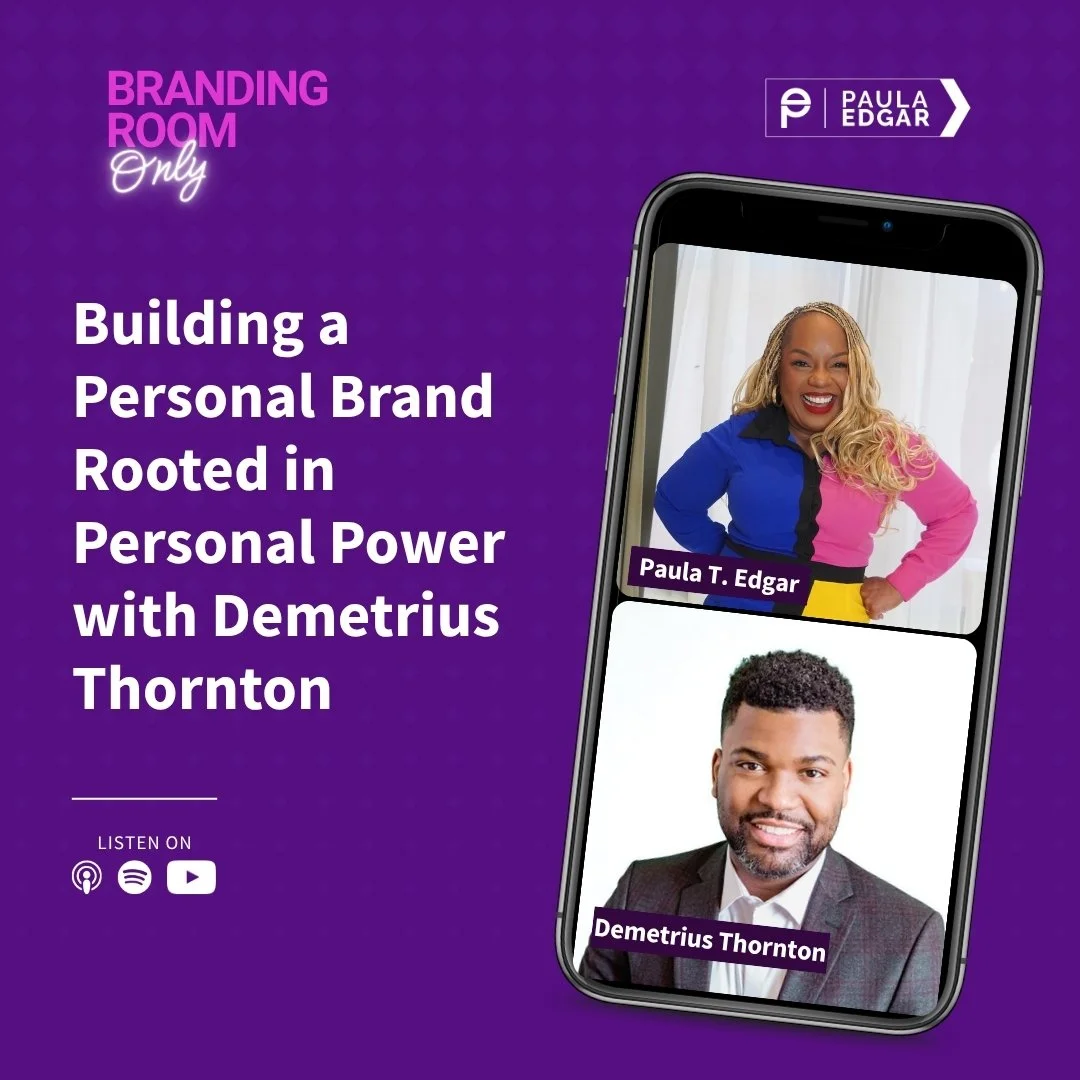
Paula Edgar: Welcome to Branding Room Only, the podcast where your personal brand gets a front row seat. I'm Paula Edgar, and if you're here, it's because you know your brand isn't just about what you do, it's about how people experience you. In each episode, you'll hear stories, strategies and lessons from leaders and influencers who built their brands and made their mark. I'll share the tools you need to do the same.
Let's go. Hi, everybody. It's Paula Edgar back in Branding Room Only. And I'm here with a guest who I like so much. I can't wait for you to hear about him. My guest today is Demetrius Thornton. He is the founder and CEO of Lemore Group, where he partners with organizations to strengthen leadership, workforce development and economic mobility. He is a workforce talent and leadership strategist, NYU professor and creator of the SCOPE Personal Power Framework helping leaders navigate complexity with clarity, courage and confidence. Across every aspect of his work, his mission is simple, closing gaps, restoring dignity and building futures. Demetrius, welcome to the Branding Room. How are you?
Demetrius Thornton: I am doing great. Excellent. Thank you, Paula. Man, I'm so excited to be here. Thank you.
Paula Edgar: Me too. So let's jump in. Tell me, what is personal brand? What does it mean to you? How would you define it?
Demetrius Thornton: You know, I got to be honest with you. I, like so many leaders and professionals, always say your personal brand is what people say when you're what? Not in the room, right? When that closed door meeting's happening and you don't have access. But as I've evolved, now for me, personal branding is about personal power. And it is truly about the conviction and the courage to change, right? And for me, that's how it's evolving now. And I'm sure we'll jump and talk more about that, but it has evolved for me over the years.
Paula Edgar: Okay. Tell me about you, in three words or phrases.
Demetrius Thornton: Okay. I would say courageous, right? Tenacious. And I would say grateful, gratitude, you know, whatever mix on that word you want to use. Those are the three things to describe me.
Paula Edgar: I love that. Do you have a favorite quote or motto that is resonating for you right now?
Demetrius Thornton: I have two, actually. One is Romans 8:28. You know, that very, very beautiful scripture is, you know, and of course, I can't think of it right now…
Paula Edgar: That's all good. We will make sure that the text is fully in the show notes.
Demetrius Thornton: Look, the other quote that I always say is the world owes you nothing. It was here first, right?
Paula Edgar: Oh, I love that.
Demetrius Thornton: That one keeps me grounded. But the second one that I didn't remember at the beginning is, all things work together for those who love Him and who are called by His purpose, right? And that one has been with me since high school and it just grows and evolves over time. Fun story, my then girlfriend, now wife, as we were dating, I asked her if she would be open to having like a relationship mantra and if she would adopt, you know, this Romans 8:28 with me. And she was like, you know what, let's do it. And ever since that time, it has been our family kind of umbrella scripture that our kids know, we drive it into them. And it's to say, look, whatever happens, this can all work together for you in the end, you know, so keep going.
Paula Edgar: I love the concept of a relationship mantra, too. Now I'm going to have to go tell my husband that 23 years later, we need a mantra. But I love it. I mean, you know, it's values, right? It's what is going to direct us. I love that.
Demetrius Thornton: Absolutely. Keep us anchored.
Paula Edgar: What about a hype song? When they're going to get full Demetrius, what's running in your head? What song is playing? Or if you're having a bad day, what song do you need to pick you up? And it can be the same song or two different songs.
Demetrius Thornton: I'm not going to tell you a song, right? Because we want to keep this PG for Paula Edgar.
Paula Edgar: We definitely do not.
Demetrius Thornton: And what I will say, look, 90s rap, gangsta rap, southern rap music. Forget it. Forget it. I'm banging down the door. If it's working out, if it's a keynote, if it's, you know, connecting with a client, whatever it is, if you put on old school gangsta Southern rap music.
Paula Edgar: The differentiation is there, like North Carolina.
Demetrius Thornton: It's a difference, right? That Southern that you feel, that Master T, that No Limit, that, you know, it's a different vibe. So that's the thing that drives me.
Paula Edgar: I hear that. I hear that. That's hilarious. So tell me, where did you grow up and how do you think that shaped you?
Demetrius Thornton: So Montgomery, Alabama, birthplace of the civil rights movement. And I think exactly that, right? Just this connection to our humanity, our shared humanity. How do we build infrastructure to take down the infrastructure, right? And it was drilled into us. If you think about it, I was the parent of a boomer who was the first generation to actually have equal rights. And so I've carried that throughout my life. You know, as we think about our country and where we are now, you know, I lean on those values, even more so now than ever before. So Montgomery, Alabama literally shaped who I am. In fact, I always say, my friends will tell you this, everybody will tell you this, the best thing about being in New York is being from Alabama. Because you just have a sense of, I can see it coming a mile away. I know what you're about to do. I know the moves. I know the hidden stuff. And that has been the biggest boon for me being in New York is being from the South.
Paula Edgar: I think I hear that, because there's a, I think I feel the same way when I go to the South. Like there's a way where I feel like you can't get nothing past these people kind of thing, which they say about New Yorkers, but it's a different way. It's an innate kind of energy. I feel like the Southerners that I know have, so that resonates for me. That resonates.
Demetrius Thornton: I mean, people say all the time, give you that Southern shade. I'm like, what just happened, right? They were smiling while they said it, right? That is all Southern, but I love being in New York, but I love being a Southerner in New York.
Paula Edgar: So tell me about your professional journey. I know that you are a Morehouse Man, but tell us the trajectory and how you got to where you are now.
Demetrius Thornton: Yeah, well, Morehouse Man, through and through. And of course, MLK was a huge driving force in me selecting Morehouse. So love Morehouse College. But, you know, after leaving Morehouse, I was truly committed to how can I grow my corporate career? You know, I had dreams of opening a hotel and that didn't work out initially, but I always knew this kind of Talented 10th, you want to go and go into corporate America and do your best and so I did that. You know, a lot of it was around how do we engage people who look like us, but also how do we grow talent across the enterprise? And I did that in HR roles. I did that in senior talent roles and continue to evolve my career across finance, sports, entertainment, hospitality, as I mentioned and government. And government was where I really began to pivot, I think, you know, really connecting the dots between what the community needs and how that can look different with problems you can never solve. We will often say, you know, you will never solve homelessness, right? But how do you get excited about trying to solve it every single day? And if there's a breakthrough, maybe not even getting credit for the work that you did, five or 10 years ago, to create the platform. And so that was the shift that I'm kind of living in now, right? How do I bring all that corporate great experience I learned with talent and feed it into community partnerships, being at the intersection of the private sector and the public sector and really feeding, you know, our people, our communities with this is what you can use to grow. This is what you need to look out for. This is how you can be thinking about this. This is what the curriculum actually looks like for success. And so that pivot in that change now has been, I feel like I'm on cloud nine every day, because I have the opportunity to really scale, what I call community brokerage and really working between the two. And I think that's where the need is at this moment.
Paula Edgar: I mean, I think that you're absolutely right. And I think that there's, given the intersection that you're at right now and being in New York with this energy that we have in New York right now, I think is a powerful…. I think this is a powerful thing, where I feel hope in a different way than I have felt in a long time. Although, you know, my mother and my grandmother used to always say that Black people have to have hope. We have to be hopeful people, because we know from whence we have come and we know we have far to go. But I just feel an energy as an entrepreneur right now, because I feel like there's an opportunity to be an agent of change, which is I think what you're saying, is like giving folks those resources, in order for them to be able to, what'd you say, have the career curriculum, whatever the thing is for the success. Yeah.
Demetrius Thornton: Yeah. I mean, it's the curriculum, but it's really about infrastructure, right? And what I'm beginning to notice is this kind of shift from, we can all make it into corporations and seeing those kinds of accessibility points become actually more stringent and harder for people to get into. And so now it's almost like you're forced to build where you are. And so how can we build that infrastructure to sustain us? And those are the kinds of conversations that I'm having with cities across America. Like, I mean, side note, Paula, we have people that are leading workforce development across our cities that are still focused on, you know, this is how you write a resume. And you shouldn't wear this to an interview. And you don't weaponize your experience, but you realize like, hey, there's some other things that we need to be focused on. And this is important, but it's not primary. And so I'm actually having those conversations and you know, the light bulbs are coming on. I just hope it happens at the rate of speed that the change is happening, to your point.
Paula Edgar: Yeah, we have a lot of change happening right now. So let's pivot back. It's not really pivoting, because we were talking about this. You started talking about personal branding being the expression of personal power. So give us a little fuller-ness about what does that mean for you and how do you think it changes the way we should think about building our brand?
Demetrius Thornton: You know, I'll share a story. And I think the best way to relate it, you know, Toni Morrison, Maya Angelou, they actually said some very similar things. But Maya Angelou said that there has to be a place inside of you that is pristine, that is clean, that no one has access to, that you can use to leverage and power yourself. Toni Morrison says something very similar. And so as I'm thinking about personal power and we have these kinds of conversations, the question I always ask is, what is intrinsic to you, right? And when I think about personal power, I think about who Paula was before we actually met Paula. Like, side note, you know I'm a huge fan of yours and I'm a huge fan of the work that you do and the impact that you make. But I would argue that everything that we see today, is just an outcome of who you already were. And so if we could help people to really connect to, oh, I do have the potency, I have the sauce, as you would call it and working, or the corporation is truly benefiting from my expertise, versus what I kind of got tricked up on is, I'm pursuing that to help validate me. And that's the difference. That is that clean place. That is that place that Tony and Maya were saying, that place is so potent that you can't allow anybody to get into that, right? It's like hip hop before commercialization or Wakanda when they knew they had the vibranium, right? It's this notion that maybe we were the value the entire time. And we were trying to adopt that external validation to make us feel great, when in fact, we already had the thing.
Paula Edgar: You know, that resonates so deeply for me, because I just returned from a trip to Egypt and to Kenya. And being on the continent for the first time and particularly being in Egypt, I was just like, how is it that we don't know we are everything. Because if this is where our ancestors like home, like there is a magic and I use the word magic all the time. That is inside of us that I think we're aligning with the same things that if you just understand how great, right? What a miracle it takes to create one person. And that miracle that manifests in you and it's spiritual, but it also is just, it's factual. Like, a lot has to happen to get a person to be in front of you. And I love you talking about, folks, recognizing it and having an understanding that is not a title and it's not, you know, a place within a space, but it is in you. And then you amplify those places when you go into them. Love that. Love that.
Demetrius Thornton: You take that wherever you go.
Paula Edgar: Yeah, yeah. And so talk to me about what you think that means for people who are, like myself, ambitious and career driven. Like, what do you think having the understanding of that would do for people who want to do more, right? Like who want to be more?
Demetrius Thornton: Paula, I think it's particularly important for people like yourself, like myself, for a number of reasons. And I'll share another story with you first. So I was working in diversity, equity, inclusion in 2020 and we thought, you know, this is our moment. The world's about to change. We're finally going to capture what we've been fighting for for so long. And I was in, what you would call a courageous conversation. You remember those.
Paula Edgar: I do.
Demetrius Thornton: And I was in the room and it was a significant amount of very senior bankers. And there was a small contingent of Black bankers. And as you and I know, there are not very many of us in those rooms. And so I remember one of the bankers, one of the white bankers saying, maybe they just aren't meant to be here, talking about, you know, the Black bankers. And It was a poignant moment, because I believe that, A, he was expressing his thought…
Paula Edgar: Courageously.
Demetrius Thornton: … courageously, right, and he was actually saying, courageously, right? Using courage. And he was saying what I believe many people were thinking in the room anyway, but just didn't have the courage to say it out loud. So I wasn't even upset about what he said. But what happened next was so many of the Black bankers and rightfully so, went into describing their education and what they've done and their accoutrements and the value that they bring. And Paula, nothing could change his mind. And so that was the moment, 2020 actually was the beginning of me thinking about the book that I wrote, which we'll talk about, “The Sculpt Personal Framework”, because I had that moment then as you had when you went to Africa to say, well, wait a minute. So we're literally going to explain ourselves and try to preach to the choir to say, hey, look at me, look at everything I've done, so we can get another head count. The rest of the world looks like me. What is it that I'm missing? And I had to extend myself a lot of grace. And that's what I say to professionals like yourself, because Paula, I know your circle. Your circle are people who are driven. They don't take excuses. They are accountability partners. They are that C-suite of advisors that say, hey, am I thinking about this the right way? You're leading and building every single year intentionality. There is no room for “we can't do this”. And so often we are faced with external validation that never comes. And so then absorb all of this, I'm trying to do this, I need to be better, I need to do this, when in fact, it was never you, you were never the problem. For driven people, such as yourself and a lot of people who may not know who may view this, you have to give yourself grace and say, you know what, this may not be my problem to solve. Or there may not be any issue, right? Or maybe this role is less than actually who I am. Maybe I'm aiming too low by even wanting to be a managing director, which is hard to believe for so many of us. But when you have that kind of conversation with yourself, it opens you up to say maybe there's something bolder, grander, right? If our people can build a pyramid, right, and we're focused on M.D., or we're focused on being the CEO of a company, which is really important. But when we see the pyramids, we say, wow. Right. And so opening us up to say there could be greater and we don't have to take on trying to prove people wrong who actually will never change their minds about everything that we've done.
Paula Edgar: We live in all of these systems and structures, some of which you've already mentioned. And, you know, a lot of people, like I said before, like they're grounded in the title and the employer that they are aligned with. And, you know, in this past two years, we've had such an exodus of the workforce, both voluntarily and involuntarily, that as somebody who thinks about personal branding all the time, it was clear to me that your value cannot be aligned with your title, because with a whole bunch of valuable people who don't have a title anymore, it doesn't take away from their value and their ability to add value. How do you think when something changes, whether voluntarily or not, people should stay grounded in that personal power, who they are, as opposed to just what they do and the role that they have?
Demetrius Thornton: Paula, I think at the beginning of the conversation, you said it was an exciting time, because there's a lot of hope and you're a huge entrepreneur and you see the value in that. I think the layoffs are a great opportunity for us to have that same kind of understanding, because if it didn't happen, it would be really hard for us to think about a world in which, what do you mean my position doesn't matter, right? And it's not to say that it does not matter. What it means is that you bring the potency to whatever seat that you're in. You ultimately are the conductor of how you want to move in this space, versus having to kind of be spoken to, or to have to have the intake around how you should perform and have that personality. The other thing I would say, too, when we think about the changing landscape is not just the layoffs, but we now know that the rules are broken. See, every rule that we thought, Paula, we had to follow, we self-govern ourselves. We don't need anyone to tell us what we can do with our business credit card, or how we need to act at the company holiday party, or what we need to do in certain rooms. We self-govern ourselves. Now you're telling me that the rules can change at any moment? So it's not just the layoffs, right? There is the change of the actual rules. So that means I have to open up to something greater, a greater possibility, because everything that I thought was stable is no longer as stable as we thought it would be.
Paula Edgar: I mean, it is true. And I think your point about self-governing and rules, you know, as a lawyer, I often think about the fact that we're in this social agreement, right? That this is the rule, you will follow it. And now we have seen a man like, well, that rule that we had, let's do this new thing, or I'm going to be a bad actor and now what you're going to do. But those actions are happening for only some.
Demetrius Thornton: That’s right.
Paula Edgar: That there's still a self-governing and there's still a self-regulation around societal norms that not everybody has tapped into the freeness or wildness that is going on. And I think that speaks to the structures that we were talking about, right? That what you're supposed to do, you have to do these things, you have to stay in this box. And, you know, I'm getting excited in this conversation and even thinking about what happens when you say too, perhaps I don't have to do that in that way, or perhaps this framework is one that doesn't work for us and we just need to actually stay that and roll out or bring that power someplace else. So I'm excited.
Demetrius Thornton: Paula, I want to say something, because you made a really important point. You said that and it's true, how those rules show up for some is not how it shows up for everyone. What I'm communicating is not to say to hell with self-governance and understanding personal branding and the things that you have to do, in terms of your evidence and your credibility. What I'm also saying is give yourself room to explore, in a way that was never advertised to many of us. And that is the grace that we can show ourselves. And also to say, you know what? I gave everything to this job, because the reality is, the more senior you become, the more you have to give up. And so give yourself the grace to say, you know what? I can pivot now. I can pivot now and not own and take on that kind of commitment. So that's really truly the difference between that positional power and that personal power is what you bring, the potency you bring, to any seat that you're in and you can take it with you as you move on to your next.
Paula Edgar: So talk to us about the SCOPE Personal Power Framework. Talk about what that is and how you have helped people navigate these complex environments and situations with this framework.
Demetrius Thornton: Well, it's really about, again, how do we stabilize your personal power and/or how do you get back to it? And I'm going to keep bringing this up, that clean place, because the reality is sometimes we… I have, you get off kilter, you lose the plot a little bit. How do you get back? And that's what SCOPE is about. S stands for situational awareness. Understand that we can hold two truths at one time. And to your point, the rules that apply to you may be different and you need to accept that and own that. C is currying favor. The networking, the, you know, what we do to get a sponsor to be seen, that sometimes moves you further and further away from that clean place that you had, before we even met you. The O is really important, it's that operational intuition. It is, how do I bring all of Paula to this situation and operate it in a way that people can receive me unfiltered? You do such a great job with that, Paula. I've seen you in many different settings. And you just have a way of saying, I know who this audience is. I know who I am. Let me give them a little bit of this, a little bit of that. And then I'll evaluate how I want to move. That kind of autonomy is personal power. P is perseverance, which we all know very well. And E is evidence, right, E is the evidence. It is not just your work product, but also what's that scripture? All things work together for my good. So when has it never not worked out? You can use that to push you forward as well. So the evidence is what you're doing and the work product, but also I've overcome a lot, so I can get through this as well. And that's that personal power framework. It has begun to take on a life of its own, because I thought it was just me, right? I was trying to give words to myself, to give myself hope, Paula, to say this doesn't make sense and I don't see how it's going to change. If the banker who owns, who said that is the guy who owns the budget and the P&L and he decides who gets hired, who's going to fight for the people who are, there's nothing I can do, right? And so that was the framework and that's how it came to be.
Paula Edgar: Well, before I get into the next part of the question, I wanted to share something. I am thinking about… Obviously, the first time I heard you talk about this, I was like, oh my gosh. Everybody was like I was at church. I was like, that's exactly it. It's exactly it. And I wanted to bring this conversation to my audience, because I think everybody needs to hear that it's not always just them. Because I want to qualify, there's some things that some people can do a little bit better. And that's why I talk about branding all the time. However, the structure that we live in and that we navigate in, can have us feeling as if we aren't it. And a lot of folks will write to me about imposter syndrome and how they can have more courage and more confidence. And I think having a grasp of what you just said and understanding that, helps us to know the evidence is that we're not imposters, right? Like that thing on your shoulder to show you where, hey, I've done this before and I can do this again. And yes, of course, I deserve, if I want to be here, because I also think that there's an opportunity for folks to tap into this and still, if they need to stay in those corporate roles, right, to still have that understanding.
Demetrius Thornton: Absolutely.
Paula Edgar: But to also, you know, be able to think what else can I innovate and build outside? You're using this as a pivot point, right? This situation, this title, et cetera, where often these roles make you think that this is the only thing for you, to your point, like that MD is the Shangri-La of it all, when there's so much more that can be tapped into. I just wanted to stop and say that.
Demetrius Thornton: You really helped me, because I think your audience will understand in a real way, this whole notion of being an entrepreneur and eating what you kill, right, is a very different skill set than driving performance and being high performing within a corporation or organization, right? And so, so many of us are in a quandary, because I only know it one way. And now you've taken the position away and I'm bringing all, I'm flexing all of these accoutrements and successes in the entrepreneurial space. And they're like, all right, cool. Right? And so, so many people are feeling broken, because no one ever told them, or showed them, or said, if you tapped into that clean place and you just stayed there, it'll help you navigate all of this. But you need the time and the space for it to be revealed to you. And we're so busy working and doing and proving that we very rarely have that time and space to do it.
Paula Edgar: Yeah, yes. My audience knows that. I tell them that my mother used to say all the time, you can be the wind or you can be the leaf and really think about what you're driving. And for me, what you're saying is like, what is that wind in you? Like, what are you tapping into, as opposed to getting wherever the corporation, or the entity wants you to be, as the leaf? And I want to remind you all that my last employer, before I went out on the entrepreneurship journey, full time, made me feel small every single day, literally making the room that I was in smaller and smaller and smaller, until I had to remember. And I feel like my mother came to me and was like, girl, didn't I tell you that you were the wind and not the leaf? And so this is not an abstract, because I think most people will think of me as the most confident person. I am very confident. But still, I was in a structure, in a space, where I had to remember who the hell I was.
Demetrius Thornton: Absolutely.
Paula Edgar: In order to be like, bye, I have to go. And it was the best decision I've ever made in my entire life, is to bet on me. So I'm hoping that this inspires people to remember that personal power that they all have. Let's talk more about organizations, before we jump into talking about the book. I know and I know that you know too, that organizations often will have a brand that is shiny and clean on the outside and be purported to be a certain way, but it doesn't always align with how they navigate inside the environment. Given that and given what we've been talking about, what are some of the things that professionals that are in these environments should do to protect the values and the credibility and that clean space that they have, so their reputation and brand can last?
Demetrius Thornton: Well, look, I think there are two things. One is we're going through this case study right now, right? And I think so many of us were probably shocked or like, well, we didn't believe that, you know, these people or this corporation felt this way, or why isn't anybody speaking up? Or you mean to tell me that brain is associated with this? And so I think part of this is just recognizing the reality of this is who we are, instead of fighting against it. The beautiful thing, Paula, to your point is we have to have hope. But the flip side of that is sometimes when there's so much hope, you actually forget to see what things are for who they are and for who it is. And so that speaks to that whole S, the situational awareness, that you can hold two truths. You can hold the truth that I have to pay my bills. You know, I'm in a role right now and until I gain enough autonomy to make that pivot, this is where I need to be. In addition to that, here are my values and this is my heartline and this is how I want to do my work and exist in this space. And the other thing I will say, too, is, you know, we tell people all the time, speak up, speak up, speak up. And I have learned to give a lot of people grace, when it comes to people using their voice, because you don't know what they're grappling with internally. And I always say you need to have a voice infrastructure. What is the infrastructure supporting how you plan to use your voice? That could be financially. That could be a support system that you have. That could be what you're saying and how you want to say it. There are a whole host of things that you should consider. So the two things I would say is as you're navigating this, accept it for what it is. Don't try to make it anything differently. This is who they are. This is what it is. The second thing I would say is situational awareness. You can hold two truths. And you've done an excellent job, Paula, of saying that there are rules for some and not for all. And then the third thing is, I would say is, if you plan to use your voice, how do you plan to use your voice? And what is the infrastructure that you need to support using that voice? Because oftentimes we use our voice wanting other people to run and support us. And when that doesn't happen, we get disappointed by the fact that they didn't clamor to say, we're with you. And you have to be able to stand alone if that's what you plan to do.
Paula Edgar: Now it reminds me of that Jerry Maguire scene where he's like, who's with me? And everybody's like, I got a job, you know, the mortgage is due tomorrow.
Demetrius Thornton: The mortgage is due tomorrow.
Paula Edgar: Right. And I like the framework of that scaffolding is around the voice, because you know, I often say I would love to be a politician, but I cannot be a politician. But I support politicians who I feel are using their voice in a way that might help, my vote might help their voice to be uplifted. And, you know, a lot of, you know, in the legal profession particularly, because that's where this administration went to hit quickly and first when it came on. There was a lot of the value that they said that they had and not showing up in the value that they actually showed. And the people inside, a lot of them who I know listen to the podcast, felt like I'm stuck, because I can't just run out of here. And yet I could be mad. And a lot of the ways they used their voice was they gave a lot of money to the organizations that were fighting against what was going on. And so never think that you are voiceless, because you always have a voice. It's just how you can use that voice.
Demetrius Thornton: Absolutely.
Paula Edgar: Speaking of using your voice, you've used your voice to write a book, “American Trickery”. What does that title represent and how does it connect to the way people think about leadership, identity and personal power?
Demetrius Thornton: I got to tell you, you spoke about your mother, you know, speaking to you and you've always talked about the prominent role she played in your life and continues to play. Well, for me, this was a moment where, in 2020, I had this thought, like, there is a difference between what I'm sensing and feeling and I don't have the words for it. It almost felt like a trick. And like the rug had been pulled from under me and there was no solution. Because Paula, I've gotten, I'm not, I have three degrees, I've gotten all the education that I'm probably going to get. And I've read all the books, right? I've read, you know, “Think Rich and Grow” and, you know, “How to Influence and Get to Yes”, I mean, I've read all the books, but there was no book that said you may be tricked, what now? And so that was the book that I saw out to write. And it really is about my experience of understanding from where I came, which is Montgomery, Alabama, how I evolved through New York and navigating my way through that. But more broadly, how did I get back to center? How did I get back to that clean place using the SCOPE framework? And “American Trickery” in the title is pretty potent. It was the scariest thing I've ever done. I tried not to use the title. I didn't want to use the title. Talking about courage, I was like, oh, let me come up with something. Let me say trickery within us, let me not use the word trickery. I mean, that was like a month of me saying, I don't want to go here. I don't want to go there. And Paula, as fate would have it, nothing worked out until I wrote the book. I applied to different roles and different RFPs and wanted to be a consultant, doing all the things. And the assignment was, write the book. And sometimes there are things that happen in our lives that you can be great and successful, but if you don't do this thing, then you may not be successful to yourself. And that's what I was feeling. And so I had recently been laid off from Madison Square Garden after having an amazing career there. But in my package exiting, it gave me the opportunity to sit down and write the book. That's what I did over a year and a half, wrote the book, self-published it. And again, it has been a faith walk. It has been scary.
Paula Edgar: Yes.
Demetrius Thornton: But when you think about that infrastructure and who I am and how I feel now, on the other side of that, we need to have this conversation to say, I wrote that book, because I knew I wasn't crazy. I knew it's America, it's not me. I'm not going to own all of this stuff. I'm going to free myself and I'm going to move forward. And so that's the book. That's how it came to be. And again, it's been a faith walk, but it's been the most amazing thing to happen so far.
Paula Edgar: Shout out to the merch that I have. You were nice enough to send me a merch and I'll be wearing it for our Independence Day conversation mark. I'm going to be outside.
Demetrius Thornton: Be outside.
Paula Edgar: Let them know. So you have talked about your journey. You have executive leadership, entrepreneurship, teaching, writing and building new things. What has each of those transitions taught you about building a body of work, instead of just building a resume. Because a lot of times people think branding is your resume, your LinkedIn. But I know that when people have an understanding of the full breadth of what they've done, the skills they picked up at each one, there's a benefit to looking back at the long haul. So what has it taught you about each of those pivots?
Demetrius Thornton: It's taught me something really important. It's one that your personal brand sometimes has to be revealed to you. And the way I surmised and either benefited from, or connected to personal branding was that I drive it. I create it. I'm a will it. I'm a make it happen. You know, that's what we do. You know, I'm banging this door down. I'm a get it, you know. And there is a part of that you have to tap into. But the larger piece of the universe, the body of work, is a revelation. And you have to kind of flow into it. And that's uncomfortable for people like us. Like, you mean to tell me I got to flow? I can't make this happen right now? I just got to wait? You know, and so there are moments of waiting and doing and wrestling with it. And I think that's been the most important piece about the body of work, that it happens over time and it continues to reveal itself. The second piece is what happened to me with the body of work is that you could be aiming low and not know it. And I believe that everything that you said about going to Africa and this just like seeing the pyramids for the first time, recognizing that, you know, there was no college degree, or law degree, or MBA that kind of gave them that, you know, like Sarah Vaughan didn't take voice lessons, like, you know, like, Like there's some things in us that are waiting to be created that supersede and can exceed anything that we were aiming for in America and even in our positions. And so for me, it has been this unfolding of like, what do you mean you want to create a tech venture? What do you mean you want to build the website out of scarcity, right? Because you don't have the income that you used to have. So instead of hiring the designer, you may have to figure out how to do it yourself. Are you ready to lean into those parts? And then you build it and you're like, wait a minute, I just did that. And so there is an unfolding and a vastness to all of us and our personal brand and our personal power and the body of work that Paula, I don't think we even begin to tap into.
Paula Edgar: I think it's so true, particularly the part about we may be aiming low. Because sometimes, as an entrepreneur, I feel like I can do whatever. I can do anything I want. But when I have an idea, I'm like, maybe I can't do that. That's crazy. And then when I've done it, I'm like, oh my goodness. I was telling myself no, or saying I can't, out of fear, or, you know, we have so much access to information. Of course I can figure this thing out and be able to offer it as a service. And I can tell you that each time that I have done that in my career, it has made me an exponential amount more than I was getting paid, when I was working for somebody else. And so for those of you and I know I say this all the time, people like people will send me messages like, Paula, you think everybody could be entrepreneur? And the answer is, yes, I do. I think everybody can tap into the thing about them that will make their soul sing, will make somebody else connect to it. And that's what I want. That's why I talk about personal branding on this podcast. That's why I'm so passionate about it, because I know that when you figure out that magic, the world just changes. People start to change in how they navigate around you. So tell me this, what's one piece of advice you would give to somebody who wants to build the personal brand that is rooted in purpose like yours is, rather than on paper, but in purpose? What's a piece of advice?
Demetrius Thornton: First thing is grace. Allow yourself grace, because we think a certain way and then over time you are illuminated or something is revealed and you have the opportunity to pivot. And what I found maybe for myself and certain people in my circle, there's a hardness and a damaging self-talk that we do to ourselves for not getting it right, or not understanding it, the very first time. Or it's almost like we're supposed to know. And a lot of that has to do with, Paula, the fear of kind of living in our worlds, right? We don't get the opportunities very often to fail forward as, you know, Michelle Obama, First Lady Obama said. That's the first time I heard it, to say, oh, I can mess up and it'll all work out in that way. And so the first thing you do is give yourself grace. The second thing, we talked about the reveal, but your purpose can evolve, right? And so the first 40 years of my life, because during this time of transition, I turned 40. And so I looked at it as kind of like the before and now what does this next 40 look like? And so now it has become a gift. And so if you could look at your life in such a way that it is a gift and you're experiencing these things to kind of help you along the way and those other things, even if you don't know what those things are yet, your personal brand then has the fluidity that it needs to have to be agile and to change and to grow. Because the challenge, the inverse of that, or the comparison of that is a very stringent personal brand that is trying to cling to the accomplishments on paper, or who we once were or was. And the world and life is trying to get you to evolve, but you don't want to, because you want to stay anchored in that old thing. And so we want an agile personal brand that can grow and evolve with us.
Paula Edgar: I love that. Personal brands cannot stay static. Not if you want it to be a strong one. Not if you want it to be a strong one.
Demetrius Thornton: We want living water. We don't want stagnant. Yeah.
Paula Edgar: I love that. So tell me, what about the fun stuff? What do you do for fun?
Demetrius Thornton: You know, so my Father's Day gift was a card from my son. And one of the things they said, what do you love about your dad? And it was like, he cooks us good food and he takes us cool places. Like that's exactly what my six year old said. And traveling and being a foodie and try, you know, trying different foods and, and go, which is why I love New York, but also going outside of, you know, my own palate and trying different things. So that's the fun stuff. I love to joke. I love to host. I love to get people in this house like, yo, we just we just cutting up, you know, we just have a good time. The fun stuff is music and in life and enjoying, but also when it connects to that personal brand is really getting that feedback. Feedback now is fun for me, right? The coaching now is fun for me, because I don't see it as so demanding that, oh, I have to do this, like that pressure. Now it's like, oh, wow, this is an opportunity. You know, I'm going to tell people a secret. You know, I called you one day and was like, Paula, I need to talk to you about something. And you got on the horn with me. You know, I selected my time slot, because you don't play about your time. I choose your slot. You know what I'm saying? I chose my slot. 4:15, you know, whatever, you got 15 minutes, but anyway. But the point I'm trying to make is, you gave me a great coaching session. You know, saying, hey, D, think about it like this. Think about it like that. I left the call energized, because, again, my personal brand is evolving. It's agile. It's coming together. And I don't want to be stagnant. So when I think about fun, feedback is fun now. Being around people I love and trust, that circle has gotten smaller. Enjoying time with them, traveling, that's fun.
Paula Edgar: I love that. So I ask everybody on the podcast two of the same questions. First one is stand by your brand. And I think I know the answer, but let's see what you say. What is the authentic aspect of your personal brand that you will never compromise on?
Demetrius Thornton: I would say courage in my convictions. I've now been able to put boundaries around that clean space and know that if I have to move on, it'll work out.
Paula Edgar: Yep. Yep. I knew you would say that. The other question is this. So the podcast is called Branding Room Only, because it's a play off of the term standing room only, because I'm clever. So my question for you is this. What is your magic? What is something that is going to attract people being in a room full of folks with no seats to experience about you? What is that magic?
Demetrius Thornton: I would say my relatability and my passion for people. I always say, when I talk about grace, it is because I've extended it, but I've also received it. So I can be empathetic with people. I know what it's like to get bonus and equity and LTIP and all the things. I also remember what it was like cleaning the women's bathroom and working an hourly job. And getting an award for having the cleanest bathroom in the district, because I was like, I'm going to do it. I'm going to clean this bathroom that good. And so the range and being able to just connect with people where they are with no frills, no pretension or pretentious thought, that, I would say, is my magic. We're here. I'm engaging. I'm loving this conversation and I want to give you my best, while I'm here.
Paula Edgar: Yep. I think that that totally resonates for me, in terms of that magic, because I've been in a room where you had a crowd and seen how you connected with them. So our time, I knew, was going to go quickly and it has. Tell the folks how they should connect with you. We're going to put a bunch of links in the show notes, but I'd like for you to say, too, where should they find and connect with you?
Demetrius Thornton: Look, connect with me. If you want to read the book and learn more about “American Trickery”, go to www.AmericanTrickery.us. My website is DemetriusThornton.com. You know, I'm always talking to clients, potential clients, but also thought partnership. Even having these conversations, I want to do for you what Paula did for me. You know, 15 minutes. Let's talk. You know, and that's what it's about. And I'm building LGNE, which is a new tech venture for medication affordability for seniors. Really excited about that. And always on LinkedIn. So connect with me, Demetrius Thornton at LinkedIn.
Paula Edgar: Fantastic. It's been wonderful having you on the podcast. Everybody, tell a friend who knows that America and corporations are tricking them, to come listen to this podcast and to find that clean space, because we all have it. And to remember to stand by your brand. See you soon, y'all. Bye.
Demetrius Thornton: Bye. Thank you.
That's it for this episode. I appreciate you hanging out with me on Branding Room Only. Now, please do me a quick favor. Head over to ratethispodcast.com/branding, so more people can join this conversation. And make sure to stop by PaulaEdgar.com/events to see what's next. Whether I'm live, online or in person, I'd love to see you there. See you next time in the Branding Room.
And until then, stand tall, shine bright, and always stand by your brand.